
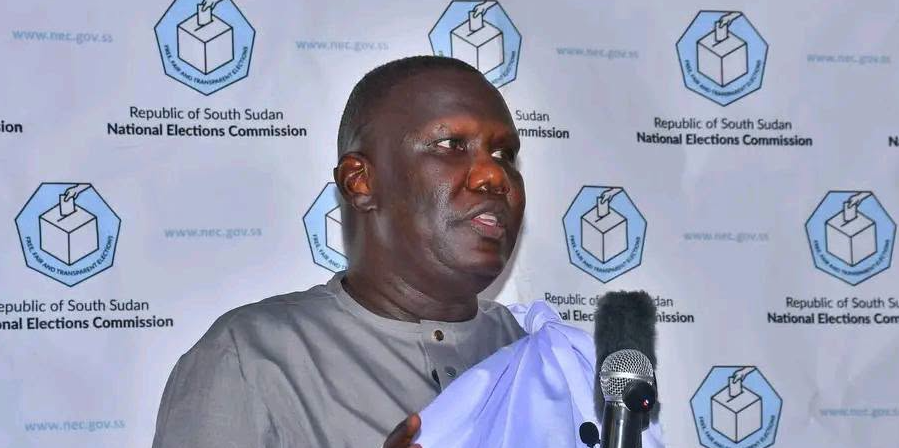
South Sudan Election Chief Defends Neutrality Amid Kiir Ties
Gabriel Bol Deng, the newly appointed Chairperson of South Sudan's National Elections Commission (NEC), is publicly defending his neutrality following concerns raised by journalists regarding his close ties to President Salva Kiir, just months before the scheduled 22 December general election. Deng acknowledged that he and President Kiir hail from the same community and that he previously held senior administrative roles within the President's office and as the NEC's secretary general. Despite these connections, he asserted that his performance and adherence to the transitional constitution and national election law, rather than his origin or past affiliations, should be the basis for judgment, following his appointment by President Kiir to replace Prof. Abednego Akok Kacuol, whose removal lacked public explanation.
This development carries significant legal implications for the integrity and perceived fairness of South Sudan's upcoming general election. The credibility of any electoral process is fundamentally dependent on the independence and impartiality of the body overseeing it. Perceptions of bias, particularly when the election chief has strong personal and professional ties to the incumbent president, can severely erode public trust, potentially leading to widespread electoral disputes, challenges to results, and even civil unrest. For legal practitioners, this situation highlights the potential for future litigation concerning electoral irregularities, the independence of state institutions, and the standards of judicial review applicable to such challenges. It also underscores the critical importance of transparent appointment processes and robust safeguards to ensure the autonomy of electoral commissions.
The legal context for this situation is primarily rooted in South Sudan's transitional constitution and its national election law, which Mr. Deng himself invoked as his guiding principles. These foundational legal instruments are expected to delineate the structure, powers, and independence of the NEC, as well as the specific procedures for the appointment and removal of its members. The transitional constitution would establish the overarching framework for democratic elections, guaranteeing citizens' rights to participate in a free and fair process. The national election law would provide detailed regulations concerning voter registration, candidate eligibility, campaign conduct, and mechanisms for dispute resolution. The President's power to appoint the NEC chairperson, as exercised in this instance, is a key constitutional prerogative, but it must be balanced against the imperative for an independent electoral body. The unannounced removal of the previous chairperson also raises questions about adherence to due process and the security of tenure for electoral officials, which are vital for fostering independence.
Key parties involved in this unfolding scenario include Gabriel Bol Deng, the new NEC Chairperson, whose neutrality is under scrutiny; President Salva Kiir, who made the appointment and whose administration is the subject of the neutrality concerns; the National Elections Commission itself, as the central body responsible for administering the election; and the journalists whose inquiries brought these issues to public light. The broader electorate, political parties, and civil society organizations are also crucial stakeholders, as their confidence in the electoral process is paramount. Should electoral disputes arise, the Supreme Court of South Sudan would likely serve as the ultimate judicial arbiter.
Attorneys and legal professionals in South Sudan, particularly those specializing in constitutional, administrative, or electoral law, should closely monitor the NEC's actions and public statements in the lead-up to the 22 December election. It is crucial to scrutinize the NEC's adherence to the transitional constitution and national election law, paying particular attention to any decisions or pronouncements that could be perceived as compromising the fairness or impartiality of the electoral process. Practitioners should prepare for potential electoral petitions or challenges, familiarizing themselves with the legal grounds for such actions and the evidentiary standards required. Advising political parties, candidates, and civil society groups on their rights and obligations under the electoral framework, and on available mechanisms for reporting irregularities or seeking redress, will be a critical service. Furthermore, staying abreast of any legislative or regulatory amendments pertaining to the NEC's powers or composition will be essential for anticipating and navigating the evolving legal landscape.
How does this affect you?
Get an AI analysis of this article grounded in your jurisdictions, practice areas, and any policy documents you've uploaded to Wansom.
Finish Reading the Full Story and the Expert Analysis.
Get the latest legal & regulatory intelligence in South Sudan
Wansom is AI and can make mistakes.