
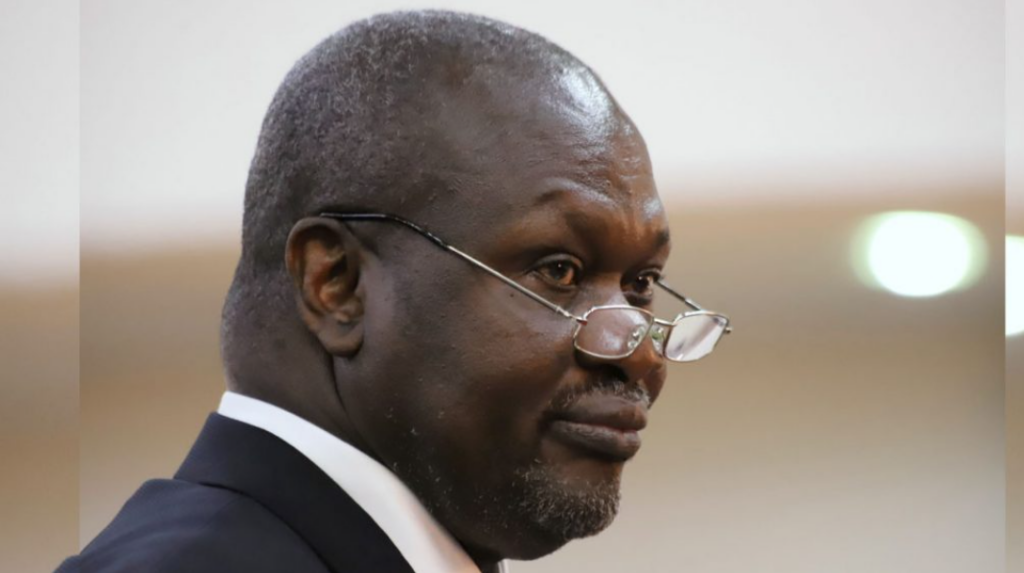
Riek Machar: White Army Command Denial at Juba Trial
Summary
- Former First Vice President Riek Machar denied leading the White Army during his trial in Juba on Monday.
- Machar described the White Army as a loosely organized, community-based armed youth group of Nuer civilians, not a militia under SPLM-IO control.
- He stated the group self-organizes, lacks military training or barracks, and does not receive support from SPLM-IO.
- Machar and seven co-defendants face charges including murder, conspiracy, terrorism, treason, destruction of public property, and crimes against humanity related to a March 2025 attack.
- The trial is adjourned until October 28, 2026, for Machar to continue his defense testimony.
Machar's Defense in Juba Trial
This defense, presented during the Riek Machar White Army denial Juba trial, seeks to establish a precedent for how armed community groups are legally defined and how culpability for their actions is attributed within South Sudan's legal framework.
Former First Vice President Riek Machar, the 74-year-old leader of the Sudan Peoples Liberation Movement-in-Opposition (SPLM-IO), presented a robust defense statement on Monday during the 124th session of his trial in Juba. Machar, who is the fifth accused in the ongoing proceedings, explicitly denied any leadership role over the group known as the White Army. This denial directly addresses allegations that the armed youth group participated in a March 2025 assault on a military garrison located in Nasir, Upper Nile State.
Machar and his seven co-defendants face severe charges, including murder, conspiracy, terrorism, treason, destruction of public property, and crimes against humanity. Prosecutors contend that forces affiliated with SPLA-IO, allegedly in concert with the White Army, were responsible for the deaths of 257 soldiers from the South Sudan Peoples Defence Forces, among them commander Gen. David Majur Dak. Furthermore, the prosecution claims military equipment was either destroyed or seized during these alleged actions. While Machar remains under house arrest, his co-defendants—Puot Kang Chol, Mam Pal Dhuor, Gatwech Lam Puoch, Lt. Gen. Gabriel Duop Lam, Camilo Gatmai Kel, Mading Yak Riek, and Dominic Gatgok Riek—are currently detained in National Security Service facilities within Juba. The court has adjourned the hearing, with Machar scheduled to continue his defense testimony on Wednesday, October 28, 2026.
Redefining the 'White Army'
During his Machar defense statement special court, Machar offered a detailed South Sudan White Army definition, asserting that the group is not a conventional military force under his command. He characterized the White Army as a "loosely organised, community-based armed youth group" predominantly associated with Nuer community armed youth group members in specific areas of Upper Nile and Jonglei states. Machar emphatically stated that the charge of him leading armed civilians is false, as is the assertion that such armed civilians are exclusively found in Nuer regions. He maintained that the SPLM-IO exercises no political or military control over this entity.
Machar described the White Army's members as ordinary civilians, primarily young people, who occasionally include women providing support akin to the ICRC for the wounded. He clarified that these individuals are not militarily trained, lack barracks, and are not officially registered in any SPLA-IO documentation. Armed with firearms and spears, they mobilize from their homes or towns to defend their land when conflict arises. Crucially, Machar denied that the White Army receives any military support or food supplies from the SPLM-IO, explaining that they self-organize through their clans and at lower administrative levels under headmen, sub-chiefs, and paramount chiefs. These volunteer warriors, he noted, elect and remove their leaders, often on an annual basis or as circumstances dictate.
Legal Precedents and Command Responsibility
Machar's defense strategy hinges on challenging the classification of the White Army as a militia, arguing that its organizational structure fundamentally differs from such a designation. He posited that its members are akin to traditional African village warriors, whose weaponry has simply evolved due to the proliferation of modern small arms. He explicitly differentiated them from groups like Dutkubeny and Mathiang Anyoor, which he stated are sponsored by the SPLA-IO, emphasizing that the White Army receives no such sponsorship. Instead, he drew parallels to other community-based groups such as Gelweng, Titweng, Monyemiji, Lokoya youth, or various age sets of the Murle.
This redefinition carries significant implications for the concept of SPLM-IO White Army command responsibility and the Machar crimes against humanity charges. Machar stressed that any male Nuer youth aged 18 or older can be elected as a leader by their peers, highlighting that the White Army constitutes the largest segment of the Nuer community. He asserted that to engage in conflict with this group is, in essence, to fight the entire community of that area. To underscore this point, he referenced historical difficulties, noting that the British required over three decades to establish administration in Nuer territory, ultimately abandoning force in favor of peaceful approaches. This defense, presented during the Riek Machar White Army denial Juba trial, seeks to establish a precedent for how armed community groups are legally defined and how culpability for their actions is attributed within South Sudan's legal framework.
Practical Implications
Lawyers and compliance officers should closely monitor the Riek Machar trial as his defense strategy, which redefines the 'White Army' as a community-based, non-militia group, could set significant legal precedents for the classification of armed groups and the attribution of command responsibility in South Sudan's legal system, impacting future cases involving conflict-related charges.
Source
How does this affect you?
Get an AI analysis of this article grounded in your jurisdictions, practice areas, and any policy documents you've uploaded to Wansom.
Finish Reading the Full Story and the Expert Analysis.
Wansom is AI and can make mistakes.