
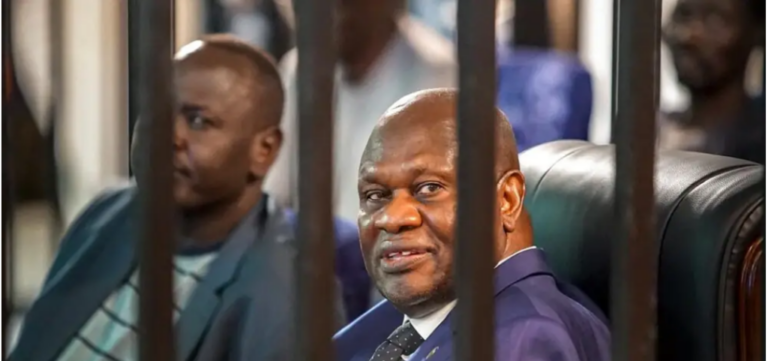
South Sudan: Machar Trial Adjourned Over Lack of Generator Fuel
Summary
- The Special Court trial of former First Vice President Riek Machar and seven co-accused has been adjourned until October 23, 2026.
- The adjournment was caused by a lack of generator fuel, preventing the court from delivering a scheduled ruling on Machar's application.
- Machar sought permission to play video footage to support his claim that the trial is politically motivated, refuting public statements made against him.
- Machar, 74, and his co-defendants face charges including murder, treason, and crimes against humanity.
- Prosecutors allege SPLA-IO forces killed 257 soldiers and destroyed $58 million in equipment during a March 2025 attack on Nasir military garrison.
Unexpected Adjournment in High-Profile Trial
The unexpected adjournment of the Machar trial over a basic logistical failure, specifically the lack of generator fuel, underscores broader infrastructure challenges that can impede critical legal processes.
Proceedings in the Special Court against former First Vice President Riek Machar and seven co-accused have been unexpectedly halted, with the trial now adjourned until Friday, October 23, 2026. The delay stemmed from a critical shortage of generator fuel, which rendered the court unable to deliver a scheduled ruling. This unforeseen technical issue prevented the court from moving forward with a key aspect of the ongoing legal battle.
The court had convened for its 122nd session specifically to issue a decision on an application submitted by Machar, who is identified as the fifth accused in the case. The application sought judicial permission to present video footage as evidence. Judge Stephen Simon Binjigwa, a member of the three-judge panel overseeing the trial, announced the adjournment after receiving notification that no fuel was available to power the necessary generators. He explicitly stated that the session, which was fixed for the ruling on the fifth accused's application, could not proceed due to the lack of generator fuel, necessitating the postponement to the specified date in 2026.
Legal Context and Accusations
The core of Machar's application involves his attempt to counter public statements made by several individuals, including former vice president Benjamin Bol Mel and Minister of Defence and Veterans' Affairs Gen. Chol Thon Balok. These statements, which Machar refutes, were reportedly made during and after his arrest, with some remarks occurring at the state burial of the late Gen. David Majur Dak in Juba. Machar, who is 74 years old, contends that his trial is politically motivated and believes the video evidence he wishes to present would substantiate this claim.
Machar and his seven co-defendants face a litany of serious charges, including murder, conspiracy, terrorism, treason, destruction of public property, and crimes against humanity. While Machar remains under house arrest, his co-defendants—Puot Kang Chol, Mam Pal Dhuor, Gatwech Lam Puoch, Lt. Gen. Gabriel Duop Lam, Camilo Gatmai Kel, Mading Yak Riek, and Dominic Gatgok Riek—are currently detained in National Security Service facilities located in Juba. The prosecution's case centers on allegations that forces allied with the SPLA-IO and the White Army were responsible for the deaths of 257 South Sudan People’s Defence Forces soldiers, including Commander Gen. David Majur Dak, during an attack on the Nasir military garrison in March 2025. Furthermore, prosecutors allege that military equipment valued at approximately $58 million was either destroyed or captured during this same incident.
Significance of the Delay
The unexpected adjournment of the Machar trial over a basic logistical failure, specifically the lack of generator fuel, underscores broader infrastructure challenges that can impede critical legal processes. Such delays can prolong the judicial timeline for high-stakes cases, potentially affecting the perception of justice and the rights of both the accused and the victims. The court's inability to proceed with a scheduled ruling due to a power issue highlights how fundamental operational requirements can impact the administration of justice, especially in complex and politically sensitive trials.
When the Special Court reconvenes on October 23, 2026, it is anticipated to finally deliver its ruling on Machar's pending application to introduce video evidence. This decision is crucial for the defense's strategy, as Machar seeks to demonstrate the alleged political motivations behind the charges he faces. The outcome of this specific application could significantly influence the direction and public perception of the entire trial, which involves grave accusations against a prominent political figure and several others.
Source
How does this affect you?
Get an AI analysis of this article grounded in your jurisdictions, practice areas, and any policy documents you've uploaded to Wansom.
Finish Reading the Full Story and the Expert Analysis.
Get the latest legal & regulatory intelligence in South Sudan
Wansom is AI and can make mistakes.