
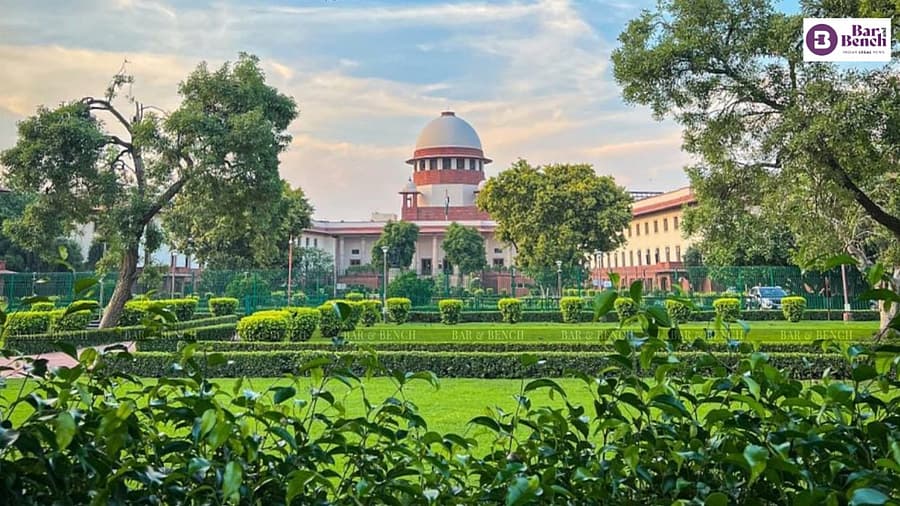
Supreme Court: Dismisses Sumit Roy Anticipatory Bail in Salboni Case
Summary
- The Supreme Court recently dismissed the anticipatory bail plea of Sumit Roy, an aide to TMC national general secretary Abhishek Banerjee.
- This decision relates to the alleged Salboni land grab case in West Bengal, where government land was purportedly illegally acquired and fraudulently transferred.
- The Court refused to overturn the Calcutta High Court's denial of pre-arrest protection, thereby vacating an earlier interim stay on Roy's arrest.
- Roy's counsel argued that despite 88 hours of interrogation, no incriminating material emerged, and he was not named in the FIR or confronted with victims or forged documents.
- The Supreme Court's ruling emphasizes a cautious stance on pre-arrest bail, particularly when lower courts have already denied such protection.
Supreme Court Denies Pre-Arrest Protection to Abhishek Banerjee Aide
For legal practitioners, the dismissal of Sumit Roy's anticipatory bail plea, despite arguments of prolonged interrogation without direct incrimination, signals that the apex court may be disinclined to overturn lower court decisions on pre-arrest protection unless compelling new circumstances are presented.
On Thursday, India's Supreme Court definitively rejected the anticipatory bail application filed by Sumit Roy, a key aide to Trinamool Congress (TMC) national general secretary Abhishek Banerjee. This decision, rendered in the high-profile Salboni land grab case, means Roy will not receive pre-arrest protection, and he has since been arrested.
A bench comprising Chief Justice of India Surya Kant, Justice Joymalya Bagchi, and Justice V Mohana declined to intervene with an earlier ruling by the Calcutta High Court, which had also denied Roy pre-arrest safeguards. Consequently, an interim stay on Roy's arrest, previously granted, has now been lifted, marking a significant development in the ongoing investigation.
The Salboni Allegations and Roy's Defense
The core of the matter revolves around an investigation into the alleged illegal acquisition and fraudulent transfer of government land located in Salboni, within West Bengal’s Paschim Medinipur district. This complex case, formally known as Sumit Roy vs State of West Bengal, has drawn considerable attention due to the involvement of a prominent political figure's associate.
During the Supreme Court hearing, Senior Advocate Gopal Sankaranarayanan, representing Sumit Roy, presented a robust defense. He highlighted that his client had endured an extensive interrogation process, totaling 88 hours across 11 separate appearances before investigators. Despite this prolonged questioning, Sankaranarayanan asserted that no incriminating evidence had been uncovered against Roy. He further emphasized that Roy was neither explicitly named in the First Information Report (FIR) nor had he been confronted with any forged documents, alleged victims, or complainants throughout the investigative proceedings. The defense counsel pointed out that the investigators' inquiries primarily focused on cash deposits made into the All India Trinamool Congress (AITC) account, which, he argued, are routinely audited and properly reported to the Election Commission of India.
Judicial Scrutiny and Anticipatory Bail Precedent
The Supreme Court bench, in its deliberation, meticulously reviewed the interrogation report submitted by the State. While acknowledging that large sums of cash had not been found in Roy's personal accounts, the Court's ultimate decision underscored a cautious approach to granting pre-arrest protection, particularly when lower courts have already denied such relief.
This ruling by the India Supreme Court carries significant weight for the precedent of anticipatory bail denial in cases involving alleged financial irregularities and land grabbing. The refusal to interfere with the Calcutta High Court's order suggests a judicial inclination to allow investigative agencies to proceed, especially when extensive questioning has already occurred without direct evidence being presented by the defense to counter the allegations. For legal practitioners, the dismissal of Sumit Roy's anticipatory bail plea, despite arguments of prolonged interrogation without direct incrimination, signals that the apex court may be disinclined to overturn lower court decisions on pre-arrest protection unless compelling new circumstances are presented. This reinforces the principle that anticipatory bail is not an automatic right, particularly in complex investigations where the state's case is still developing.
Practical Implications
The Supreme Court's dismissal of anticipatory bail for Sumit Roy, despite arguments of extensive interrogation without direct evidence, signals a cautious approach to pre-arrest protection in cases involving alleged land grabbing and financial irregularities. Lawyers should note this precedent when advising clients seeking anticipatory bail, particularly when lower courts have already denied such protection, as the Supreme Court may be disinclined to interfere.
Source
How does this affect you?
Get an AI analysis of this article grounded in your jurisdictions, practice areas, and any policy documents you've uploaded to Wansom.
Finish Reading the Full Story and the Expert Analysis.
Get the latest legal & regulatory intelligence in India
Wansom is AI and can make mistakes.