
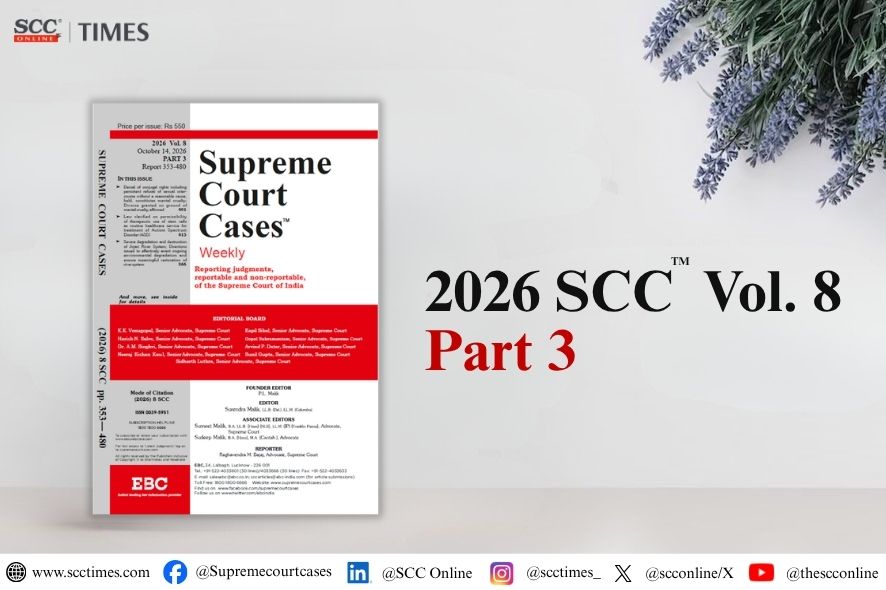
India Supreme Court: 2026 Vol 8 Part 3 Releases Pivotal Judgments
Summary
- The India Supreme Court's 2026 SCC Vol. 8 Part 3 features significant rulings on environmental protection, family law, and medical ethics.
- The Court mandated the restoration of the severely degraded Jojari River system in Rajasthan, where 2 million lives are at risk.
- Denial of conjugal rights, including persistent refusal of sexual intercourse without reasonable cause, was affirmed as mental cruelty for divorce under the Hindu Marriage Act.
- The Supreme Court clarified that administering stem cell therapy for Autism Spectrum Disorder (ASD) outside approved clinical trials is unethical and constitutes medical malpractice.
Overview of Key Rulings
The Court issued directives aimed at effectively halting the ongoing environmental degradation and ensuring the meaningful restoration of the Jojari River system, a critical measure given that 2 million lives are reportedly at risk.
The latest installment of Supreme Court Cases, specifically 2026 SCC Vol. 8 Part 3, brings forth a series of pivotal judgments from the India Supreme Court addressing diverse and critical legal domains. This volume encapsulates significant decisions that span environmental protection, the nuances of matrimonial law, and the ethical considerations within medical jurisprudence. These rulings collectively underscore the Court's active role in shaping legal precedents across various facets of Indian society.
Among the prominent cases featured, the Supreme Court has delivered crucial directives concerning the severe degradation of a vital river system, clarified the grounds for divorce based on mental cruelty, and provided legal guidance on the therapeutic application of stem cells. Each decision within this volume contributes to the evolving landscape of Indian law, offering clarity and direction on complex societal challenges.
Environmental Mandate for River Restoration
A significant environmental ruling highlighted in 2026 SCC Vol. 8 Part 3 addresses the alarming state of the Jojari River system in Rajasthan. The India Supreme Court, in the case of *Contamination in Jojari River, Rajasthan, In re*, (2026) 8 SCC 366, recognized the severe degradation and destruction plaguing this crucial water body. This environmental crisis poses a direct threat to the well-being of an estimated 2 million lives in the region, emphasizing the urgent need for intervention.
Responding to the gravity of the situation, the Court issued directives aimed at effectively halting the ongoing environmental degradation and ensuring the meaningful restoration of the Jojari River system. These comprehensive instructions are designed to mitigate the existing damage and prevent further ecological harm, reflecting the judiciary's commitment to safeguarding natural resources and public health against pollution and neglect.
Defining Mental Cruelty in Matrimonial Law
In a notable decision concerning family law, the India Supreme Court, as reported in 2026 SCC Vol. 8 Part 3, provided crucial clarification on what constitutes mental cruelty as a ground for divorce. The case of *Sonal Talpada v. Veerbhan Singh*, (2026) 8 SCC 401, specifically addressed the interpretation of Section 13(1)(i-a) of the Hindu Marriage Act, 1955, which governs such matrimonial disputes.
The Court unequivocally held that the denial of conjugal rights, particularly the persistent refusal of sexual intercourse without any reasonable justification, amounts to mental cruelty. This affirmation by the Supreme Court solidified the legal basis for granting a divorce on these grounds, providing a clear precedent for future cases involving similar circumstances within marital relationships.
Clarifying Stem Cell Therapy for Autism
The India Supreme Court also weighed in on a critical public health matter, clarifying the legal standing of stem cell research and therapy. Within 2026 SCC Vol. 8 Part 3, the ruling in *Yash Charitable Trust v. Union of India*, (2026) 8 SCC 415, specifically addressed the permissibility of using therapeutic stem cells.
This landmark decision clarified that administering stem cell therapy for Autism Spectrum Disorder (ASD) outside approved and monitored clinical trials is unethical and amounts to medical malpractice, emphasizing that all stem cell research involving human participants must necessarily be in a clinical trial setting. The Court's pronouncement provides important legal guidance for medical practitioners and patients, delineating the boundaries and acceptance of such advanced medical treatments within the existing regulatory framework.
Source
How does this affect you?
Get an AI analysis of this article grounded in your jurisdictions, practice areas, and any policy documents you've uploaded to Wansom.
Finish Reading the Full Story and the Expert Analysis.
Get the latest legal & regulatory intelligence in India
Wansom is AI and can make mistakes.