
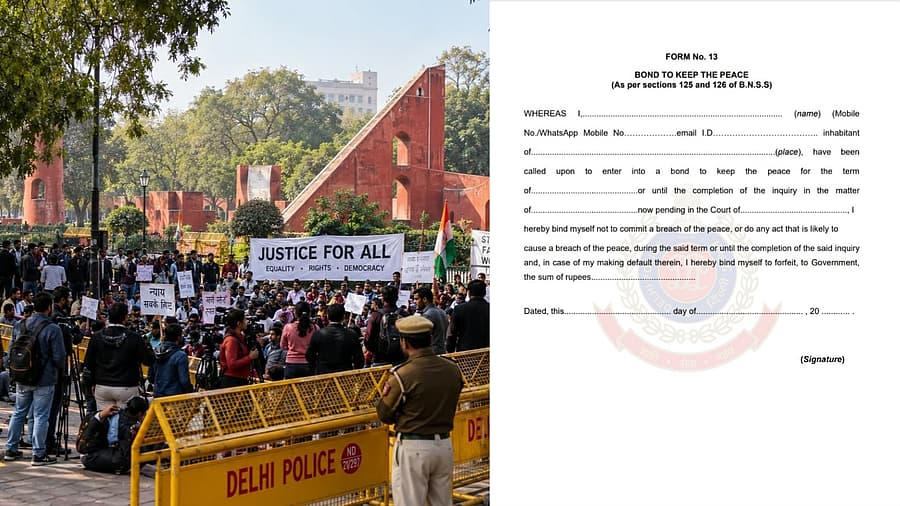
India: Peace Bonds Used in Bharatiya Nagarik Suraksha Sanhita Protests
Summary
- India enacted three new penal laws in 2023, including the Bharatiya Nagarik Suraksha Sanhita (BNSS), replacing colonial-era statutes.
- Union Home Minister Amit Shah stated these laws would make the criminal justice system "completely Swadeshi."
- Lawyers criticized the new laws, arguing they retained many problematic colonial provisions.
- In 2026, "peace bonds," a colonial-era tool, were used during nationwide protests to compel detained individuals to promise not to cause a "breach of peace."
- The concept of peace bonds originated in 1361 Medieval England with King Edward III's Justices of the Peace Act.
India's Evolving Penal Code and Persistent Concerns
The widespread application of these Bharatiya Nagarik Suraksha Sanhita peace bonds during periods of public unrest has raised significant questions about their role in managing dissent.
In 2023, the Indian parliament enacted a significant overhaul of its criminal justice framework, introducing three new penal statutes: the Bharatiya Nagarik Suraksha Sanhita (BNSS), the Bharatiya Nyaya Sanhita (BNS), and the Bharatiya Sakshya Adhiniyam (BSA). These legislative changes were intended to replace the country's long-standing colonial-era laws, a move lauded by Union Home Minister Amit Shah as an effort to render the criminal justice system "completely Swadeshi," or indigenous. This initiative aimed to shed the vestiges of British rule and establish a legal system more reflective of contemporary Indian values.
Despite the government's stated intentions, legal practitioners voiced considerable skepticism regarding the true nature of these reforms. Many lawyers critically assessed the new statutes, describing them as merely "old wine in a new bottle," suggesting that while the names had changed, numerous problematic provisions inherited from the colonial period remained largely intact. This critique highlighted concerns that the fundamental structure and certain punitive aspects of the previous legal framework had been carried over, rather than being fundamentally reformed.
Peace Bonds Resurface Amidst Protests
The continuity of these colonial-era legal tools became particularly evident in 2026, when methods historically employed by the British Raj to suppress dissent were observed firmly entrenched within India's updated penal procedures. Recent nationwide protests, coupled with the subsequent police response, brought specific provisions related to preventive policing into sharp focus. These events underscored how deeply embedded certain mechanisms for maintaining public order, even those with contentious origins, continue to be in the country's legal apparatus.
A notable practice observed during these demonstrations involved the use of "peace bonds." Detained protestors were compelled to sign these bonds, which legally bound them to refrain from causing any "breach of peace" for varying durations. This measure, a form of preventive detention, effectively placed restrictions on individuals' future conduct under threat of further legal action, illustrating a direct application of the very provisions that critics argued were merely rebranded colonial instruments. The widespread application of these Bharatiya Nagarik Suraksha Sanhita peace bonds during periods of public unrest has raised significant questions about their role in managing dissent.
The Deep Roots of Preventive Detention
The concept of peace bonds, now utilized under the new Indian penal laws 2023, possesses a history stretching back over six centuries, predating even the colonial period in India. Its origins can be traced to Medieval England, specifically to the Justices of the Peace Act enacted by King Edward III in 1361. This pivotal 14th-century legislation, established on the Sunday before the Feast of the Conversion of St Paul, granted Justices of the Peace—who served as the precursors to modern-day magistrates—the statutory authority to demand sureties.
These sureties were required from individuals suspected of posing a threat to public peace or those deemed to be of bad character. The power to compel such bonds allowed authorities to preemptively mitigate potential disturbances by imposing conditions on individuals' behavior. This historical lineage demonstrates that the mechanism of demanding a bond to prevent future "breach of peace," a tool now seen in the context of protestor detention India peace bonds, is not a recent innovation but a deeply ingrained legal instrument that has persisted across different eras and legal systems. Its retention in the Bharatiya Nagarik Suraksha Sanhita underscores the enduring nature of certain preventive policing India new laws, despite the stated aim of decolonizing the legal framework.
Practical Implications
Lawyers representing individuals involved in protests or facing preventive detention in India must understand the legal basis and implications of peace bonds under the new Bharatiya Nagarik Suraksha Sanhita (BNSS). This includes advising clients on the potential restrictions and legal challenges associated with signing such bonds, which are being used to quell dissent.
Source
How does this affect you?
Get an AI analysis of this article grounded in your jurisdictions, practice areas, and any policy documents you've uploaded to Wansom.
Finish Reading the Full Story and the Expert Analysis.
Get the latest legal & regulatory intelligence in India
Wansom is AI and can make mistakes.