
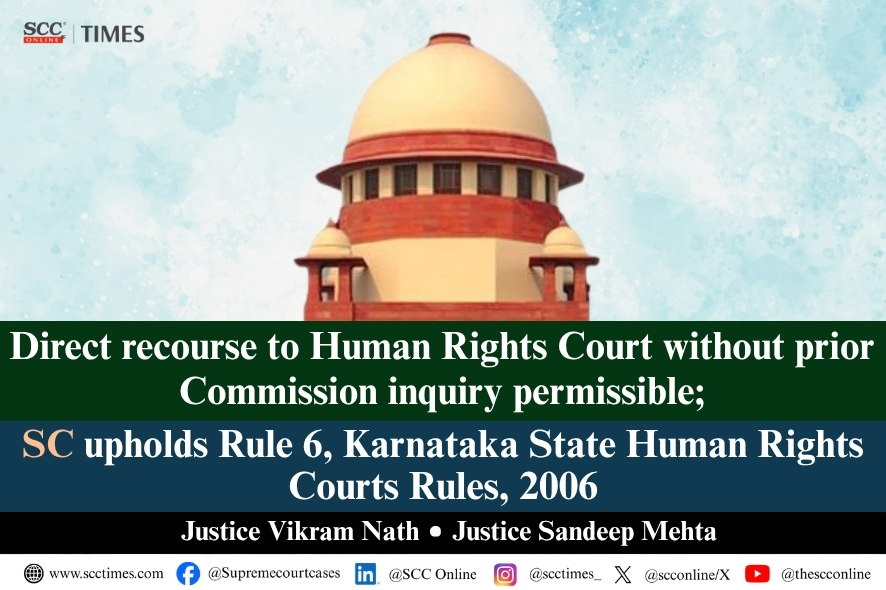
Supreme Court: Upholds Rule 6 Karnataka Human Rights, Direct Court Access Affirmed
Summary
- The Supreme Court upheld Rule 6 of the Karnataka State Human Rights Courts Rules, 2006.
- This ruling permits direct recourse to a Human Rights Court without a prior Human Rights Commission inquiry.
- The Court clarified that the Commission and Human Rights Court are distinct but complementary mechanisms under the Human Rights Act, 1993.
- Rule 6 provides procedural machinery for invoking court jurisdiction and does not create a substantive or parallel legal regime.
What Happened
This decision clarifies that individuals seeking redress for human rights violations in the state are not necessarily required to first approach the Human Rights Commission before filing a case directly with a Human Rights Court.
India's Supreme Court has recently affirmed a crucial procedural aspect concerning human rights litigation in Karnataka, specifically upholding Rule 6 of the Karnataka State Human Rights Courts Rules, 2006. This decision clarifies that individuals seeking redress for human rights violations in the state are not necessarily required to first approach the Human Rights Commission before filing a case directly with a Human Rights Court. The ruling effectively streamlines the process for victims and their legal representatives, providing a more direct pathway to judicial remedies.
The apex court's pronouncement confirms that the provision within the Karnataka State Human Rights Courts Rules, 2006, which allows for direct access to these specialized courts, is entirely permissible. This means that the procedural machinery outlined in Rule 6 is a valid mechanism for invoking the jurisdiction of a Human Rights Court without an initial inquiry by the Human Rights Commission. The decision provides significant clarity on the operational framework for human rights enforcement within Karnataka.
Legal Context
The Supreme Court's judgment hinges on its interpretation of the Human Rights Act, 1993 India, which establishes the foundational legal framework for human rights protection in the country. The Court emphasized that the Human Rights Commission and the Human Rights Court are conceived as two distinct, yet complementary, entities under this overarching legislation. These bodies are designed to work in tandem to ensure comprehensive oversight and enforcement of human rights, each fulfilling a specific role within the broader system.
Crucially, the Court determined that Rule 6 of the Karnataka State Human Rights Courts Rules, 2006, serves purely as a procedural mechanism. It facilitates the invocation of a Human Rights Court's jurisdiction and does not, in any way, establish a substantive or parallel legal regime that deviates from the spirit or intent of the Human Rights Act, 1993. This distinction is vital, as it confirms that direct access is a procedural option within the existing legal structure, rather than an alternative system undermining the Commission's role.
Why It Matters
This Supreme Court human rights jurisdiction ruling holds significant implications for the enforcement of human rights in Karnataka and potentially sets a precedent for other states. By affirming the validity of direct access Human Rights Court India, the decision empowers individuals to seek justice more expeditiously, bypassing what could sometimes be a lengthy initial inquiry process by the Human Rights Commission. This could lead to a more efficient resolution of human rights cases, reducing delays for victims seeking relief.
For legal practitioners, the ruling provides welcome clarity, confirming that they can advise clients on directly approaching Human Rights Courts in Karnataka without the prerequisite of a prior Commission inquiry. This eliminates ambiguity regarding the procedural steps and reinforces the direct judicial avenue available for human rights violations. The ability to bypass a Human Rights Commission inquiry could prove instrumental in cases requiring urgent judicial intervention, thereby strengthening the overall human rights protection framework in the region.
Practical Implications
This ruling clarifies that lawyers in India can advise clients on directly approaching Human Rights Courts in Karnataka without a prior Commission inquiry, potentially streamlining the process for seeking remedies for human rights violations.
Source
Source: Original reporting via SCC Times
How does this affect you?
Get an AI analysis of this article grounded in your jurisdictions, practice areas, and any policy documents you've uploaded to Wansom.
Finish Reading the Full Story and the Expert Analysis.
Get the latest legal & regulatory intelligence in India
Wansom is AI and can make mistakes.