
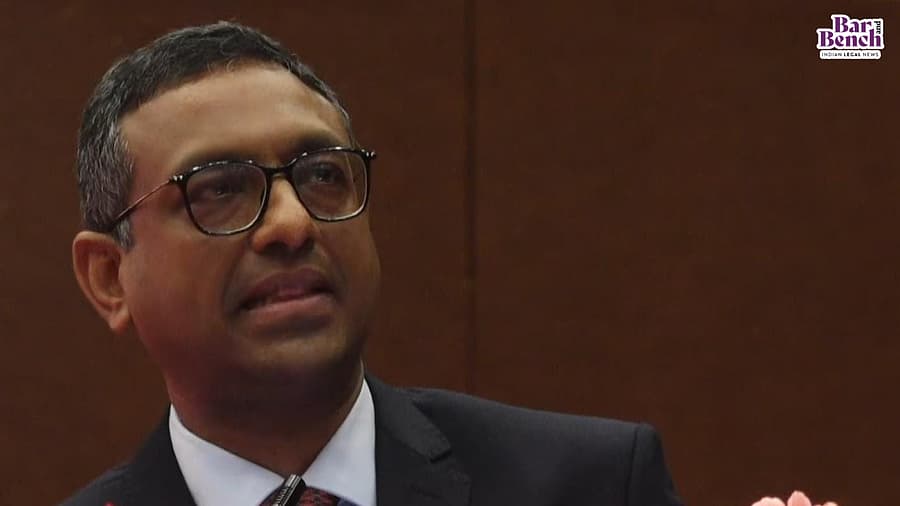
Rajshekhar Rao: AI Cannot Replace Human Judgment for Access to Justice
Summary
- Senior Advocate Rajshekhar Rao stated that AI tools alone cannot guarantee access to justice, as human judgment remains indispensable for deciding cases.
- Rao warned that AI "hallucination," where chatbots misunderstand or misinterpret information, could fundamentally alter judicial decisions.
- He acknowledged AI's potential to improve court efficiency and widen access to justice but insisted that judges must retain ultimate authority.
- Rao's comments were made at the inaugural JusTech National Conclave at DNLU, focusing on AI's role in the Indian judiciary.
- The Conclave session, titled “Algorithmic Justice in the Driver’s Seat,” featured a panel of distinguished legal experts discussing AI integration.
The Human Element in Justice
He elaborated that even a minor misunderstanding or misinterpretation by a chatbot could fundamentally alter the entire premise of a judicial ruling, thereby jeopardizing the integrity and fairness of the legal system.
Senior Advocate Rajshekhar Rao recently underscored a critical distinction regarding the integration of artificial intelligence in legal processes: while AI tools offer substantial promise for enhancing efficiency, they cannot supplant the indispensable human judgment required for the fair adjudication of cases. Speaking at the inaugural JusTech National Conclave, hosted by Dharmashastra National Law University (DNLU) in Jabalpur, Rao presented a nuanced perspective on the burgeoning role of AI in the Indian judiciary. His remarks firmly established that the ultimate responsibility for deciding legal matters must unequivocally reside with human judges, irrespective of technological advancements.
Rao's address highlighted that the mere availability of AI tools does not inherently guarantee equitable access to justice. He issued a strong caution against the uncritical reliance on AI, specifically pointing to the phenomenon of "hallucination," where AI systems can generate factually incorrect or misleading outputs. He elaborated that even a minor misunderstanding or misinterpretation by a chatbot could fundamentally alter the entire premise of a judicial ruling, thereby jeopardizing the integrity and fairness of the legal system. This concern forms a cornerstone of the debate surrounding AI's limitations in complex legal interpretation and application.
AI's Promise and Peril
Despite his emphasis on the irreplaceable nature of human decision-making, Senior Advocate Rajshekhar Rao readily acknowledged the profound potential of AI to revolutionize the legal sector. He suggested that AI applications could significantly streamline court operations, expand the reach of justice to more individuals, and reduce the heavy burden associated with routine administrative and research tasks for legal professionals. However, he consistently reiterated that these prospective benefits must never overshadow the paramount necessity of human oversight and the final authority of judges in all judicial proceedings.
Rao's presentation at the Conclave, which was dedicated to exploring the practical applications of artificial intelligence and technology within the Indian judiciary, posed a more profound question than simply whether AI would transform the judiciary—a transformation he believes is almost certain. Instead, he challenged the audience to consider who or what should ultimately steer the course of justice. He unequivocally asserted that the judge must remain "firmly in the driver’s seat" when justice is being administered, reinforcing the principle that technology should serve as a powerful assistant, not a replacement, for the intricate process of judicial discretion and ethical judgment.
The JusTech Conclave Discussion
The inaugural JusTech National Conclave served as a pivotal forum for in-depth discussions on the evolving landscape of technology in India's legal framework. This significant event, organized by DNLU, convened a distinguished assembly of legal luminaries to deliberate on the multifaceted implications of AI. The initial session, aptly titled “Algorithmic Justice in the Driver’s Seat: Reincarnating the Judiciary through AI and Technology,” featured a prominent panel of experts.
This esteemed panel comprised Supreme Court Justice Joymalya Bagchi, Madhya Pradesh High Court judge Justice Anand Pathak, Senior Advocates Rajshekhar Rao and S Gurukrishna Kumar, alongside Advocate Siddharth R Gupta. Their collective expertise contributed to a comprehensive exploration of how AI can be integrated responsibly into the legal system. The discussions at the Conclave, particularly the insights shared by Senior Advocate Rajshekhar Rao, consistently highlighted the critical need to strike a delicate balance between leveraging AI for enhanced efficiency and upholding the foundational principles of justice and human accountability.
Practical Implications
Lawyers and compliance officers should note that while AI tools can enhance efficiency, they do not replace human judgment in legal analysis and decision-making. This perspective from a Senior Advocate in India underscores the need for critical human oversight when utilizing AI for legal research or compliance tasks, particularly to mitigate risks associated with AI 'hallucination' and ensure accurate legal interpretation.
Source
Source: Insights from legal reporting.
How does this affect you?
Get an AI analysis of this article grounded in your jurisdictions, practice areas, and any policy documents you've uploaded to Wansom.
Finish Reading the Full Story and the Expert Analysis.
Get the latest legal & regulatory intelligence in India
Wansom is AI and can make mistakes.