
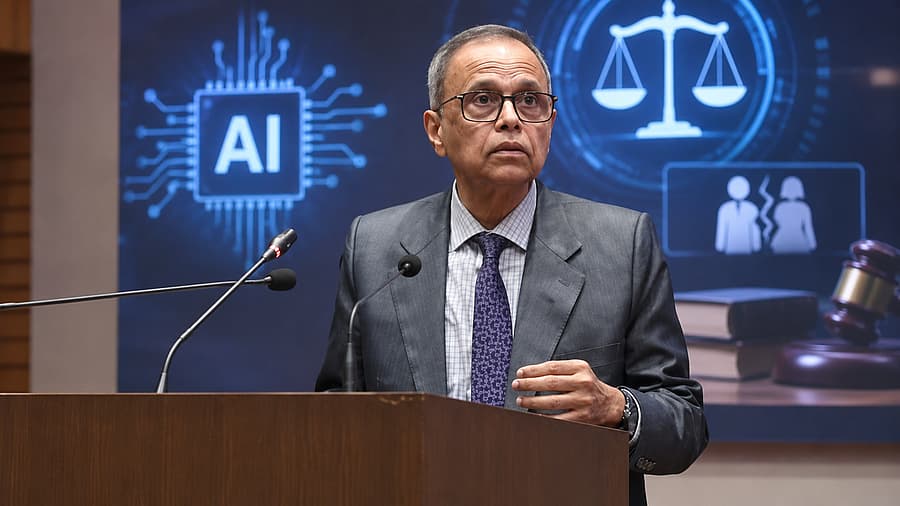
Justice Joymalya Bagchi: Proposes AI Divorce Courts for India
Summary
- Supreme Court Justice Joymalya Bagchi proposed establishing 24/7 AI courts specifically for mutual consent divorce cases.
- The initiative aims to shift routine judicial work from human judges to AI systems to improve efficiency and access to justice.
- Justice Bagchi cited the Indian judiciary's backlog of over five crore cases as a critical reason for technological intervention.
- He advocates for AI to handle other predictable legal matters, including applications for early hearings before higher courts.
- The proposal seeks to optimize human resource allocation and modernize justice administration through transformative AI tool deployments.
A Vision for AI-Driven Justice in India
Justice Bagchi explicitly stated that mutual consent divorce cases should be 'hived off' to these 24/7 AI courts, arguing this would enhance access to justice and prevent the squandering of valuable human capital on exercises that are not truly adjudicatory in nature.
Supreme Court Justice Joymalya Bagchi recently unveiled a forward-thinking proposal, advocating for the establishment of specialized artificial intelligence (AI) courts dedicated to handling mutual consent divorce cases. This initiative aims to operate round-the-clock, fundamentally re-imagining how routine judicial responsibilities are managed within the Indian legal system. The central tenet of his argument is to strategically shift predictable, non-contentious legal work away from human judges, thereby freeing up their valuable time and expertise for more intricate and complex adjudicatory tasks. This concept of Justice Joymalya Bagchi AI divorce courts represents a significant step towards modernizing judicial processes.
Justice Bagchi articulated this innovative vision during his address at the Just Tech National Conclave, an event meticulously organized by Dharmashastra National Law University in Jabalpur. The conclave itself served as a platform to explore the evolving and critical role of AI and advanced technology within the broader administration of justice. During his speech, he underscored that by channeling specific, predictable proceedings to automated AI systems, the judiciary could achieve substantial gains in both operational efficiency and overall accessibility for citizens seeking legal recourse.
Addressing India's Judicial Backlog through Technology
A core impetus behind Justice Bagchi's urgent call for enhanced AI integration lies in the formidable caseload currently overwhelming the Indian judiciary. He starkly highlighted the presence of over five crore pending cases, a colossal figure that, in his expert assessment, cannot be effectively managed or resolved using the existing infrastructure and human resources alone. This immense judicial backlog, therefore, serves as a compelling justification for the immediate and transformative adoption of technological solutions to ensure the timely and equitable delivery of justice.
The Justice Bagchi judiciary technology proposal explicitly posits that without such "transformative interventions," particularly through the strategic deployment of artificial intelligence tools, the aspirational goal of achieving quick, efficient, and timely justice will regrettably remain out of reach. He specifically articulated that mutual consent divorce cases should be "hived off" to these proposed 24/7 AI courts. This, he argued, would not only significantly enhance ease of access to justice for citizens but also prevent the inefficient expenditure of valuable human capital on exercises that are fundamentally non-adjudicatory in their nature. This perspective firmly positions AI courts India as a crucial component for systemic improvement.
Expanding AI's Role Beyond Divorce Proceedings
Justice Bagchi's comprehensive vision for AI in justice administration extends well beyond the specific domain of mutual consent divorce AI cases. He advocates for a much broader application of artificial intelligence to encompass other routine and inherently predictable legal matters. These are typically cases that are governed by clearly established legal principles, making them particularly well-suited for automated adjudication rather than demanding the nuanced judgment and extensive deliberation of human judges.
Among the various specific examples he cited, Justice Bagchi suggested that even applications seeking early hearings before both the Supreme Court and the various High Courts across the nation should ideally be processed and managed through advanced AI systems, rather than consuming the time of human judges. This forward-looking Indian Supreme Court AI proposal reflects a strategic and comprehensive approach to leveraging technology, aiming to alleviate judicial burdens and streamline a wide array of legal procedures for greater overall efficiency and effectiveness within the justice system.
Practical Implications
Lawyers in India should monitor the ongoing discussions and proposals for AI integration in the judiciary, especially concerning routine matters like mutual consent divorces. While currently a proposal, such developments could significantly alter future case processing, potentially streamlining certain legal procedures and requiring lawyers to adapt to new technological interfaces for these types of cases.
Source
How does this affect you?
Get an AI analysis of this article grounded in your jurisdictions, practice areas, and any policy documents you've uploaded to Wansom.
Finish Reading the Full Story and the Expert Analysis.
Get the latest legal & regulatory intelligence in India
Wansom is AI and can make mistakes.