
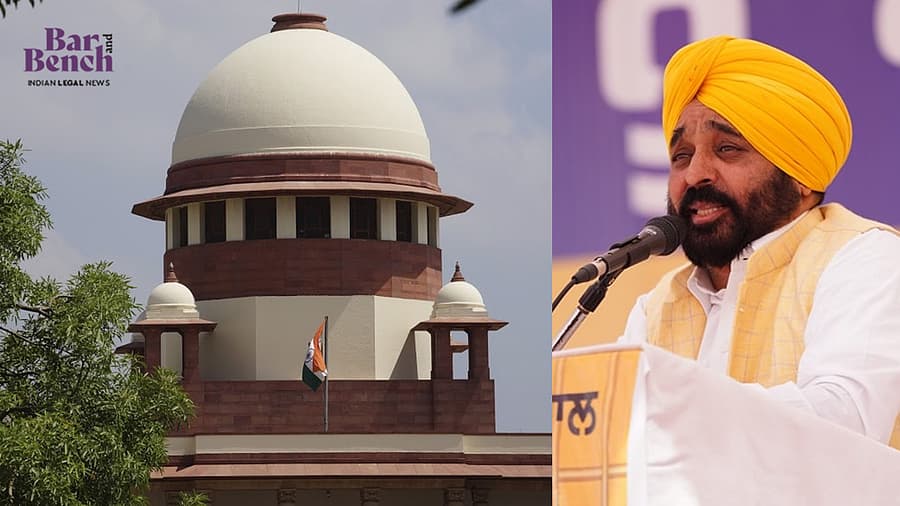
State of Punjab v Nikhil Saraf: Supreme Court Hears CBI Probe Challenge
Summary
- The Punjab government has challenged a Punjab and Haryana High Court order mandating a CBI probe into corruption allegations linked to CM Bhagwant Mann's office.
- A Special Leave Petition was filed in the Supreme Court early Tuesday morning, citing the case "State of Punjab v Nikhil Saraf".
- Senior Advocate Vikas Singh sought urgent listing, arguing the High Court's order violates the federal structure and is being "trumped up" during election season.
- The High Court bench, led by Chief Justice Ashwani Kumar Mishra, had directed the CBI to submit an investigation report within two months.
- The Chief Justice of India indicated the Supreme Court would list the matter for hearing on Wednesday or Thursday.
Supreme Court Challenge Initiated
This legal confrontation carries significant implications for the delicate balance of power between state governments and central investigative agencies, particularly within India's federal system.
The Punjab government has lodged an appeal with the Supreme Court, contesting a directive issued by the Punjab and Haryana High Court. This High Court order mandated the Central Bureau of Investigation (CBI) to initiate a criminal case to investigate allegations of corruption. These accusations are specifically linked to the office of Punjab Chief Minister Bhagwant Mann.
The challenge, formally titled "State of Punjab v Nikhil Saraf", was filed as a Special Leave Petition (SLP) in the early hours of Tuesday, specifically around 1:42 am. This swift action by the state government underscores the perceived urgency and significance of the High Court's ruling, which directly impacts the state administration.
Arguments for Urgent Hearing
Representing the State of Punjab before the Supreme Court, Senior Advocate Vikas Singh pressed for an immediate hearing of the matter. Singh highlighted the impending assembly elections in the state as a critical factor necessitating prompt judicial intervention. He articulated that the case involves state officers and concerns various allegations related to transfers and postings, suggesting these issues are being "trumped up" during an an election period.
Singh further emphasized that the core of the dispute touches upon the fundamental federal structure of the country. He argued that the High Court's order, particularly given the electoral context, represents a violation of this federal framework. The senior counsel reiterated the urgency, stating he would not have sought such a listing otherwise. In response to the plea for expedition, Chief Justice of India Surya Kant indicated that the case would be scheduled for hearing either on Wednesday or Thursday.
High Court's Directive and Background
The contested order from the Punjab and Haryana High Court was delivered on Monday morning by a bench comprising Chief Justice Ashwani Kumar Mishra and Justice Rohit Kapoor. Their directive specifically instructed the CBI to register a criminal case and subsequently submit a report on its investigation within a two-month timeframe. This order forms the direct basis for the Punjab government's appeal to the apex court.
Adding to the investigative backdrop, the Enforcement Directorate (ED) had previously requested the Punjab Police to register a First Information Report (FIR) concerning related matters. This earlier action by the ED provides a broader context to the ongoing scrutiny and allegations surrounding the Chief Minister's office, preceding the High Court's direct intervention for a CBI probe.
Federalism and Judicial Oversight
This legal confrontation carries significant implications for the delicate balance of power between state governments and central investigative agencies, particularly within India's federal system. The Punjab government's argument, articulated through Senior Advocate Vikas Singh, directly invokes the principle of federalism, suggesting that the High Court's directive infringes upon state autonomy and jurisdiction. The Supreme Court's eventual ruling in "State of Punjab v Nikhil Saraf" could establish a crucial precedent regarding the extent to which High Courts can mandate central agency investigations into state functionaries, especially when state elections are imminent.
The outcome will be closely watched by state administrations nationwide, as it could redefine the boundaries of judicial oversight into state governance and the operational independence of central investigative bodies. It highlights the ongoing tension in India's federal structure when allegations of corruption involving state officials lead to directives for probes by central agencies, potentially influencing political narratives and administrative stability during sensitive periods like elections.
Practical Implications
Lawyers advising state governments or public officials facing central agency investigations should closely monitor this Supreme Court challenge. The outcome could set a significant precedent regarding the scope of High Court powers to mandate CBI probes against state functionaries and the Supreme Court's interpretation of federal structure arguments in such contexts, potentially influencing future inter-agency disputes and the protection of state autonomy.
Source
How does this affect you?
Get an AI analysis of this article grounded in your jurisdictions, practice areas, and any policy documents you've uploaded to Wansom.
Finish Reading the Full Story and the Expert Analysis.
Get the latest legal & regulatory intelligence in India
Wansom is AI and can make mistakes.