
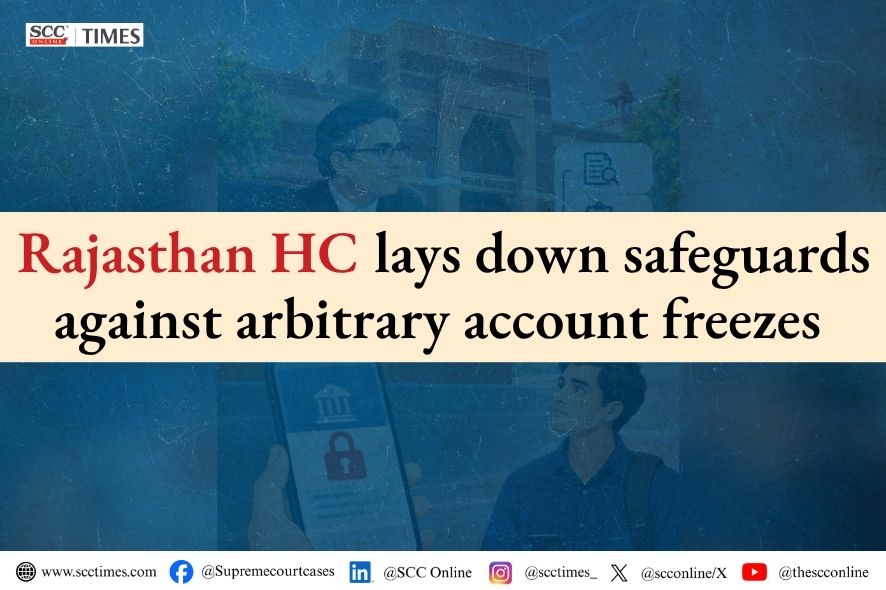
Rajasthan HC: Entire Bank Accounts Cannot Be Frozen in Cyber Fraud
Summary
- The Rajasthan High Court has established new safeguards against arbitrary bank account freezes.
- The ruling, in Shree Balaji Enterprises v. RBI, specifically addresses freezes during cyber fraud investigations.
- It mandates that entire bank accounts cannot be frozen without adequate justification.
- This decision aims to protect account holders from broad, unsubstantiated restrictions on their funds.
- The court emphasizes the need for specific reasons linking frozen funds to alleged fraudulent activity.
What Happened
The Rajasthan High Court's judgment is pivotal because it explicitly states that the entirety of a bank account cannot be frozen without proper justification during cyber fraud investigations.
The Rajasthan High Court has recently issued a significant ruling concerning the freezing of bank accounts during investigations into cyber fraud. This judicial intervention aims to introduce crucial safeguards against practices that have been deemed arbitrary in such cases. The decision stems from the specific legal challenge brought forth in the matter of Shree Balaji Enterprises v. RBI, a case that has now set an important precedent for how financial institutions and law enforcement agencies must approach asset freezes.
In its pronouncement, the High Court directly addressed the common practice of freezing entire bank accounts when cyber fraud is suspected. The court's directive is clear: such blanket freezes are not permissible without adequate justification. This ruling underscores a judicial emphasis on due process and the protection of individuals' and entities' financial assets, even in the face of serious allegations like cybercrime. It mandates a more nuanced and evidence-based approach to investigative actions that impact financial liquidity.
Legal Context
The landscape of cyber fraud investigations often involves swift action to prevent the dissipation of funds. Historically, this has sometimes led to the freezing of bank accounts suspected of being linked to fraudulent activities. While the intent behind such freezes is to secure evidence and recover illicit gains, the method employed has frequently been criticized for its broad scope, often impacting legitimate funds alongside potentially illicit ones.
Prior to this ruling, account holders often faced situations where their entire bank accounts were rendered inaccessible based on a mere suspicion or a small fraction of the account's balance being implicated in a fraud. This created significant operational and financial distress for individuals and businesses alike. The Rajasthan High Court's decision in Shree Balaji Enterprises v. RBI directly confronts this issue, establishing a legal framework that demands a more proportionate response from authorities. It seeks to balance the imperative of combating cybercrime with the fundamental rights of account holders to access their funds, ensuring that investigative measures are not unduly punitive or arbitrary.
Significance of the Ruling
The Rajasthan High Court's judgment is pivotal because it explicitly states that the entirety of a bank account cannot be frozen without proper justification during cyber fraud investigations. This means that authorities must now provide specific, demonstrable reasons linking the frozen funds to the alleged fraudulent activity, rather than simply freezing an entire account based on a general suspicion. The ruling implies a shift towards more targeted and evidence-backed freezing orders, which will require investigators to present a clearer nexus between the alleged fraud and the specific assets being restricted.
This landmark decision provides a vital legal recourse for individuals and businesses whose bank accounts have been subjected to arbitrary freezes. It reinforces the principle that while law enforcement has a legitimate interest in investigating and preventing cyber fraud, these powers must be exercised within the bounds of legal propriety and due process. The requirement for justification ensures that financial institutions and investigative bodies adhere to stricter protocols, potentially leading to more precise and less disruptive interventions in future cyber fraud cases across India.
Practical Implications
Lawyers representing clients whose bank accounts have been frozen during cyber fraud investigations can leverage this Rajasthan High Court ruling to challenge arbitrary or blanket freezes, demanding proper justification. Compliance officers in financial institutions must review and update their account freezing protocols to ensure they align with this precedent, avoiding potential legal challenges and ensuring due process.
Source
Source: Original reporting via SCC Times
How does this affect you?
Get an AI analysis of this article grounded in your jurisdictions, practice areas, and any policy documents you've uploaded to Wansom.
Finish Reading the Full Story and the Expert Analysis.
Get the latest legal & regulatory intelligence in India
Wansom is AI and can make mistakes.