
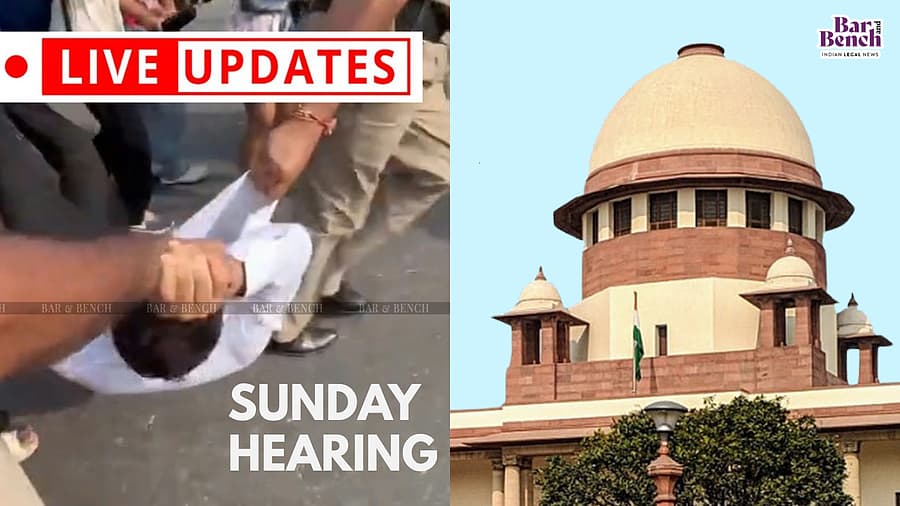
India Supreme Court: CJP Protest Detentions Hearing on Police Brutality
Summary
- The Supreme Court of India held a special Sunday hearing regarding detentions during a protest crackdown.
- Justice Joymalya Bagchi emphasized the Court's equal commitment to protecting the life and liberty of all individuals, regardless of their status.
- The Court clarified that police officers do not hold an independent right in maintaining law and order beyond the State's official submissions.
- Concerns were raised about individuals being detained from trains and outside Delhi, with "micro-journalism" cited as a factor in widespread reporting.
What Happened
The response and the concern of the Court to protect life and liberty is equally sensitive.
During a special Sunday hearing at the Supreme Court of India concerning a recent protest crackdown and associated detentions, Justice Joymalya Bagchi made significant observations. The proceedings addressed the widespread actions taken by authorities, which Justice Bagchi acknowledged as having a "gargantuan measure." The court convened to hear respondents on these matters, indicating the gravity with which the judiciary views the situation.
An advocate representing certain police officers attempted to present a perspective on the alleged brutality faced by law enforcement during the protests. This counsel asserted that "massive brutality" had occurred against police personnel, including individual officers. However, Justice Bagchi interjected, clarifying that police officers do not hold an independent right in the maintenance of law and order that supersedes the State's official submissions. The Justice directed the counsel to assist the Solicitor General instead, reinforcing the procedural hierarchy within the legal framework.
Senior Advocate Shoeb Alam subsequently voiced specific concerns regarding the arbitrary detention of individuals. He highlighted instances where people were reportedly pulled from trains and detained while traveling to Delhi, as well as others apprehended from locations outside the capital. Alam attributed the widespread awareness of these incidents to the contemporary phenomenon of "micro-journalism," noting that this trend, particularly among the younger generation, ensures that "everything gets reported." This observation underscores the role of modern communication in bringing such events to public and judicial attention during the India Supreme Court CJP protest detentions hearing.
Legal Context
The Supreme Court's stance, articulated by Justice Joymalya Bagchi, provides crucial legal context for understanding the protection of personal liberty in India, especially during times of protest. Justice Bagchi unequivocally stated that the courts remain "agnostic" to the individual's status, whether they are a police officer, a lawyer, or an ordinary citizen. This principle underscores the judiciary's commitment to impartiality and equal application of the law.
The Court's "concern to protect life and liberty is equally sensitive" for all, a declaration that reinforces fundamental constitutional rights. This assertion is particularly relevant in the context of protest crackdown detentions in India, where the right to protest and personal liberty are often at the forefront of legal challenges. The observation that police officers do not possess an independent right to maintain law and order beyond the State's submission is a critical clarification of their role and accountability within the legal system. It implies that their actions must align with state directives and cannot be driven by personal discretion that might infringe upon citizens' rights.
Why It Matters
The observations made during this Supreme Court of India Sunday hearing carry significant weight for the ongoing discourse surrounding protest actions and state responses. Justice Joymalya Bagchi's clear articulation of the Court's role as a protector of individual life and liberty, irrespective of the person's background or profession, sends a strong message to both authorities and citizens. It emphasizes that the judiciary will not differentiate between individuals when assessing potential infringements on fundamental rights, thereby upholding the principle of equality before the law.
The Court's acknowledgment of the "gargantuan measure" of the actions taken during the protest crackdown highlights the scale of the state's response and implicitly signals the need for judicial scrutiny. Furthermore, the concerns raised by Senior Advocate Shoeb Alam about detentions on trains and from outside Delhi, coupled with his reference to "micro-journalism," point to the evolving landscape of information dissemination and its impact on legal proceedings. The fact that "everything gets reported" through modern media channels means that instances of police brutality protest India and arbitrary detentions are increasingly visible, potentially influencing public perception and judicial oversight. This judicial intervention serves as a vital check on executive power, reinforcing the importance of due process and individual freedoms even amidst public unrest.
Practical Implications
Lawyers advising clients involved in protests or facing detention should note the Supreme Court's clear stance on protecting individual life and liberty, irrespective of status, which may inform strategies for challenging arbitrary detentions or police actions.
Source
How does this affect you?
Get an AI analysis of this article grounded in your jurisdictions, practice areas, and any policy documents you've uploaded to Wansom.
Finish Reading the Full Story and the Expert Analysis.
Get the latest legal & regulatory intelligence in India
Wansom is AI and can make mistakes.