
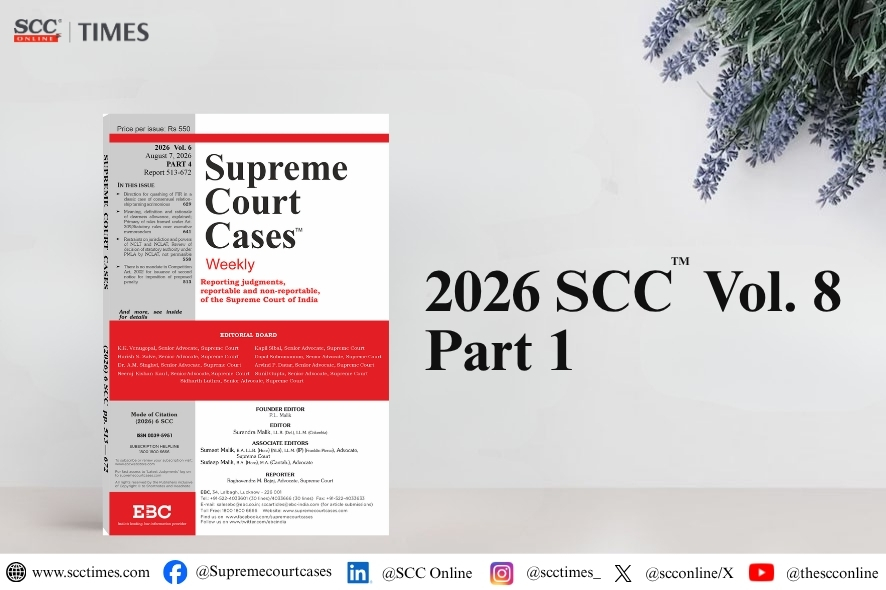
Supreme Court: 2026 SCC Vol. 8 Part 1 Cases Clarify Key Legal Issues
Summary
- The 2026 SCC Vol. 8 Part 1 features eight significant Supreme Court rulings.
- These rulings cover diverse legal areas including constitutional distribution of powers, environmental clearance, and insolvency proceedings.
- Key criminal law topics such as police custody, POCSO, POSH, and prisons are also addressed.
- The volume provides crucial precedents for legal professionals across various specializations.
- Lawyers should consult this volume to stay informed on recent Supreme Court India rulings and their implications.
Overview of Key Rulings
Lawyers should review this volume for recent Supreme Court precedents impacting constitutional law, environmental compliance, insolvency proceedings, and criminal defense strategies to ensure up-to-date legal advice and litigation preparedness.
The Supreme Court of India has recently issued a significant collection of eight rulings, compiled within the 2026 SCC Vol. 8 Part 1. This particular volume of the Supreme Court Cases (SCC) series serves as a crucial resource, presenting a range of judgments that address fundamental aspects of Indian law. These decisions from the apex court are poised to influence various legal domains, offering clarity and setting precedents across a spectrum of complex issues.
This inaugural part of Volume 8 encapsulates a diverse array of legal challenges brought before the Supreme Court, reflecting the breadth of its judicial oversight. Legal practitioners and scholars alike will find this compilation indispensable for understanding the current trajectory of jurisprudence in India. The rulings contained within this volume are essential for staying abreast of the latest judicial interpretations and their potential impact on ongoing and future legal matters.
Diverse Legal Areas Addressed
The rulings featured in 2026 SCC Vol. 8 Part 1 delve into several critical areas, providing authoritative guidance on matters ranging from constitutional principles to specific criminal and environmental statutes. Among the key issues examined are the intricate aspects of the constitutional distribution of powers, a foundational element of India's governance structure. These judgments clarify the demarcation and exercise of authority among different governmental branches and levels, impacting the very framework of legal and administrative operations.
Furthermore, the volume includes important decisions concerning environmental law, specifically addressing the requirement for prior environment clearance. These Supreme Court India rulings are vital for businesses and regulatory bodies, as they define the parameters for environmental compliance and sustainable development. The implications extend to project approvals and the legal responsibilities associated with environmental protection. Additionally, the collection tackles issues related to insolvency proceedings, particularly the enforcement of claims by operational creditors, which is a significant component of the Insolvency and Bankruptcy Code (IBC). These judgments provide crucial clarity for creditors seeking to recover dues and for companies navigating financial distress.
Criminal law also receives substantial attention within this volume, with rulings pertaining to the grant of police custody. These decisions are fundamental to criminal defense strategies and the rights of individuals during investigation, ensuring due process is upheld. Moreover, the Supreme Court has addressed sensitive matters under the Protection of Children from Sexual Offences (POCSO) Act and the Prevention of Sexual Harassment (POSH) Act, reinforcing protections for vulnerable populations and workplace safety. The judgments also touch upon conditions and rights within prisons, contributing to the ongoing discourse on correctional reforms and human rights within the penal system.
Significance for Legal Practice
The comprehensive nature of the 2026 SCC Vol. 8 Part 1 makes it an indispensable resource for legal professionals across various specializations. Lawyers should review this volume for recent Supreme Court precedents impacting constitutional law, environmental compliance, insolvency proceedings, and criminal defense strategies to ensure up-to-date legal advice and litigation preparedness. The rulings on constitutional distribution of powers, for instance, will directly inform arguments in cases involving federalism or governmental authority.
For those practicing environmental law, the pronouncements on prior environment clearance offer definitive interpretations that could shape future project developments and regulatory enforcement. Similarly, practitioners dealing with corporate insolvency will find the decisions on operational creditors claims under the IBC to be pivotal for advising clients. In the realm of criminal law, the guidance on police custody, along with the interpretations of POCSO and POSH, will be critical for defending clients and advocating for victims. This collection of Supreme Court India rulings underscores the dynamic evolution of Indian jurisprudence and the necessity for legal professionals to continuously update their knowledge base to provide effective and informed counsel.
Practical Implications
Lawyers should review this volume for recent Supreme Court precedents impacting constitutional law, environmental compliance, insolvency proceedings, and criminal defense strategies to ensure up-to-date legal advice and litigation preparedness.
Source
How does this affect you?
Get an AI analysis of this article grounded in your jurisdictions, practice areas, and any policy documents you've uploaded to Wansom.
Finish Reading the Full Story and the Expert Analysis.
Get the latest legal & regulatory intelligence in India
Wansom is AI and can make mistakes.