
India Arbitration: Domain Expert Arbitrators Now Essential for Complex Cases
Summary
- A panel at India ADR Week 2026 in Mumbai advocated for appointing arbitrators with specific industry domain expertise in Indian domestic disputes.
- Panelists noted that complex commercial matters benefit more from domain specialists, practitioners, and general counsel than solely retired judges.
- Hindustan Unilever's Vivek Mittal observed that technical arbitrations often stall because established arbitrators, including ex-judges, lack subject matter expertise.
- Mittal explicitly proposed that General Counsel should serve as arbitrators, leveraging their practical insights.
- Pine Labs General Counsel Shalini Saxena stressed the necessity of subject-matter familiarity for all tribunal members and urged institutions to guide arbitrators accordingly.
Evolving Arbitrator Selection in India
The emerging opportunity for General Counsel as arbitrators India also presents a significant development, potentially diversifying the pool of available arbitrators and injecting practical, business-oriented perspectives into dispute resolution.
A recent discussion at India ADR Week 2026 in Mumbai highlighted a critical shift in arbitrator selection criteria for domestic disputes within the country. Panelists observed that while traditional arbitral tribunals often comprise retired judges, the increasing complexity of commercial matters necessitates a move towards appointing India arbitration domain expert arbitrators. This evolving perspective suggests a need to balance established procedural experience with deep industry-specific knowledge.
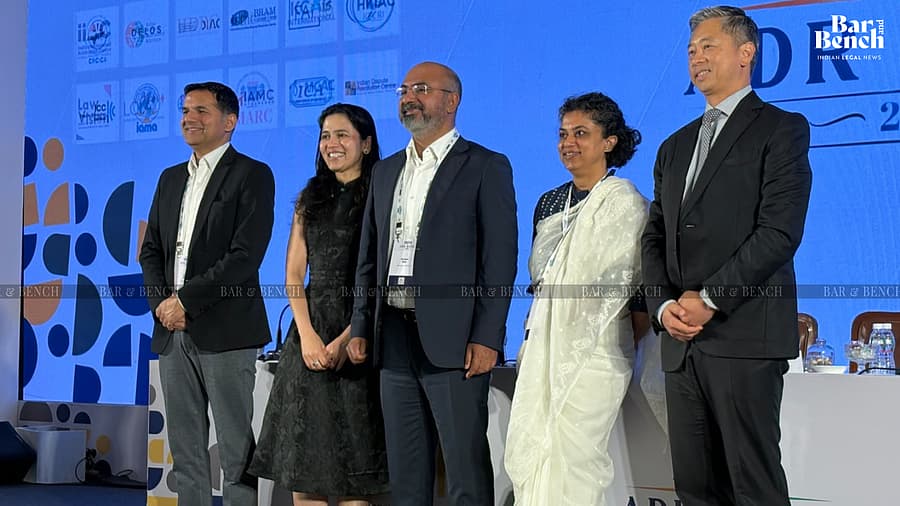
The panel, titled "In-house Counsel's Roles and Expectations during the Arbitral Process," brought together prominent legal figures to discuss these dynamics. Moderated by Skadden Partner Sharmistha Chakrabarti, the session featured insights from Mahindra & Mahindra General Counsel Naveen Raju, Hindustan Unilever Executive Director of Legal & Corporate Affairs Vivek Mittal, Pine Labs General Counsel Shalini Saxena, and Skadden's Asia Head of International Arbitration, Friven Yeoh. Their collective experience underscored the growing demand for domain specialists, practitioners, and even general counsel to serve on arbitral benches, particularly in intricate commercial cases.
Addressing Gaps in Traditional Arbitral Expertise
A significant point of contention raised during the discussion centered on the limitations of relying solely on former judges for complex technical arbitrations. Vivek Mittal of Hindustan Unilever drew a clear distinction between domestic and international arbitration frameworks, noting that technical disputes in India frequently encounter obstacles when adjudicated by individuals who approach cases exclusively through a courtroom lens. He articulated a concern that such an approach can impede the efficient resolution of highly specialized matters.
Mittal further elaborated on this challenge, stating that the current landscape of Indian arbitration has become "very complex" because many established arbitrators, typically ex-judges or senior counsel, often lack the requisite subject matter expertise. This observation points to a potential disconnect between the procedural proficiency of traditional arbitrators and the intricate technical or commercial nuances inherent in modern disputes, impacting the overall efficacy of Indian commercial arbitration expertise.
The Case for Domain Specialists and In-house Counsel
In response to these identified gaps, the panel advocated for a broader inclusion of domain specialists India arbitration. A key proposal emerged from Vivek Mittal, who explicitly suggested that General Counsel should become arbitrators. This proposition highlights the unique value that in-house legal professionals can bring to the arbitral process, leveraging their practical industry knowledge and commercial acumen.
Echoing this sentiment, Pine Labs General Counsel Shalini Saxena emphasized the paramount importance of subject-matter familiarity for all tribunal members, regardless of their professional background. She called upon arbitral institutions to take a more active role in guiding and influencing their arbitrators, encouraging them to prioritize and demonstrate a strong understanding of the specific domain relevant to the dispute. This collective push aims to refine arbitrator selection criteria India, ensuring that tribunals are better equipped to handle the intricacies of contemporary commercial disputes.
Implications for Indian Commercial Arbitration
The insights shared at India ADR Week 2026 underscore a pivotal moment for Indian commercial arbitration expertise. The call for India arbitration domain expert arbitrators signifies a strategic re-evaluation of what constitutes an ideal arbitral panel, moving beyond a sole reliance on judicial experience. This shift is poised to influence arbitrator selection criteria India, encouraging parties and institutions to actively seek out individuals with specialized industry knowledge.
The emerging opportunity for General Counsel as arbitrators India also presents a significant development, potentially diversifying the pool of available arbitrators and injecting practical, business-oriented perspectives into dispute resolution. By integrating domain specialists, the Indian arbitration ecosystem aims to enhance the efficiency, relevance, and ultimately, the credibility of its domestic arbitral processes, ensuring that outcomes are not only legally sound but also commercially astute.
Practical Implications
Lawyers engaged in Indian domestic arbitration should be aware of the growing emphasis on appointing arbitrators with specific industry domain expertise over solely judicial experience, influencing arbitrator selection strategies. In-house counsel should note the emerging opportunity to serve as arbitrators, leveraging their practical insights.
Source
Source: Original reporting via {source}
How does this affect you?
Get an AI analysis of this article grounded in your jurisdictions, practice areas, and any policy documents you've uploaded to Wansom.
Finish Reading the Full Story and the Expert Analysis.
Get the latest legal & regulatory intelligence in India
Wansom is AI and can make mistakes.