
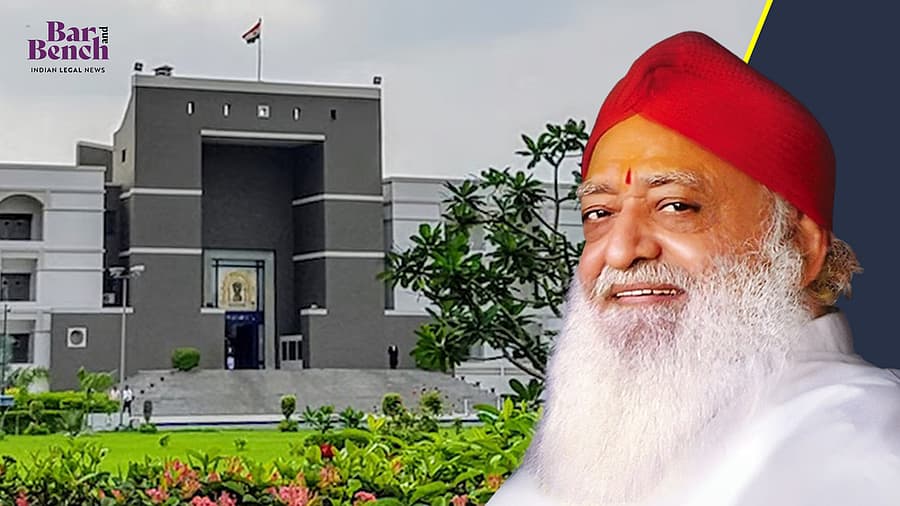
Gujarat High Court: Rejects Asaram Temporary Bail for Ailing Wife Visit
Summary
- The Gujarat High Court rejected Asaram's plea for 20-day temporary bail to visit his ailing wife.
- Justices Gita Gopi and LS Pirzada based their decision on a medical report indicating his wife's positive response to treatment and imminent discharge.
- The court offered Asaram the alternative of communicating with his wife via video conferencing from Jodhpur Jail.
- Asaram is currently serving life sentences for two separate rape convictions, one involving a Surat disciple and another a minor girl.
- The ruling highlights the strict judicial scrutiny applied to temporary bail applications, even on humanitarian grounds, emphasizing current medical evidence and alternative communication methods.
Court Denies Temporary Bail Request
This ruling by the Gujarat High Court underscores the rigorous scrutiny applied to applications for temporary bail, even when they are based on humanitarian considerations such as an ailing family member.
The Gujarat High Court recently declined a petition from self-styled spiritual leader Asaram, who sought a 20-day temporary release from custody. The application, filed under the case name Ashumal @ Asharam v State of Gujarat, aimed to allow him to visit his 83-year-old wife, who was receiving medical treatment at a hospital in Ahmedabad.
A Division Bench comprising Justices Gita Gopi and LS Pirzada reviewed the request, ultimately deciding against granting the temporary bail. Their decision was heavily influenced by a medical report presented to the court, which indicated that Asaram's wife had shown a positive response to her treatment and was anticipated to be discharged from the hospital within two to three days.
In their pronouncement, the Justices stated that given the patient's favorable medical progress and the doctors' expectation of her imminent discharge, there was no compelling reason to approve the application for the petitioner, who is currently incarcerated in Jodhpur Jail, Rajasthan. While denying the physical release, the Court did offer an alternative, permitting Asaram to seek authorization from jail authorities to communicate with his wife via video conferencing.
Background of the Plea and Convictions
The temporary bail plea was predicated on the assertion that Asaram's wife was critically ill and had been admitted to a hospital located in Naroda. Prior to the final ruling, specifically on September 29, the Gujarat High Court had issued a directive requiring local police to verify the claims regarding her medical condition.
Asaram is currently serving multiple life sentences for serious offenses. A Gandhinagar court convicted him in a rape case registered in 2013, finding him guilty of repeatedly sexually assaulting a female disciple from Surat between 2001 and 2006. At the time of these crimes, the victim resided at his ashram in Motera.
In addition to this conviction, Asaram is also serving a life sentence in a separate case from 2013, where he was found guilty of raping a minor girl in Rajasthan. These prior convictions form a significant part of the legal context surrounding any application for temporary release, including those made on humanitarian grounds.
Judicial Scrutiny of Humanitarian Bail
This ruling by the Gujarat High Court underscores the rigorous scrutiny applied to applications for temporary bail, even when they are based on humanitarian considerations such as an ailing family member. The court's emphasis on current medical reports and the precise condition of the patient highlights that such pleas are not granted automatically but require concrete, verifiable evidence of critical need.
The decision also illustrates a judicial preference for less restrictive alternatives when possible. By offering video conferencing as a means for Asaram to connect with his wife, the court balanced the humanitarian aspect with the need to maintain the integrity of the judicial process and the punitive nature of his existing sentences. This approach is particularly relevant in India for high-profile convicts seeking temporary bail on medical grounds, where courts often seek to avoid setting precedents that could be misused.
Ultimately, the Gujarat High Court's rejection of Asaram's temporary bail plea reinforces the principle that while compassionate grounds are considered, they must be substantiated by immediate and severe circumstances that cannot be addressed through alternative means. This case serves as a clear example of the strict conditions under which such temporary releases are permitted.
Practical Implications
This ruling highlights the strict scrutiny courts apply to temporary bail applications, even on humanitarian grounds. Lawyers should note the emphasis on current medical reports and the court's willingness to offer alternative communication methods (like video conferencing) rather than granting physical release, especially for high-profile convicts.
Source
How does this affect you?
Get an AI analysis of this article grounded in your jurisdictions, practice areas, and any policy documents you've uploaded to Wansom.
Finish Reading the Full Story and the Expert Analysis.
Get the latest legal & regulatory intelligence in India
Wansom is AI and can make mistakes.