
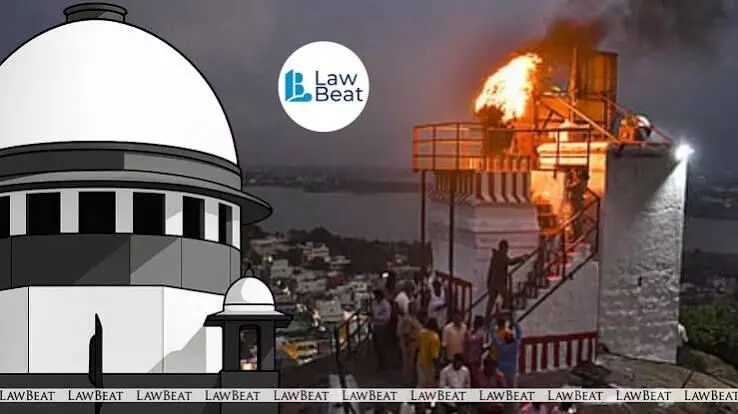
Supreme Court: Tamil Nadu HR&CE Defends Thirupparankundram Deepam Tradition
Summary
- The Tamil Nadu HR&CE Department is defending the traditional Karthigai Deepam lighting at Thirupparankundram in the Supreme Court.
- The department opposes the Hindu Dharma Parishad's plea for a 24-hour lamp on the Deepathoon, full hill illumination, and ASI takeover of the temple.
- The HR&CE affidavit states that lighting the Deepam on the hill summit has never been an established custom over the past 150 years.
- The State argues that decisions on rituals fall under the temple administration's exclusive domain, protected by the Tamil Nadu Hindu Religious and Charitable Endowments Act, 1959.
- The case emphasizes that any custom asserted for rights under Articles 25 and 26 of the Constitution must be specifically pleaded and strictly proven.
Supreme Court Considers Thirupparankundram Deepam Dispute
The State further emphasized that decisions regarding the conduct of poojas and festivals, including the specific manner and location for lighting the Karthigai Deepam, fall exclusively within the domain of the temple administration.
The Supreme Court is currently reviewing a significant dispute concerning the long-standing Karthigai Deepam tradition at the Arulmigu Subramaniaswamy Temple in Thirupparankundram, Tamil Nadu. The Tamil Nadu Hindu Religious and Charitable Endowments (HR&CE) Department has filed a robust counter affidavit, staunchly defending the temple's established practice of lighting the Deepam exclusively at the Deepa Mandapam, located near the Uchipillaiyar Temple, for over 150 years.
This legal challenge stems from a writ petition filed by the Hindu Dharma Parishad, represented by K.K. Ramesh, against the Union of India and others. The Parishad seeks three primary reliefs: the installation of a lamp to burn continuously for 24 hours on a stone pillar known as the "Deepathoon," the illumination of the entire hill during the Karthigai Deepam festival, and a complete takeover of both the temple and the hill by the Archaeological Survey of India (ASI). Dr. T.G. Vinay, IAS, Commissioner of the HR&CE Department and Respondent No. 6 in the case (Writ Petition (Civil) No. 1280 of 2026), verified the affidavit in Chennai on November 12, 2026. The matter, tagged with lead petition W.P.(C) No. 640 of 2026, is returnable on December 9, 2026, before a bench comprising Chief Justice of India Surya Kant and Justice Joymalya Bagchi.
State Defends Established Tradition and Statutory Authority
The Tamil Nadu HR&CE Department's affidavit firmly asserts that there has never been an established practice, custom, or even a prior claim for lighting the Karthigai Deepam upon the summit of the hill. The Commissioner characterized the Hindu Dharma Parishad's petition as "wholly misconceived" and "a gross abuse of the process of this Hon'ble Court," arguing that none of the requested reliefs are grounded in any legal right, proven custom, or infringement of fundamental rights. Granting these requests, the State contends, would disrupt the settled ownership and statutory administration of the temple, which operates as a public religious institution under the Tamil Nadu Hindu Religious and Charitable Endowments Act, 1959.
The State further emphasized that decisions regarding the conduct of poojas and festivals, including the specific manner and location for lighting the Karthigai Deepam, fall exclusively within the domain of the temple administration. This authority, according to the affidavit, is not subject to the demands of individual devotees or private associations like the petitioner. Historical records support this stance, with a 1923 civil court decree noting that earlier attempts in 1862 and 1912 by Hindus to light a lamp near the hillock's summit were resisted due to the absence of such a custom and concerns about potential breaches of peace. The State also refuted claims that hilltop lighting was an ancient Tamil tradition suppressed by wartime prohibitions, stressing that any custom asserted as a right under Articles 25 and 26 of the Constitution must be specifically pleaded and strictly proven by the party making the claim.
Implications for Religious Autonomy and Legal Precedent
This case before the Supreme Court carries significant implications for the autonomy of religious institutions and the legal standards for asserting new religious practices in India. The HR&CE Department's strong defense highlights the importance of established custom and statutory administration under the Tamil Nadu Hindu Religious and Charitable Endowments Act, 1959, in defining and protecting religious traditions. The State's argument underscores that the burden of proof for asserting new rights or challenging long-standing traditions under Articles 25 and 26 of the Constitution is exceptionally high.
The outcome of this dispute over the Thirupparankundram Karthigai Deepam tradition will likely reinforce the principle that temple administrations retain exclusive authority over their rituals and practices, unless a compelling legal or constitutional basis for intervention is demonstrated. The Commissioner's assertion that the petition would "unsettle and render nugatory the settled ownership and the statutory administration of the Temple" serves as a critical reminder of the legal protections afforded to established religious institutions and their traditional practices.
Practical Implications
Lawyers advising religious institutions or involved in public interest litigation concerning religious practices should note the Supreme Court's consideration of established custom, statutory administration under the Tamil Nadu Hindu Religious and Charitable Endowments Act, 1959, and the high burden of proof required to assert new religious rights or challenge long-standing traditions under Articles 25 and 26 of the Constitution. This case reinforces the autonomy of temple administration in matters of ritual and practice.
Source
Source: Original reporting via LiveLaw
How does this affect you?
Get an AI analysis of this article grounded in your jurisdictions, practice areas, and any policy documents you've uploaded to Wansom.
Finish Reading the Full Story and the Expert Analysis.
Get the latest legal & regulatory intelligence in India
Wansom is AI and can make mistakes.