
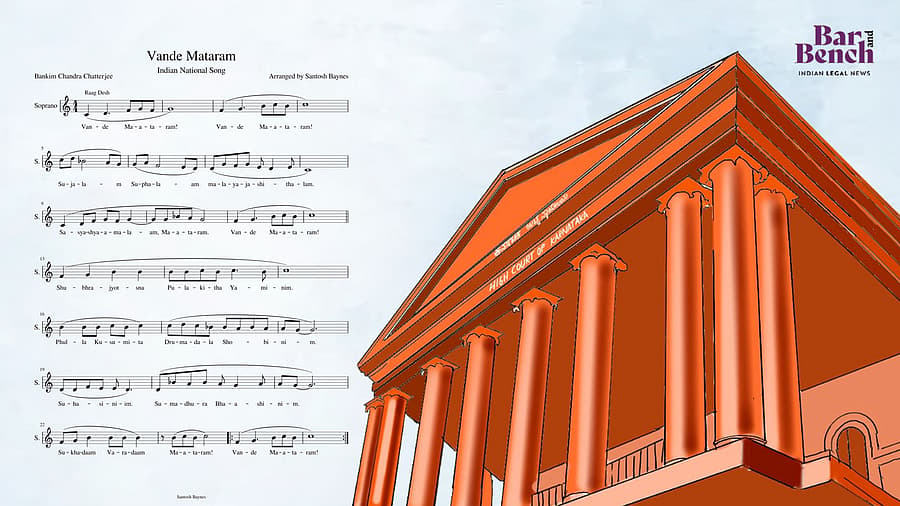
Karnataka High Court: Girish Bharadwaj v State of Karnataka PIL Deferred
Summary
- The Karnataka High Court has postponed its hearing on a Public Interest Litigation challenging the state's order to limit 'Vande Mataram' to two stanzas at government events.
- The deferral was prompted by the state's notification that a similar constitutional challenge is currently pending before the Supreme Court.
- The PIL, filed by Girish Bharadwaj, contests a September 8 state directive that permits all six stanzas only when specific high-ranking dignitaries are present.
- The Supreme Court case, brought by TM Krishna, questions the legality of a 2026 amendment to the Prevention of Insults to National Honour Act, which designates 'Vande Mataram' as a national song and penalizes its disruption.
- The High Court's decision on the stanza limit will likely be influenced by the Supreme Court's ruling on the broader constitutional validity of the national song's legal protections.
Court Postpones Review of Vande Mataram Stanza Limit
The High Court's decision to await the Supreme Court's ruling underscores the interconnectedness of these legal challenges, awaiting guidance from the apex court on broader constitutional questions.
The Karnataka High Court recently adjourned its proceedings concerning a Public Interest Litigation (PIL) that challenges a state government directive limiting the rendition of 'Vande Mataram' to its initial two verses during official events. The division bench, comprising Justice Anu Sivaraman and Justice TP Vivekananda, instructed that the petition, filed by Girish Bharadwaj against the State of Karnataka, be scheduled for further consideration in three weeks.
The deferral came after the state's legal representatives informed the court that a related matter is currently under review by the Supreme Court. This strategic postponement by the Karnataka High Court underscores the interconnectedness of legal challenges surrounding the national song, awaiting guidance from the apex court on broader constitutional questions.
The PIL, initiated by advocate Girish Bharadwaj through his counsel Angad Kamath, specifically contests a September 8 order issued by the Karnataka government. This order mandates that only the first two stanzas of 'Vande Mataram' be sung at programmes organized by the state, setting a specific limit on the national song's performance.
Legal Challenge to National Honour Act Amendment
The state government's September 8 directive, which is the subject of the High Court PIL, permits an exception to its two-stanza rule. In events attended by the President, Vice-President, Prime Minister, or the state Governor, the entire six-verse composition of 'Vande Mataram' is allowed to be sung. This distinction highlights the nuanced approach taken by the state regarding the national song's rendition based on the dignitaries present.
The Supreme Court case, which prompted the High Court's deferral, involves a petition lodged by Carnatic vocalist TM Krishna. His plea before the apex court questions the constitutional legality of a legislative change introduced in 2026 to the Prevention of Insults to National Honour Act. This amendment is significant as it designates 'Vande Mataram' as a national song and stipulates penalties, including imprisonment up to three years, for deliberately obstructing its rendition or disturbing gatherings where it is sung.
Parliament's recent enactment of the Prevention of Insults to National Honour (Amendment) Act, 2026, to formally include 'Vande Mataram' as a national song, forms the backdrop for TM Krishna's challenge. The outcome of this Supreme Court review could have far-reaching implications for how 'Vande Mataram' is treated and performed across the nation, directly influencing the High Court's decision on the Karnataka government's stanza limit.
Implications of the Deferral
The Karnataka High Court's decision to postpone its hearing in `Girish Bharadwaj v State of Karnataka` means that the legal challenge to the state's `Vande Mataram` stanza limit remains unresolved for now. While the state government's September 8 order, which restricts the national song to two stanzas at most official functions, continues to be in effect, it does so under the shadow of ongoing judicial scrutiny.
This deferral underscores the judiciary's recognition of the broader legal landscape surrounding the national song, particularly the constitutional questions being addressed by the Supreme Court regarding the 2026 amendment to the Prevention of Insults to National Honour Act. The apex court's eventual ruling on TM Krishna's petition could establish a precedent or provide clarity that will directly inform the High Court's judgment on the specific `Karnataka government Vande Mataram limit`.
Consequently, the legal status of the `PIL challenging Vande Mataram state order` is now intrinsically linked to the `TM Krishna Vande Mataram Supreme Court` proceedings. The final resolution of the `Karnataka High Court Vande Mataram stanzas` dispute will likely hinge on the Supreme Court's interpretation of the `Prevention of Insults to National Honour Act challenge`, impacting how the national song is officially performed in Karnataka and potentially beyond.
Practical Implications
This deferral means the legal challenge to Karnataka's Vande Mataram stanza limit remains unresolved, with the state order still in effect but under judicial scrutiny. Lawyers advising government bodies or event organizers should monitor the related Supreme Court proceedings, as the outcome could impact compliance requirements regarding national song renditions.
Source
How does this affect you?
Get an AI analysis of this article grounded in your jurisdictions, practice areas, and any policy documents you've uploaded to Wansom.
Finish Reading the Full Story and the Expert Analysis.
Get the latest legal & regulatory intelligence in India
Wansom is AI and can make mistakes.