
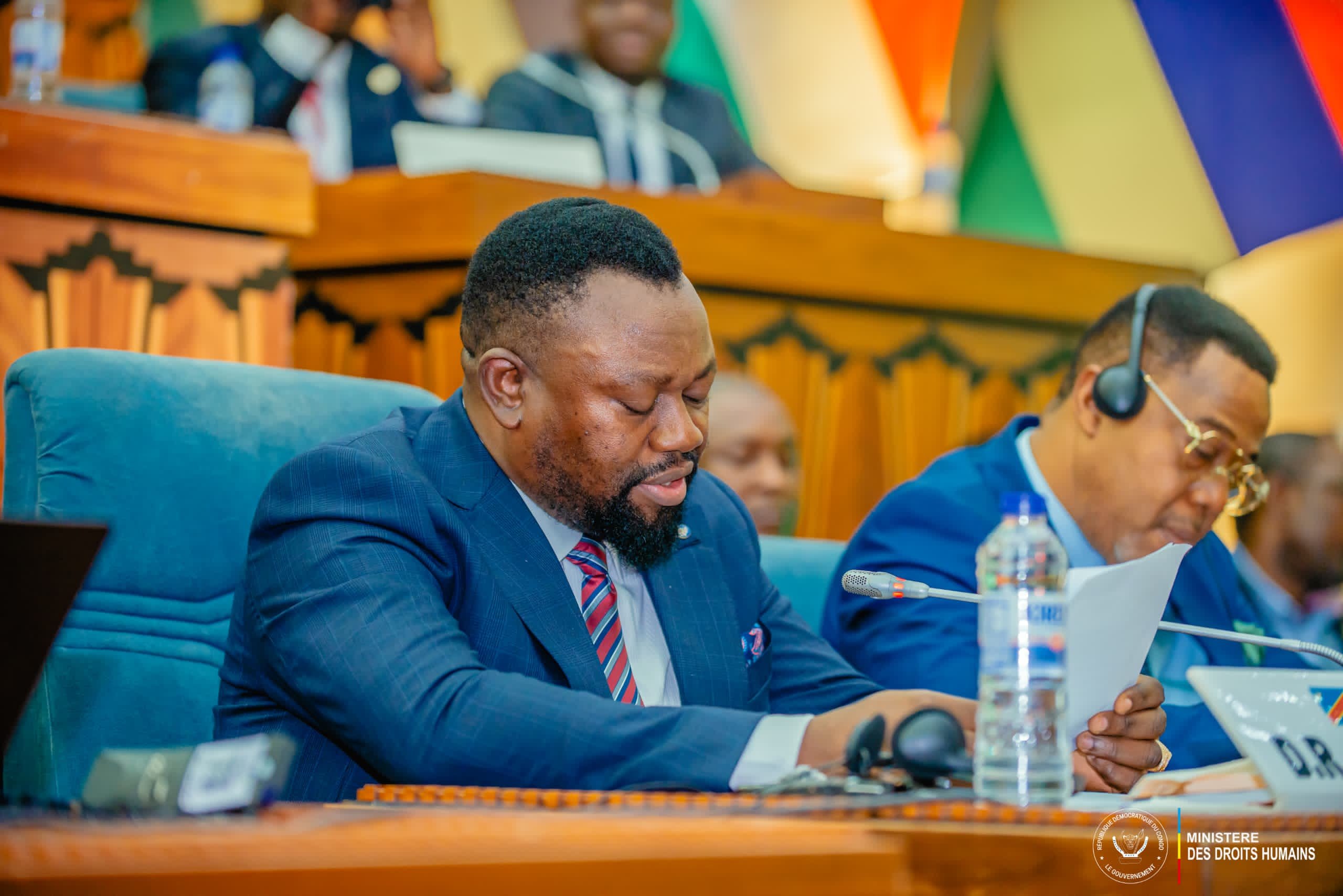
DR Congo Minister Accuses Kabila of Inciting Violence at African Human Rights Commission
On Monday, October 12, in Dakar, Senegal, the Congolese Minister of Human Rights, Samuel Mbemba, publicly accused former Democratic Republic of Congo President Joseph Kabila at the 89th ordinary session of the African Commission on Human and Peoples' Rights of intending to escalate violence in the eastern part of the country. This accusation followed Kabila's announcement of a new politico-military movement, which he reportedly leads from Goma, a city under rebel occupation in North Kivu, and which is presented as a replacement for the AFC/M23 rebellion. Mbemba's intervention at the Commission, which was examining the human rights situation across Africa amidst security crises and geopolitical tensions, highlighted his concern that Kabila's recent discourse on October 9 failed to acknowledge Rwandan aggression as a primary cause of instability and human rights violations in the region, raising questions about his true intentions and potential consequences.
This event carries significant legal implications, underscoring the use of international human rights forums for addressing complex domestic and regional security challenges. For legal practitioners, it illustrates how political accusations, especially those involving former heads of state and armed groups, can be brought before quasi-judicial bodies like the ACHPR, potentially leading to international scrutiny, investigations, or recommendations concerning state responsibility and individual accountability under international law. The allegations touch upon critical issues of incitement to violence, support for non-state armed actors, and the protection of civilian populations, all of which are central tenets of international humanitarian law and human rights conventions.
The legal context for this development is primarily the African Charter on Human and Peoples' Rights, which established the African Commission on Human and Peoples' Rights (ACHPR) as its monitoring and interpretative body. The ACHPR, a quasi-judicial institution, is mandated to promote and protect human rights across the continent, including through examining state reports and considering communications. While its decisions are not directly enforceable as court judgments, its findings and recommendations carry substantial moral and political weight within the African Union framework. The accusations also implicitly invoke principles of international criminal law concerning responsibility for international crimes, such as aggression or crimes against humanity, which could potentially be pursued in other international or national jurisdictions if sufficient evidence emerges.
Key parties involved include Samuel Mbemba, the Congolese Minister of Human Rights, representing the government of the Democratic Republic of Congo; Joseph Kabila, the former President of the DRC, who is the subject of the accusations; and the African Commission on Human and Peoples' Rights (ACHPR), which served as the platform for Mbemba's statement. The African Union is also an implicit party, as the ACHPR operates under its auspices. Furthermore, Rwanda and the AFC/M23 movement are central to the allegations of regional instability and support for armed groups.
Attorneys advising clients with interests in the DRC, or those engaged in international human rights advocacy, should closely monitor the proceedings and any subsequent resolutions or recommendations from the ACHPR. The gravity of accusing a former head of state of potentially exacerbating violence and supporting armed groups could trigger further investigations, diplomatic pressure, or even sanctions, impacting regional stability and the investment climate. Legal professionals must be prepared to analyze the evolving legal and political landscape, understanding the potential for such accusations to escalate into formal complaints or referrals to international criminal jurisdictions, thereby requiring a comprehensive grasp of international human rights and humanitarian law.
How does this affect you?
Get an AI analysis of this article grounded in your jurisdictions, practice areas, and any policy documents you've uploaded to Wansom.
Finish Reading the Full Story and the Expert Analysis.
Get the latest legal & regulatory intelligence in DR Congo
Wansom is AI and can make mistakes.