
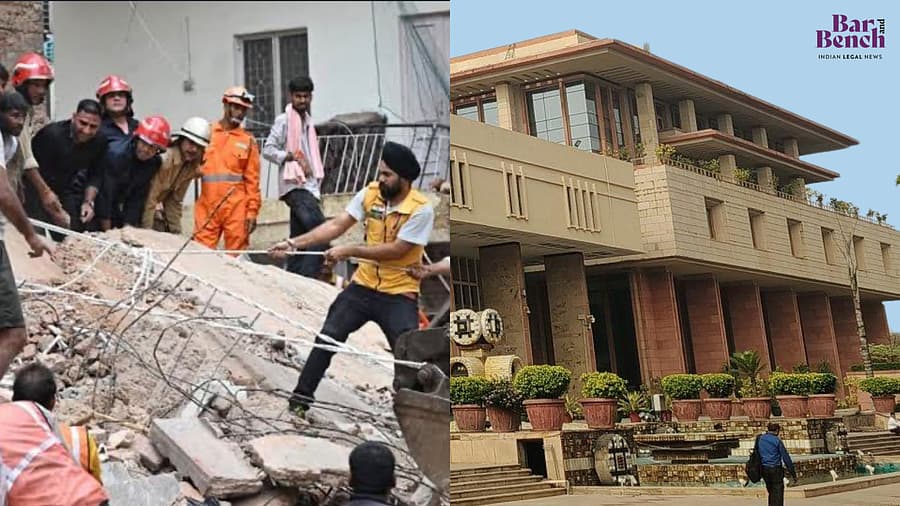
Delhi High Court: Satya Niketan Collapse PIL Calls Conduct 'Criminal'
Summary
- The Delhi High Court strongly condemned the Satya Niketan paying guest (PG) building collapse, characterizing it as "callous and criminal conduct."
- Seven individuals, including students and workers, died when the building collapsed during repair work on September 6 near Delhi University's South Campus.
- A Division Bench, including Chief Justice Devendra Kumar Upadhyaya, made the remarks while hearing a public interest litigation (PIL) filed by Aakarshak Danveer Rathi.
- The Court expressed deep concern for the student victims, noting their shattered hopes and the long-standing problem of student accommodation in Delhi.
- The matter is scheduled for further hearing on September 25, when other related cases will also be considered by the Court.
Tragic Collapse and Judicial Condemnation
The Delhi High Court strongly condemned the recent Satya Niketan paying guest (PG) building collapse, characterizing the tragic incident as a result of "callous and criminal conduct."
The tragic collapse of a paying guest (PG) accommodation in Satya Niketan, located near Delhi University’s South Campus, on September 6, resulted in the deaths of seven individuals. The building, which served as a boys' PG, caved in while undergoing repair work, claiming the lives of both students and workers. This devastating incident has drawn sharp criticism from the Delhi High Court, which recently characterized the event as a clear instance of "callous and criminal conduct."
Court's Empathy and Ongoing Litigation
During a recent hearing, a Division Bench of the Delhi High Court, comprising Chief Justice Devendra Kumar Upadhyaya and Justice Tejas Karia, addressed the Satya Niketan collapse while considering a public interest litigation (PIL) filed by Aakarshak Danveer Rathi. The Court expressed profound dismay over the incident, specifically referencing an article from The Indian Express that detailed the loss of four students' lives in the tragedy.
Chief Justice Upadhyaya articulated the Court's deep empathy for the victims, noting that these students had arrived in Delhi from smaller towns, carrying significant hopes and aspirations for their future. He lamented that these dreams were "shattered by such a callous and criminal conduct." The Chief Justice also acknowledged the long-standing issue of student accommodation in the city, observing that students have been flocking to Delhi for higher education for the past 20-25 years, a phenomenon that has unfortunately been met with inadequate and unsafe housing options. The Delhi High Court Satya Niketan collapse PIL is scheduled for further hearing on September 25, when other related cases will also be considered.
Broader Implications for Building Safety
The Delhi High Court's pointed remarks, labeling the Satya Niketan PG building collapse as "callous and criminal conduct," carry significant weight, signaling a potential shift towards stricter enforcement and greater accountability in building safety. This judicial stance, articulated during the hearing of the Aakarshak Danveer Rathi public interest litigation, suggests that property owners and operators of accommodations like PGs could face severe legal repercussions, including criminal charges, for negligence leading to such disasters.
The ongoing Delhi High Court building safety PIL, initiated in response to this tragedy, highlights a broader concern about the structural integrity of buildings across the city, particularly those catering to the burgeoning student population. The Court's focus on the "criminal conduct" aspect implies that mere civil liability might not suffice, pushing for a more robust framework to ensure the safety of residents. This development could compel authorities to re-evaluate existing building codes and inspection mechanisms, aiming to prevent future collapses and enhance India property owner liability in cases of structural failure.
Practical Implications
This development signals heightened judicial scrutiny on building safety and potential criminal liability for property owners and operators of accommodations like PGs in Delhi. Lawyers should advise clients, particularly those in real estate or hospitality, to review and reinforce structural integrity and safety compliance to mitigate significant legal and reputational risks.
Source
Source: Reporting on court proceedings.
How does this affect you?
Get an AI analysis of this article grounded in your jurisdictions, practice areas, and any policy documents you've uploaded to Wansom.
Finish Reading the Full Story and the Expert Analysis.
Get the latest legal & regulatory intelligence in India
Wansom is AI and can make mistakes.