
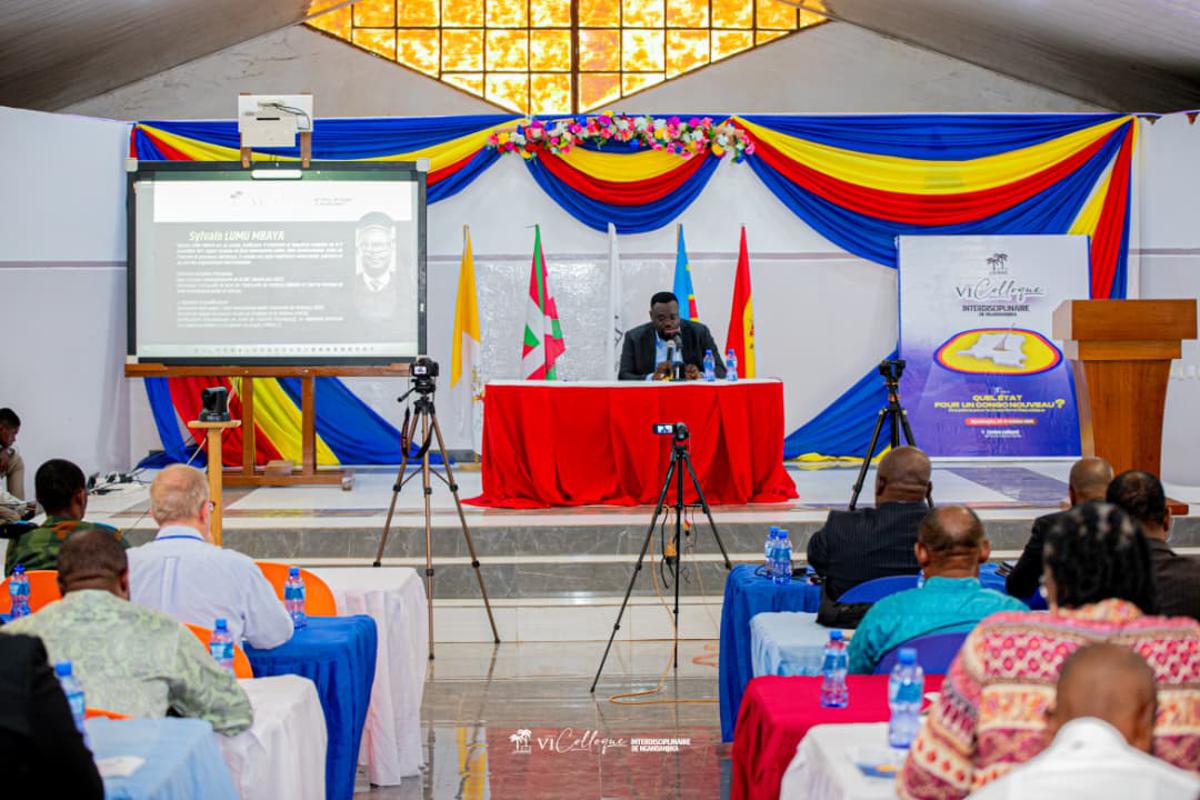
Colloque de Ngandajika: Famille Clé pour Refonder l'État Congolais
Summary
- Professor Dezzy Mukebayi spoke at the 6th interdisciplinary colloquium in Ngandajika, Kasaï-Central.
- He argued that the reconstruction of the Congolese state must fundamentally begin within families.
- Mukebayi urged parents to instill civic and moral values in their children.
- He also called for the state to provide greater support for families in their educational role.
The Ngandajika Colloquium on State Reconstruction
His argument posits that the rebuilding of the Congolese state, according to this perspective, is not solely a top-down governmental endeavor but fundamentally requires a bottom-up approach, starting with the foundational unit of society.
The 6th interdisciplinary colloquium held in Ngandajika, located in the Kasaï-Central province, recently served as a platform for significant discourse on the future of the Democratic Republic of Congo. A central theme emerged from the discussions, emphasizing the critical role of the family unit in the broader effort to rebuild the Congolese state. This academic gathering brought together various perspectives to explore foundational elements necessary for national development and stability.
Among the prominent voices at this event was Professor Dezzy Mukebayi, who holds the position of Dean of the Faculty of Law at the Official University of Mbuji-Mayi. Professor Mukebayi presented a compelling argument that the comprehensive reconstruction of the Congolese state, a process often referred to as the "refondation État congolais famille," must inherently commence at the most fundamental level of society: within its families. His address underscored the belief that national renewal is inextricably linked to the strength and values cultivated within households.
Family as the Bedrock of Civic Values
Professor Mukebayi’s intervention at the Colloque de Ngandajika highlighted the family as a crucial institution for fostering the civic and moral foundations essential for a robust state. He articulated a vision where the family unit acts as the primary educator, instilling in children the principles and ethics necessary for responsible citizenship. This perspective suggests that without a strong moral and civic upbringing at home, the broader societal structures will lack the necessary integrity and cohesion to support effective governance and national progress.
His argument posits that the rebuilding of the Congolese state, according to this perspective, is not solely a top-down governmental endeavor but fundamentally requires a bottom-up approach, starting with the foundational unit of society. The emphasis on the family’s role in civic education, or the "rôle éducatif famille RDC," is seen as a proactive measure to cultivate a generation equipped with the values to contribute positively to the nation's future. This theoretical framework underscores the profound impact of early education and socialization within the family context on the overall health and direction of the nation.
Dual Responsibilities: Parents and State
In his address, Professor Mukebayi outlined a dual responsibility for the successful implementation of this family-centric approach to state reconstruction. He specifically urged parents across the Democratic Republic of Congo to actively embrace their critical role in transmitting essential civic and moral values to their children. This call to action emphasizes the daily, ongoing efforts required within households to shape the character and ethical compass of future generations, thereby laying the groundwork for a more just and stable society.
Beyond individual parental duties, Professor Mukebayi also directed an appeal to the state itself. He advocated for increased and more effective governmental support for families, recognizing their indispensable educational function. This support, he argued, is vital to empower families to fulfill their role adequately, ensuring they have the resources and environment conducive to nurturing responsible citizens. The synergy between parental dedication and state assistance is presented as key to achieving the desired societal transformation and strengthening the "refondation État congolais famille" initiative.
Practical Implications
This article discusses a theoretical perspective on the family's role in the reconstruction of the Congolese state and civic education, as presented at an academic colloquium. It does not present any direct, actionable legal implications for lawyers or compliance officers, such as new legislation, regulatory changes, or case precedents to consider.
Source
How does this affect you?
Get an AI analysis of this article grounded in your jurisdictions, practice areas, and any policy documents you've uploaded to Wansom.
Finish Reading the Full Story and the Expert Analysis.
Wansom is AI and can make mistakes.