
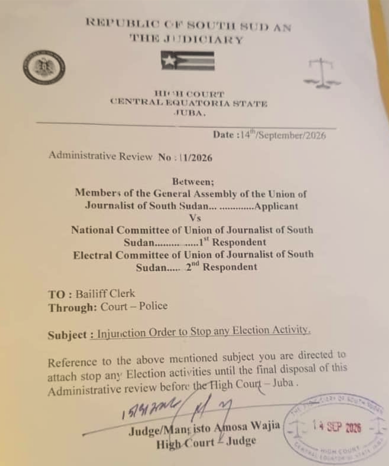
Juba High Court: Halts UJoSS Elections Over Administrative Review
Summary
- The High Court of Central Equatoria State in Juba issued an injunction on September 14, 2026, halting all electoral activities for the South Sudan Journalists Union (UJoSS).
- The order, Administrative Review No. 11/2026, was prompted by an appeal from UJoSS General Assembly members against the National and Election Committees.
- Appellants cited disputes over the union's constitution, non-compliance with regulatory orders, and a lack of transparency regarding financial reports and election committee formation.
- UJoSS President Oyet Patrick Charles expressed surprise but stated the union would respect the court's decision while pursuing a legal challenge.
- The elections were scheduled for September 16-18, 2026, following a contentious virtual General Assembly meeting held on July 15, 2026.
Juba High Court Halts Journalists' Union Elections
This case underscores the critical importance for trade unions and similar organizations to rigorously adhere to their constitutional provisions and regulatory directives, particularly concerning election procedures and financial transparency, to prevent legal challenges and injunctions.
The High Court of Central Equatoria State in Juba has issued a significant judicial decision, bringing all electoral activities for the South Sudan Journalists Union (UJoSS) to an immediate halt. This injunction, signed by Supreme Court Judge Mengistu Amosa Waja on September 14, 2026, specifically targets all arrangements and operations related to the upcoming elections. The court order, identified as Administrative Review No. 11/2026, mandates a complete cessation of electoral processes until a final determination is reached in the ongoing administrative review case.
This unexpected development occurred just as delegates from across South Sudan were converging in Juba for the UJoSS General Assembly, which was scheduled to commence on September 16 and conclude on September 18, 2026, with elections anticipated at its culmination. The court's intervention stems from an appeal and administrative review initiated by members of the Union’s General Assembly, who lodged their challenge against both the UJoSS National Committee and its Election Committee. UJoSS President Oyet Patrick Charles, when contacted, expressed surprise at the injunction but affirmed the union’s commitment to respecting the court’s decision, indicating that legal counsel would pursue a challenge to the ruling.
Underlying Causes of the Election Dispute
The judicial decision follows persistent calls from a segment of the General Assembly members for the union’s executive office, led by President Oyet Patrick and Secretary-General Majak Daniel Kwang, to address long-standing disputes concerning the UJoSS constitution and to ensure compliance with directives from the Registrar of Trade Unions at the Ministry of Justice. A statement from these General Assembly members welcomed the court’s intervention, characterizing it as a crucial and responsible measure to reinforce the rule of law, uphold democratic principles, and safeguard the union’s unity and independence.
Central to the UJoSS election dispute South Sudan are allegations that attempts were made to proceed with elections without the requisite submission and approval of financial and administrative reports to the General Assembly. Furthermore, members asserted that the electoral committee was formed without the General Assembly's explicit approval. They emphasized that the legitimacy of any election is not merely derived from its occurrence but from its strict adherence to the union’s constitution, relevant trade union election law South Sudan, and fundamental principles of transparency and integrity. The dissenting members have urged the UJoSS leadership and the election committee to fully comply with the Central Equatoria State High Court order and suspend all electoral procedures until all outstanding legal and regulatory issues are satisfactorily resolved.
Contentious Pre-Election Preparations
The path to these now-halted elections has been fraught with contention. On July 15, 2026, the Union of South Sudanese Journalists conducted a virtual General Assembly meeting. During this meeting, a series of resolutions were reportedly approved by a voting bloc comprising representatives from eight states and three administrative areas, with over 70 registered members in attendance. The union, in a statement, affirmed that a quorum was confirmed for this meeting, and the appointment and formation of the electoral committee were unanimously approved in accordance with the union’s 2013 constitution, as amended in 2024, and other pertinent electoral regulations. The period from September 16 to 18, 2026, was subsequently set for the national elections.
However, this process drew widespread criticism from journalists, particularly regarding the mechanism employed by the Executive Committee to pass the financial report and constitutional amendments, which were prerequisites for holding the elections. While the Executive Committee attributed its chosen mechanism to a shortage of resources, these arrangements and decisions ultimately became the subject of the legal dispute and judicial challenge before the High Court, culminating in the South Sudan Journalists Union election injunction.
Legal and Regulatory Significance
This case underscores the critical importance for trade unions and similar organizations to rigorously adhere to their constitutional provisions and regulatory directives, particularly concerning election procedures and financial transparency, to prevent legal challenges and injunctions. The Central Equatoria State High Court order serves as a potent reminder that internal governance structures and processes must withstand external scrutiny, especially when fundamental democratic principles like fair elections and accountability are at stake. The intervention by the Juba High Court halts UJoSS elections, thereby reinforcing the judiciary's role in ensuring that organizational activities, even within private associations, comply with established legal frameworks.
The General Assembly members' appeal, leading to Administrative Review No. 11/2026, highlights a broader concern about organizational integrity and the rule of law within civil society bodies in South Sudan. For legal advisors and compliance officers, this situation emphasizes the necessity of proactive review and strict adherence to internal bylaws and external regulatory requirements, such as those stipulated by the Registrar of Trade Unions, to mitigate risks of such disruptive legal challenges.
Practical Implications
This case highlights the critical importance for legal advisors to ensure that trade unions and similar organizations strictly adhere to their constitutional provisions and regulatory directives, particularly regarding election procedures and financial transparency, to prevent legal challenges and injunctions. Compliance officers should review internal governance structures to mitigate such risks.
Source
How does this affect you?
Get an AI analysis of this article grounded in your jurisdictions, practice areas, and any policy documents you've uploaded to Wansom.
Finish Reading the Full Story and the Expert Analysis.
Get the latest legal & regulatory intelligence in South Sudan
Wansom is AI and can make mistakes.