
SS Leaders: Seek Abyei Twic Border Dispute Legal Advice
Summary
- Vice-President Taban Deng Gai and Hon. Adau Deng Kuol recently urged communities in the Abyei Area and Twic County to resolve their border dispute through new court action.
- These calls for litigation overlook existing legal frameworks, including the 2005 Comprehensive Peace Agreement, the Abyei Boundary Commission report, and the Permanent Court of Arbitration's award.
- The Abyei Boundary Commission report, confirmed by the PCA, found no dispute regarding the southern border between Kordofan and Bhar el Ghazal as of January 1, 1956.
- The historical land dispute between North and South Sudan, which led to a 21-year war and over five million deaths, underscores the gravity of the issue.
- Legal professionals advising on the Abyei Twic border dispute must prioritize established international legal frameworks over recent political suggestions for new court proceedings.
Recent Calls for Judicial Resolution
For legal professionals advising on the Abyei Twic border dispute legal advice, it is paramount to rely on the established international legal frameworks rather than recent political pronouncements.
In Juba, South Sudan, two prominent political figures recently advocated for judicial intervention to resolve the long-standing Abyei Twic border dispute. Vice-President of the Republic of South Sudan, Taban Deng Gai, issued a public statement to the media on August 31, 2026, as reported by Eye Radio. He urged leaders from Twic County and the Dinka Ngok of Abyei to abandon confrontational rhetoric, stating, "Go to court, not war," and emphasized the need for peaceful and legal means to settle their boundary disagreements. Vice-President Deng characterized the ongoing land conflict between the Ngok and Twic communities as a "senseless war."
Similarly, on September 7, 2026, during the funeral rites for the late Mawien Machok, Hon. Adau Deng Kuol also addressed the issue, with her comments reported by Twic Media Reports (TMR). She called upon Twic Mayardit and Ngok Deng Kuol to submit their protracted land dispute to a court, suggesting that a judicial ruling could bring an end to the conflict. Hon. Kuol further expressed that the communities should prepare their evidence files, allowing a court to determine ownership of the contested land. She estimated that such a legal process might conclude within approximately seven months.
Established Legal Frameworks for the Abyei Border
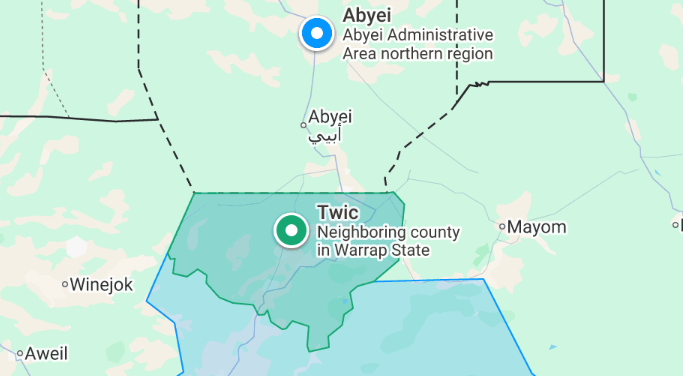
These recent calls for new court proceedings overlook a substantial body of established legal frameworks and prior adjudications concerning the South Sudan Abyei border legal status. Key among these are the Comprehensive Peace Agreement (CPA) of 2005, the subsequent report by the Abyei Boundary Commission (ABC), and the arbitral award issued by the Hague-based Permanent Court of Arbitration (PCA). These documents collectively address the final status of Abyei, including its boundaries between Kordofan in Sudan and areas south of the Kiir River in Bhar el Ghazal.
Crucially, the Abyei Boundary Commission report, though contested in 2009 by the Government of Sudan and the SPLM, contained definitive findings. For instance, there was no dispute regarding the southern border between Kordofan and Bhar el Ghazal, which was recognized as remaining unchanged from January 1, 1956, due to the absence of prior demarcation or delimitation in that specific area. Even when disagreements over the northern, eastern, and western boundaries led to the CPA 2005 Abyei arbitration, the Permanent Court of Arbitration Abyei upheld the ABC Experts' decision, affirming that they had not exceeded their mandate and reiterating that the southern border between Kordofan and Bhar el Ghazal remained undisputed.
The Inapplicability of New Judicial Action
The suggestions from Vice-President Taban Deng and Hon. Adau Deng Kuol for new court action appear to disregard these foundational legal resolutions. The assertion that the current conflict is "senseless" also overlooks the historical context, as the land dispute between North and South Sudan was a primary driver of a 21-year war, resulting in over five million casualties in the struggle to defend land, people, and resources. The Republic of South Sudan's current geographic borders with neighboring countries are historically rooted in the colonial lines of January 1, 1956.
Given the existing legal precedents, including the PCA's confirmation of the Abyei Boundary Commission report's findings, the premise for initiating new legal proceedings for the Twic Dinka Ngok land dispute law is questionable. The source suggests that urging communities to pursue legal action when there is no clear "cause of action for determination" based on prior, definitive rulings represents a significant oversight. The "legal wisdom" expressed by Hon. Adau, particularly her timeline for a resolution, lacks support from substantive legal provisions or established court rules, further highlighting the disconnect from existing frameworks.
Importance of Relying on Established Legal Precedents
For legal professionals advising on the Abyei Twic border dispute legal advice, it is paramount to rely on the established international legal frameworks rather than recent political pronouncements. The statements by Taban Deng Adau Deng Abyei statements, while seemingly advocating for peaceful resolution, introduce confusion by suggesting a path to litigation that may already be foreclosed by prior, binding decisions. Accurate counsel demands a thorough understanding of the CPA 2005 Abyei arbitration, the Abyei Boundary Commission report, and the Permanent Court of Arbitration Abyei award.
These existing legal instruments provide a clear South Sudan Abyei border legal status for significant portions of the contested territory. Lawyers must recognize that certain boundary issues have already received definitive legal resolutions. Therefore, any legal advice concerning the Twic Dinka Ngok land dispute law should guide parties toward understanding and implementing these established rulings, rather than encouraging new, potentially futile, judicial processes. This approach ensures that legal guidance is grounded in fact and precedent, preventing further misdirection in a highly sensitive and historically charged territorial disagreement.
Practical Implications
This article highlights the critical need for legal professionals advising on the Abyei-Twic border dispute to rely on established international legal frameworks, such as the CPA 2005, Abyei Boundary Commission report, and PCA arbitration, rather than recent political pronouncements suggesting new court action. It underscores that certain boundary issues may already have definitive legal resolutions, which lawyers must be aware of to provide accurate counsel.
Source
How does this affect you?
Get an AI analysis of this article grounded in your jurisdictions, practice areas, and any policy documents you've uploaded to Wansom.
Finish Reading the Full Story and the Expert Analysis.
Get the latest legal & regulatory intelligence in South Sudan
Wansom is AI and can make mistakes.