
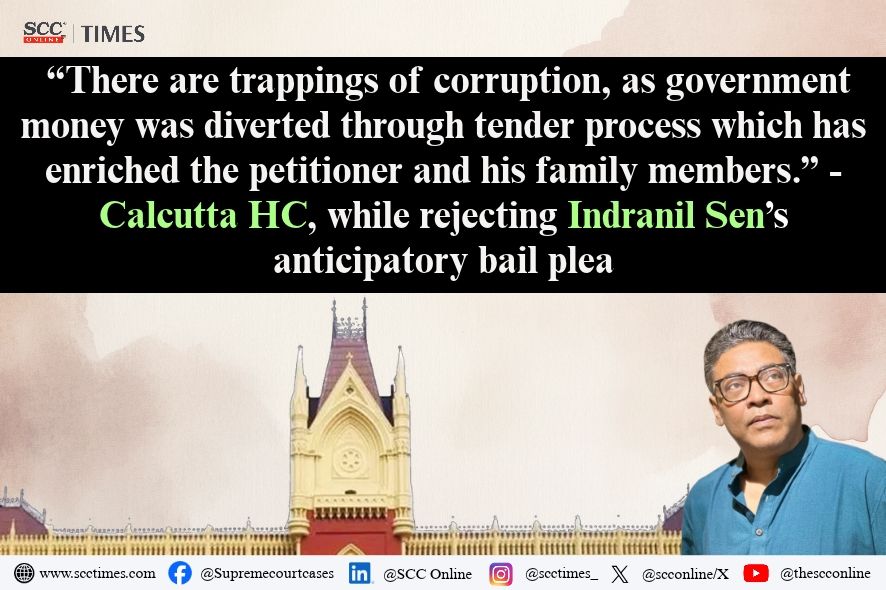
Calcutta High Court: Indranil Sen Denied Anticipatory Bail
Summary
- The Calcutta High Court denied anticipatory bail to former minister Indranil Sen, who was subsequently arrested on October 28, 2026.
- The court found a prima facie nexus between Sen and entities allegedly involved in diverting government funds.
- It was observed that an abuse of official position could not be ruled out at this stage of the proceedings.
- This decision reflects a stringent judicial approach to corruption charges against public officials in India.
What Happened
The Calcutta High Court's decision underscores a rigorous judicial stance against alleged corruption, particularly when there is a preliminary indication of a public official's involvement in the misuse of state resources.
The Calcutta High Court recently declined to grant anticipatory bail to Indranil Sen, a former minister, in a case involving significant corruption charges. Following the denial of anticipatory bail, Indranil Sen was arrested by Kolkata Police on October 28, 2026. This development highlights the judiciary's firm approach to allegations of financial impropriety by public figures.
The court's refusal was predicated on specific findings that established a preliminary connection between Sen, the petitioner, and various entities. These entities are reportedly implicated in the alleged diversion of government funds, a serious accusation that formed a central part of the court's consideration. The judicial body indicated that, at this initial stage of proceedings, the possibility of an abuse of official position India could not be dismissed.
The ruling emphasizes the gravity with which the court views cases where public office holders are linked to financial irregularities. The findings suggest that there was sufficient material to establish a prima facie nexus, warranting the denial of pre-arrest bail for the former minister.
Legal Context
In India, the provision for anticipatory bail allows an individual to seek pre-arrest bail if they apprehend arrest on non-bailable charges. However, the discretion to grant such relief is not absolute, particularly in cases involving serious economic offenses or allegations of corruption against public officials. The Calcutta High Court corruption ruling in this instance reflects a stringent application of legal principles.
The court's observation of a 'prima facie nexus' between the petitioner and entities allegedly involved in the diversion of government funds is a critical element. This indicates that there was enough initial evidence to suggest a plausible link, which significantly impacts the likelihood of an anticipatory bail refusal India. Such a finding often signals that the court perceives a genuine need for custodial interrogation or further investigation without the protection of pre-arrest bail.
Furthermore, the court's statement that an 'abuse of official position India' could not be ruled out at this stage underscores the judiciary's concern for maintaining public trust in governance. When allegations involve the misuse of public office for personal gain or the illicit diversion of government funds, courts tend to adopt a more cautious approach, prioritizing the integrity of the investigative process over individual liberty in the pre-arrest phase.
Why It Matters
The Calcutta High Court's decision underscores a rigorous judicial stance against alleged corruption, particularly when there is a preliminary indication of a public official's involvement in the misuse of state resources. This ruling sends a clear message about the heightened scrutiny that individuals holding public office can expect when facing Indranil Sen corruption charges.
This outcome is significant for its implications on future cases involving alleged corruption and the diversion of government funds. It reinforces the principle that a preliminary connection to illicit activities, especially those involving public money and an abuse of official position, can be a decisive factor in denying anticipatory bail. The Calcutta HC Indranil Sen anticipatory bail refusal serves as a precedent, highlighting the judiciary's commitment to addressing corruption allegations with seriousness.
The ruling also contributes to the broader discourse on accountability for public officials. It suggests that courts are increasingly less inclined to grant pre-arrest protection when there is a credible, initial link between a public servant and alleged financial misconduct, thereby strengthening the hand of investigative agencies in pursuing such cases.
Practical Implications
Lawyers advising public officials or those involved in government contracts should note the Calcutta HC's stringent approach to anticipatory bail in corruption cases, particularly where a prima facie nexus to fund diversion and abuse of official position is established. This indicates a heightened judicial scrutiny and a lower tolerance for such allegations, impacting defense strategies and emphasizing the need for robust compliance frameworks.
Source
Source: Original reporting via SCC Times
How does this affect you?
Get an AI analysis of this article grounded in your jurisdictions, practice areas, and any policy documents you've uploaded to Wansom.
Finish Reading the Full Story and the Expert Analysis.
Wansom is AI and can make mistakes.