
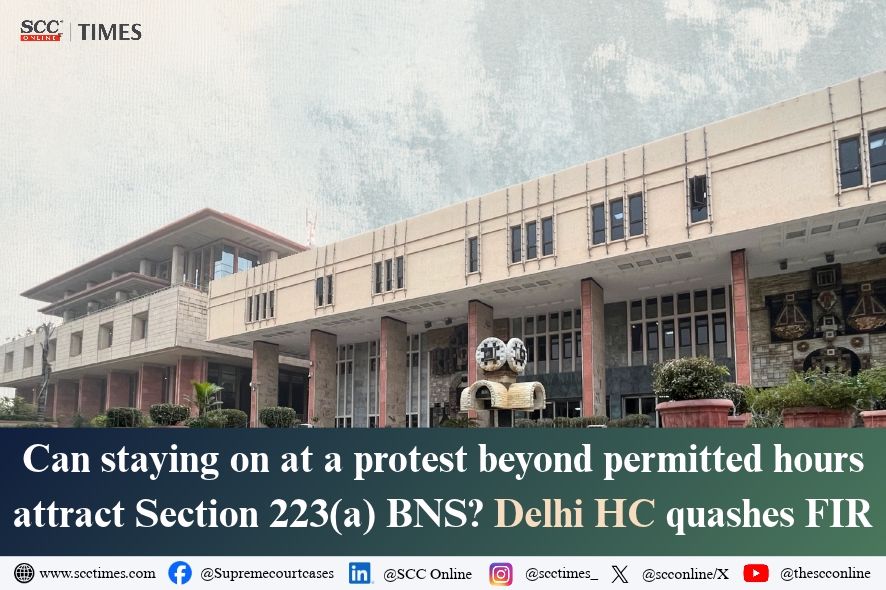
Delhi High Court: Quashes Protest FIR BNS, Mere Presence Not Offense
Summary
- The Delhi High Court recently quashed an FIR related to a protest.
- The court ruled that mere presence at a demonstration does not establish offenses under Sections 223(a) and 3(5) BNS.
- These sections concern disobedience of a duly promulgated order by a public servant.
- The decision clarifies the threshold for criminal liability in protest-related cases.
The Court's Decision
Lawyers should note this ruling clarifies that mere presence at a protest, even in situations where the demonstration might extend beyond permitted hours or designated areas, may not suffice to establish offenses under Sections 223(a) and 3(5) BNS.
The Delhi High Court recently delivered a significant ruling, quashing an FIR that had been lodged in connection with a protest. This decision, which directly addresses the threshold for criminal liability during public demonstrations, clarifies the application of specific provisions under the Bharatiya Nyaya Sanhita (BNS). The court's pronouncement centered on the principle that simply being present at a demonstration does not, by itself, constitute an offense under Sections 223(a) and 3(5) BNS. This ruling provides crucial clarity on what constitutes "disobedience of public servant order BNS" in the context of public assembly.
The quashed FIR had implicated individuals under these sections, which pertain to the disobedience of an order duly promulgated by a public servant. By setting aside the charges, the Delhi High Court has underscored the necessity for more than just "mere presence at protest FIR" to establish culpability. This judgment is poised to influence how law enforcement agencies approach cases arising from public gatherings and the subsequent legal challenges.
Understanding the Legal Framework
Sections 223(a) and 3(5) of the Bharatiya Nyaya Sanhita are pivotal provisions that address instances of non-compliance with directives issued by public authorities. Specifically, Section 223(a) deals with disobedience to an order lawfully promulgated by a public servant, if such disobedience causes or tends to cause obstruction, annoyance, or injury, or risk of obstruction, annoyance, or injury, to any person lawfully employed, or causes danger to human life, health, or safety, or causes a riot or affray. Section 3(5) BNS similarly targets acts of disobedience that undermine public order or safety. The essence of these sections is to ensure that lawful orders from public servants, designed to maintain peace and order, are respected.
However, the application of these sections requires a careful assessment of the alleged act of disobedience. The Delhi High Court's ruling emphasizes that the mere physical presence of an individual at a protest, without further evidence of active defiance or a specific act of disobedience, is insufficient to trigger the provisions of "Section 223(a) BNS protest" or "Section 3(5) BNS protest." This distinction is critical, as it differentiates between passive attendance and active contravention of a public servant's legitimate directive. The court's stance reinforces the principle that criminal liability must be predicated on a demonstrable act of non-compliance, rather than simply being in a particular location.
Broader Implications for Protests
This "Delhi High Court protest ruling" carries significant implications for both individuals participating in demonstrations and legal practitioners. By quashing the FIR, the court has effectively raised the bar for prosecuting individuals under Sections 223(a) and 3(5) BNS. It establishes that the threshold for proving "disobedience of a duly promulgated order by public servant" is not met by simple attendance at a gathering, even if that gathering might be deemed to have exceeded certain parameters. This provides a crucial precedent for defending clients facing charges related to participation in demonstrations, particularly concerning the threshold for 'disobedience of a duly promulgated order'.
Lawyers should note this ruling clarifies that mere presence at a protest, even in situations where the demonstration might extend beyond permitted hours or designated areas, may not suffice to establish offenses under Sections 223(a) and 3(5) BNS. This judicial interpretation safeguards the right to peaceful assembly by ensuring that individuals are not arbitrarily charged based solely on their attendance. The judgment reinforces the need for prosecuting authorities to present concrete evidence of active disobedience or specific actions that directly contravene a lawful order, moving beyond the broad allegation of "mere presence at protest FIR." This ruling will likely serve as a vital reference in future cases involving "Section 223(a) BNS protest" and "Section 3(5) BNS protest" across the country.
Practical Implications
Lawyers should note this ruling clarifies that mere presence at a protest, even beyond permitted hours, may not suffice to establish offenses under Sections 223(a) and 3(5) BNS. This provides a crucial precedent for defending clients facing charges related to participation in demonstrations, particularly concerning the threshold for 'disobedience of a duly promulgated order'.
Source
How does this affect you?
Get an AI analysis of this article grounded in your jurisdictions, practice areas, and any policy documents you've uploaded to Wansom.
Finish Reading the Full Story and the Expert Analysis.
Wansom is AI and can make mistakes.