
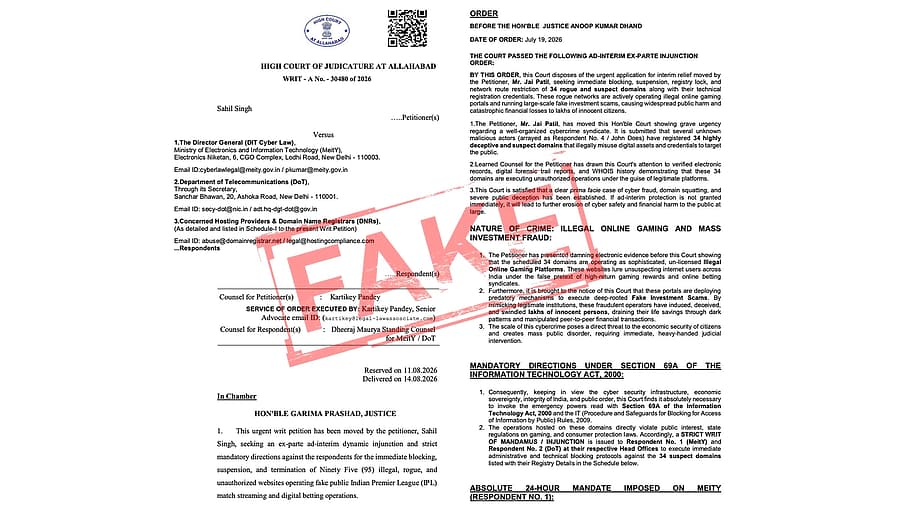
UP Police: FIR Filed for Forged Allahabad High Court Order
Summary
- UP Police has registered an FIR to investigate allegations that a forged Allahabad High Court order was used to block 95 websites.
- The fake order, purportedly from Justice Garima Prashad, was sent to the Department of Telecommunications by a lawyer identified as Senior Advocate Kartikey Pandey.
- The High Court confirmed through an internal investigation that no such order existed on its website or was ever passed by Justice Prashad.
- The criminal case is registered under multiple sections of the Bharatiya Nyaya Sanhita (BNS) pertaining to cheating and forgery of court records.
- A Reuters reporter initially discovered the fraudulent blocking order on the Department of Telecommunications website, prompting the High Court's inquiry.
What Happened
The fact that a reporter discovered the fake order on a government website before the High Court itself was aware underscores the critical need for robust authentication mechanisms for all official communications, particularly those purporting to be court orders.
Uttar Pradesh Police has initiated a criminal investigation into allegations that a forged Allahabad High Court order was utilized to prompt the Union government to block at least 95 websites. These websites were reportedly streaming counterfeit Indian Premier League (IPL) matches and operating illegal betting platforms.
The First Information Report (FIR) was officially registered on November 6, following a complaint submitted by a joint registrar of the Allahabad High Court. The Chief Justice had previously directed the registration of a criminal case concerning the matter on November 3. The High Court became aware of the issue after receiving an email on October 30 from Reuters technology reporter Munsif Vengattil, who sought confirmation regarding a blocking order he had discovered on the Department of Telecommunications website.
This fraudulent blocking order, dated September 2, referenced a High Court directive purportedly issued by Justice Garima Prashad. It was reportedly sent to the Department of Telecommunications by a lawyer who identified himself as Senior Advocate Kartikey Pandey. However, the High Court's subsequent internal investigation confirmed that no such order existed on its official website, and Justice Prashad's private secretary also verified that no such directive had ever been passed.
Legal Ramifications
The criminal case filed by the UP Police has been registered under several stringent provisions of the Bharatiya Nyaya Sanhita (BNS). Specifically, the FIR cites Sections 318(2), 336(2), 336(3), 337, 338, and 340(2) of the BNS.
These particular sections of the Bharatiya Nyaya Sanhita address a range of offenses related to cheating and forgery, with a significant emphasis on the falsification of official court records. The application of these comprehensive BNS sections underscores the severe legal consequences associated with attempting to manipulate judicial processes through fabricated documents, highlighting the judiciary's commitment to upholding the integrity of its orders.
Why It Matters
This incident, involving a fake Allahabad High Court order, highlights critical vulnerabilities within the systems designed for legal verification and digital communication. The attempt to use a fraudulent court directive to compel the Department of Telecommunications to execute a website takedown of 95 online platforms demonstrates the potential for sophisticated deception and the risks associated with unverified legal documents.
The fact that a reporter discovered the fake order on a government website before the High Court itself was aware underscores the critical need for robust authentication mechanisms for all official communications, particularly those purporting to be court orders. Such a scheme, if successful, could have led to the unwarranted blocking of numerous online platforms, causing substantial disruption and potential legal challenges for those affected. It also raises significant concerns about the ease with which individuals might attempt to manipulate official channels using fabricated legal documents, posing a direct threat to both judicial authority and public trust.
Practical Implications
This incident highlights the critical need for legal practitioners and compliance officers to meticulously verify the authenticity of all court orders, especially those received indirectly or from external sources, to prevent acting on fraudulent directives and to mitigate significant legal and reputational risks for their clients and firms.
Source
How does this affect you?
Get an AI analysis of this article grounded in your jurisdictions, practice areas, and any policy documents you've uploaded to Wansom.
Finish Reading the Full Story and the Expert Analysis.
Get the latest legal & regulatory intelligence in India
Wansom is AI and can make mistakes.