
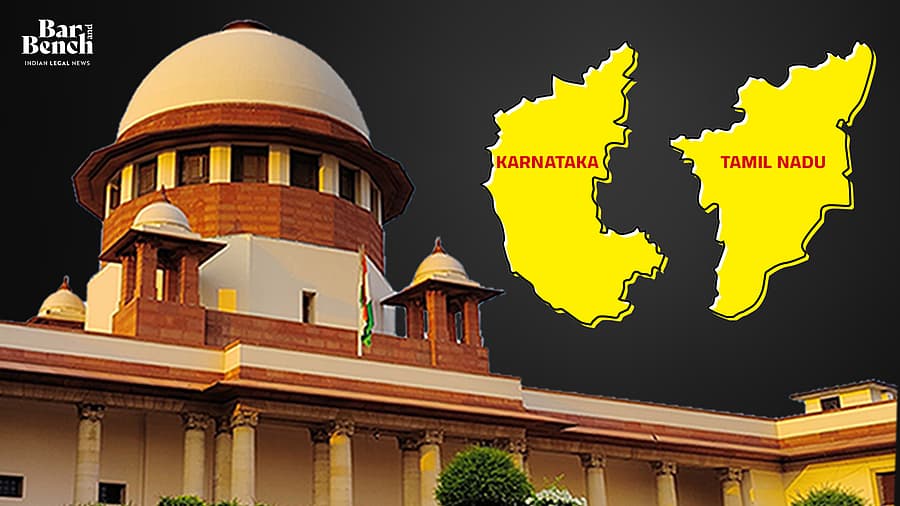
Supreme Court: Rejects Tamil Nadu's Plea for More Cauvery Water
Summary
- The Supreme Court dismissed Tamil Nadu's applications for additional Cauvery river water from Karnataka.
- Justices Vikram Nath and Aparesh Kumar Singh issued the order.
- Tamil Nadu claimed a shortfall of approximately 11 thousand million cubic feet (TMC) prevented irrigation, citing a rain-deficient year.
- Karnataka denied the allegations, stating it was complying with orders from the Cauvery Water Management Authority (CWMA).
- The long-standing dispute originates from 1892 and 1924 agreements and was previously addressed by a 2007 Tribunal award.
The Court's Decision
This latest Supreme Court judgment, delivered by Justices Vikram Nath and Aparesh Kumar Singh, effectively reinforces the existing mechanisms for water distribution.
The Supreme Court recently rejected applications filed by the Tamil Nadu government, which had sought the release of additional water from the Cauvery river by Karnataka. Justices Vikram Nath and Aparesh Kumar Singh presided over the bench that issued the order, with the Court declaring its decision by stating, "We have dismissed (the application)." This ruling came after Tamil Nadu had submitted two distinct applications, both aiming to secure directives for the immediate provision of its allocated share of Cauvery water.
In August, Tamil Nadu had formally alleged that it had not received its due water allocation from Karnataka, despite experiencing a year marked by insufficient rainfall. The state further contended that a deficit of approximately 11 thousand million cubic feet (TMC) had rendered it incapable of supplying any water for agricultural irrigation. Conversely, the Karnataka government refuted these accusations, asserting its full compliance with the directives issued by the Cauvery Water Management Authority (CWMA).
Historical Context of the Dispute
The long-standing contention between Karnataka and Tamil Nadu regarding the distribution of Cauvery river water traces its origins back to two historical agreements. These foundational pacts were established in 1892 and 1924, involving the then-existing Madras Presidency and the Princely State of Mysore. Following numerous unsuccessful attempts at negotiation between the successor states, the Supreme Court intervened, mandating the establishment of the Cauvery Water Disputes Tribunal.
This Tribunal subsequently issued its award in 2007, which stipulated that Tamil Nadu was entitled to draw a specific quantity of water on a daily basis. However, the resolution proved temporary, as the dispute persisted, with both states filing petitions to seek a review of the Tribunal's decision. The matter resurfaced in the Supreme Court in 2016, when Tamil Nadu once again lodged a petition.
Legal Framework and the Current Ruling
The recent dismissal by the Supreme Court underscores the judiciary's approach to established water allocation frameworks. Karnataka's defense, centered on its adherence to the Cauvery Water Management Authority's orders, highlights the significance of regulatory bodies in managing inter-state resource disputes. The CWMA plays a crucial role in overseeing the implementation of water-sharing arrangements, which were initially formalized through the Supreme Court-directed Tribunal.
This latest Supreme Court judgment, delivered by Justices Vikram Nath and Aparesh Kumar Singh, effectively reinforces the existing mechanisms for water distribution. It signals a reluctance to overturn or significantly modify established allocations through subsequent applications, particularly when a state claims compliance with the designated management authority. The decision implies that the established award and the CWMA's directives remain the primary legal basis for addressing the complex Cauvery water dispute.
Practical Implications
Lawyers advising state governments or entities involved in inter-state resource disputes should note this ruling reinforces the finality and difficulty of overturning established water allocation mechanisms through subsequent applications, even in cases of perceived shortfall. It underscores the importance of adhering to existing tribunal awards and CWMA directives, as judicial intervention for immediate relief may be limited.
Source
How does this affect you?
Get an AI analysis of this article grounded in your jurisdictions, practice areas, and any policy documents you've uploaded to Wansom.
Finish Reading the Full Story and the Expert Analysis.
Get the latest legal & regulatory intelligence in India
Wansom is AI and can make mistakes.