
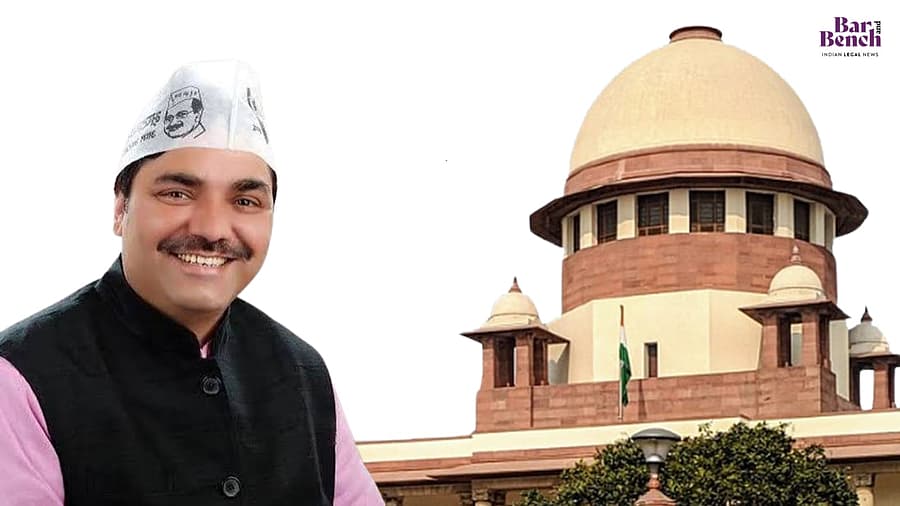
Supreme Court: Grants Naresh Balyan MCOCA Bail, Overturns Delhi HC Refusal
Summary
- The Supreme Court granted bail to AAP leader Naresh Balyan in a case under the Maharashtra Control of Organised Crime Act (MCOCA).
- This decision by Justices Vikram Nath and Aparesh Kumar Singh overturned a previous bail denial by the Delhi High Court.
- Balyan was arrested on December 4, 2024, for alleged links to an organized crime syndicate led by Kapil Sangwan.
- The prosecution accused Balyan of facilitating the syndicate by identifying extortion targets and orchestrating fraudulent property dealings.
- The Delhi High Court had previously denied bail, citing intercepted conversations indicating a clear connection between Balyan and the syndicate.
Supreme Court Grants Bail
Lawyers handling cases under the Maharashtra Control of Organised Crime Act should note this Supreme Court decision, as it provides a precedent for challenging bail denials in serious organized crime cases, even when lower courts have found a 'discernible nexus' to a crime syndicate.
The Supreme Court of India recently intervened in a high-profile case, granting bail to Naresh Balyan, a prominent Aam Aadmi Party (AAP) leader and former Member of the Legislative Assembly. This significant decision, delivered by a bench comprising Justice Vikram Nath and Justice Aparesh Kumar Singh, pertains to charges filed against Balyan under the stringent Maharashtra Control of Organised Crime Act (MCOCA). The ruling effectively overturned a previous decision by the Delhi High Court, which had refused to grant him pre-trial liberty.
The apex court's order came in response to a petition filed by Balyan, challenging the Delhi High Court's earlier denial of his bail application. While the specific details and full reasoning behind the Supreme Court's decision are still pending, the outcome marks a crucial development in the ongoing legal proceedings. The case, formally known as Naresh Balyan v. State NCT of Delhi, has drawn considerable attention due to the political stature of the accused and the serious nature of the charges under MCOCA.
Allegations and Prior Proceedings
Naresh Balyan's legal troubles began with his arrest on December 4, 2024, by the Delhi Police Crime Branch. Authorities accused him of having direct connections to an organized crime syndicate allegedly led by Kapil Sangwan, an absconding gangster also known as Nandu. The prosecution's case painted Balyan as a key "facilitator" within this criminal network, asserting that he played an instrumental role in identifying potential targets for extortion.
Further allegations against the former MLA included his involvement in the execution of fraudulent property agreements and the orchestration of forced property sales at significantly undervalued prices. Despite these serious accusations, Balyan has consistently maintained his innocence, vehemently denying any involvement in the alleged criminal activities and challenging the very application of the Maharashtra Control of Organised Crime Act to his situation.
High Court's Stance and Broader Implications
Prior to the Supreme Court's intervention, the Delhi High Court had, on August 3, declined Balyan's request for bail. In its ruling, the High Court noted that intercepted mobile conversations appeared to establish a clear link between Balyan and the alleged crime syndicate. The lower court also emphasized that prolonged detention alone could not be the decisive factor for granting bail in grave offenses, particularly those falling under special legislative frameworks like MCOCA, which are designed to combat organized crime with stricter provisions.
This Supreme Court decision, granting bail despite the Delhi High Court's finding of a "discernible nexus" and its strong stance on MCOCA cases, sets an important precedent. Lawyers handling cases under the Maharashtra Control of Organised Crime Act should note this Supreme Court decision, as it provides a precedent for challenging bail denials in serious organized crime cases, even when lower courts have found a 'discernible nexus' to a crime syndicate. This ruling may offer new avenues for argument in bail applications under special statutes. Earlier in March, another bench of the High Court had also expressed concerns regarding the pace of the investigation, directing the Delhi Police to accelerate their probe and provide a clear timeline for its completion.
Practical Implications
Lawyers handling cases under the Maharashtra Control of Organised Crime Act (MCOCA) should note this Supreme Court decision, as it provides a precedent for challenging bail denials in serious organized crime cases, even when lower courts have found a 'discernible nexus' to a crime syndicate. This ruling may offer new avenues for argument in bail applications under special statutes.
Source
How does this affect you?
Get an AI analysis of this article grounded in your jurisdictions, practice areas, and any policy documents you've uploaded to Wansom.
Finish Reading the Full Story and the Expert Analysis.
Get the latest legal & regulatory intelligence in India
Wansom is AI and can make mistakes.