
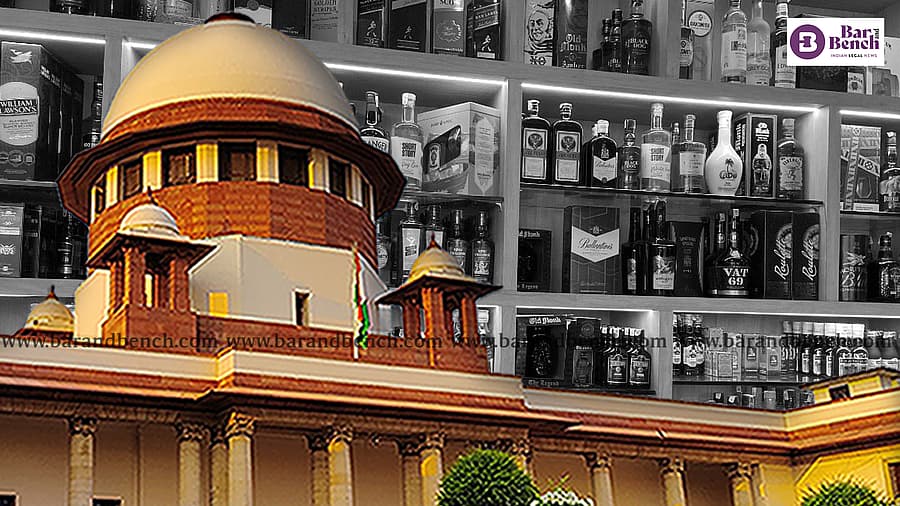
Supreme Court India: Mandates Centre's Response on Liquor Age Verification Plea
Summary
- The Supreme Court expressed concern over the Union government's non-appearance in a hearing regarding mandatory liquor age verification.
- A non-profit, Community Against Drunken Driving (CADD), filed the plea seeking a uniform age-check system at all alcohol-serving establishments nationwide.
- The court granted the Union government four weeks to respond and requested Solicitor General Tushar Mehta's involvement.
- The petition aims to prevent underage drinking and reduce incidents of drunk driving across the country.
- The next hearing for this significant case, which could lead to new compliance obligations, is scheduled in six weeks.
Judicial Scrutiny Over Age Verification Plea
The Supreme Court's pointed remarks and the directive for the Solicitor General to appear underscore the judiciary's serious view of the issue, signaling potential for significant regulatory shifts for liquor outlets, bars, pubs, and restaurants across India.
The Supreme Court of India recently voiced significant apprehension regarding the Union government's failure to engage in proceedings concerning a crucial petition. This plea advocates for the implementation of a nationwide mandatory age verification system at all liquor sales points. During the hearing, a bench comprising Justice Vikram Nath, Justice R Mahadevan, and Justice Aparesh Kumar Singh observed that despite formal notice being served to the Union Government, designated as Respondent 1 in the case, no legal representative appeared on its behalf.
Justice Nath explicitly questioned the government's commitment to the matter, stating, "It is an important issue. They don't take you seriously?" This pointed remark underscored the judiciary's concern over the apparent lack of seriousness from the Centre. The petitioner's counsel affirmed this sentiment, responding that "They are not taking the matter seriously." In light of this, the Court has now mandated the Union government to submit its response within a four-week timeframe.
Further emphasizing the gravity of the situation, the bench indicated its intention to formally request the Solicitor General of India, Tushar Mehta, to participate in the upcoming proceedings. The petitioner has been instructed to ensure a copy of the court's order is served directly to the Solicitor General's office. The next hearing for this pivotal case, titled Community Against Drunken Driving Versus The Union Of India And Ors., has been scheduled to take place in six weeks.
The Core of the Petition
The foundational petition driving this Supreme Court India liquor age verification plea was lodged by Community Against Drunken Driving (CADD), a non-profit organization dedicated to public safety. CADD's primary objective through this legal action is to secure a judicial directive for the establishment of a robust and mandatory age-verification framework. This system is envisioned for widespread application across all establishments involved in alcohol sales and service, specifically including liquor shops, bars, pubs, and restaurants.
The non-profit's plea is strategically designed to tackle two critical societal issues: the pervasive problem of underage drinking and the associated dangers of drunk driving incidents. By ensuring strict age checks at the point of sale or service, CADD aims to significantly curtail access to alcohol for minors, thereby reducing both immediate and long-term harms. A key argument presented in the petition highlights the current absence of a standardized, uniform mechanism for age verification across the country, leading to inconsistent enforcement and loopholes that facilitate underage alcohol consumption.
Implications for Compliance and Public Safety
The Supreme Court's strong stance and the specific directives issued in this case signal a potentially transformative moment for the regulation of alcohol sales in India. The judiciary's direct questioning of the Union government's seriousness, coupled with the request for Solicitor General Tushar Mehta's involvement, elevates the profile of this mandatory age checks liquor outlets India issue considerably. This indicates that the Court views the prevention of underage drinking and drunk driving as a matter of significant public interest, warranting high-level governmental attention.
For compliance officers and legal counsel representing liquor outlets, bars, pubs, and restaurants in India, this development is particularly pertinent. The outcome of this underage drinking prevention Supreme Court case could introduce new, stringent compliance obligations, potentially requiring significant operational adjustments to implement uniform and effective age verification systems. The emphasis on a national, mandatory system suggests that ad-hoc or localized approaches may no longer suffice, pushing for a more harmonized and rigorously enforced regulatory environment designed to enhance public safety and curb alcohol-related harms.
Practical Implications
Compliance officers and legal counsel for liquor outlets, bars, pubs, and restaurants in India should closely monitor this Supreme Court case, as it signals a potential for new mandatory age verification systems and increased compliance obligations to prevent underage drinking.
Source
How does this affect you?
Get an AI analysis of this article grounded in your jurisdictions, practice areas, and any policy documents you've uploaded to Wansom.
Finish Reading the Full Story and the Expert Analysis.
Get the latest legal & regulatory intelligence in India
Wansom is AI and can make mistakes.