
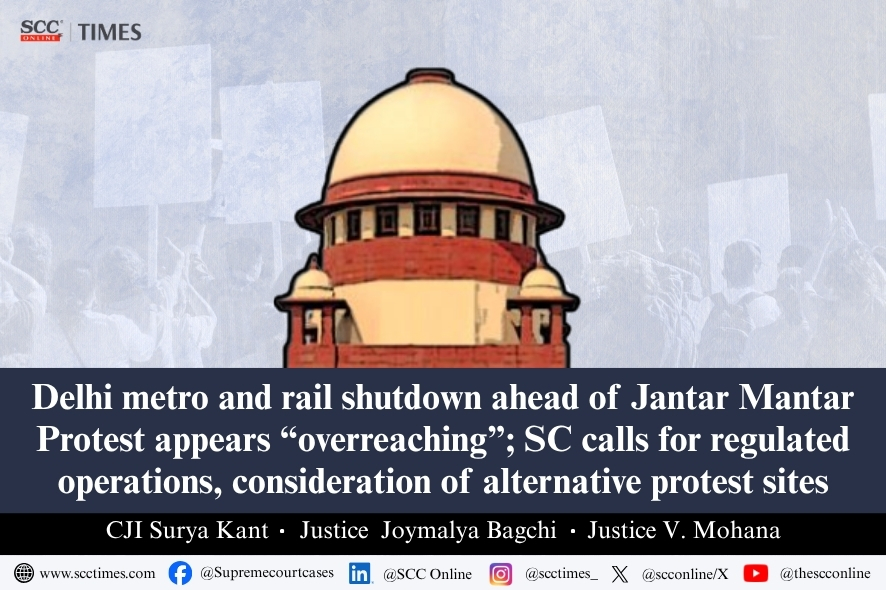
SC: Delhi Metro Jantar Mantar Protest Regulation Compliance Report Mandated
Summary
- The Supreme Court directed DMRC, Railway authorities, and Delhi Police (Traffic) to file a compliance report.
- This report is due within four days regarding actions taken ahead of a Jantar Mantar protest.
- The Court deemed the pre-emptive shutdown of Delhi metro and rail services as potentially "overreaching."
- The Supreme Court called for regulated operations instead of blanket bans.
- Authorities were also urged to consider alternative protest sites.
Judicial Intervention Regarding Protest Management
The Supreme Court characterized these actions as potentially "overreaching," suggesting that the extent of the disruption caused by the ban on DMRC railway services might have been disproportionate to the perceived threat or need.
The Supreme Court of India has issued a significant directive concerning the management of public protests in the national capital, specifically in anticipation of a planned demonstration at Jantar Mantar. The apex court mandated that the Delhi Metro Rail Corporation (DMRC), along with general Railway authorities and the Delhi Police (Traffic) department, submit a detailed compliance report. This report is required to be filed within a strict four-day timeframe, indicating the urgency and close judicial oversight the Court is exercising over the matter.
This judicial intervention was prompted by concerns surrounding the pre-emptive measures taken by authorities, which included a shutdown of Delhi metro and rail services. The Supreme Court characterized these actions as potentially "overreaching," suggesting that the extent of the disruption caused by the ban on DMRC railway services might have been disproportionate to the perceived threat or need. The Court's observation underscores a critical examination of how public services are impacted in the lead-up to and during public assemblies.
The directive for a compliance report is a clear signal from the Supreme Court that it intends to scrutinize the operational decisions made by these key public service providers and law enforcement agencies. This move aims to ensure that future responses to planned protests, particularly those involving significant public inconvenience like transport shutdowns, are conducted within appropriate legal and operational boundaries. The focus is on accountability and the justification for such extensive measures.
Balancing Public Order and Fundamental Rights
The Supreme Court's assessment that the pre-emptive shutdown of metro and rail services appeared "overreaching" highlights a fundamental tension between maintaining public order and upholding the constitutional right to protest in India. The Court's stance suggests a judicial inclination to protect the democratic space for dissent, even while acknowledging the state's legitimate interest in preventing chaos or violence. This delicate balance is a recurring theme in the jurisprudence surrounding public demonstrations.
In response to the perceived excess, the Supreme Court specifically called for "regulated operations" rather than outright bans or shutdowns. This implies a preference for more nuanced and less disruptive methods of managing public gatherings. The Court's guidance suggests that authorities should explore strategies that allow for the continuation of essential public services while simultaneously facilitating the exercise of the right to protest.
Furthermore, the Court emphasized the "consideration of alternative protest sites." This aspect of the ruling points towards a proactive approach to protest management, where designated or suitable locations could be identified and utilized to minimize disruption to urban life and public transport infrastructure. Such a strategy could help prevent scenarios where authorities feel compelled to impose widespread service interruptions, thereby addressing the core issue that led to the DMRC railway services ban SC.
Implications for Future Protest Management
The Supreme Court's directive for a compliance report, coupled with its observations on "overreaching" measures, sets a precedent for how future protests in Delhi, and potentially across India, will be managed. This ruling signals to the Delhi Metro Rail Corporation, the broader Railway authorities, and the Delhi Police (Traffic) that their operational decisions during public demonstrations will be subject to rigorous judicial review. It underscores the importance of adopting strategies that are both effective in maintaining order and respectful of citizens' rights.
The call for "regulated operations" and the "consideration of alternative protest sites" will likely influence the development of new protocols for protest management. Authorities may need to revise their standard operating procedures to incorporate less restrictive measures than blanket transport shutdowns. This judicial guidance aims to foster a more balanced approach to SC Delhi metro Jantar Mantar protest regulation, ensuring that public services remain accessible while legitimate protests can proceed.
The requirement for the Delhi Police Traffic compliance report within four days is particularly crucial. It places an immediate burden on the police to justify their actions and demonstrate how they plan to adhere to the Supreme Court's guidance. This report will serve as a benchmark for assessing the authorities' responsiveness to judicial oversight and their commitment to implementing more proportionate and rights-respecting methods of protest regulation. The broader implication is a shift towards more thoughtful and less disruptive protest management strategies, guided by the Supreme Court's emphasis on balancing rights with public safety.
Practical Implications
Lawyers advising protest organizers or public transport authorities should be aware of the Supreme Court's intervention, which signals judicial scrutiny of 'overreaching' measures like transport shutdowns and emphasizes regulated operations and consideration of alternative protest sites. This ruling could influence future protest management strategies and related legal challenges.
Source
Source: Original reporting via SCC Times
How does this affect you?
Get an AI analysis of this article grounded in your jurisdictions, practice areas, and any policy documents you've uploaded to Wansom.
Finish Reading the Full Story and the Expert Analysis.
Get the latest legal & regulatory intelligence in India
Wansom is AI and can make mistakes.