
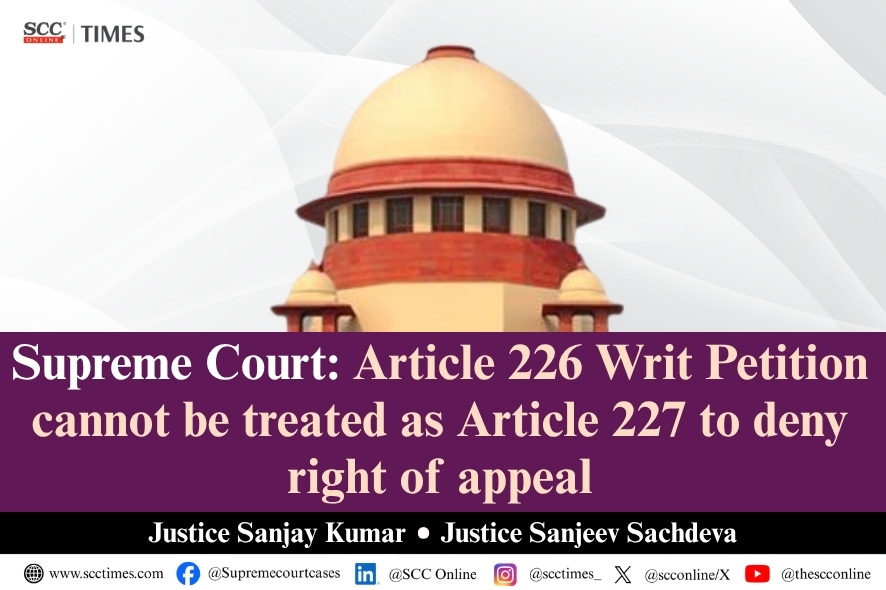
Supreme Court: Article 226 Appeal Denial Blocked, Revenue Court Writs Upheld
Summary
- The Supreme Court has ruled that a writ petition filed under Article 226 cannot be treated as one under Article 227 to deny an appellate remedy.
- This decision prevents courts from re-characterizing petitions to strip litigants of their right to appeal.
- Orders issued by Revenue Courts can be challenged through writ petitions under Article 226.
- Article 226 grants High Courts broad original writ jurisdiction, while Article 227 provides supervisory jurisdiction over lower courts and tribunals.
- The ruling ensures that challenges to Revenue Court orders under Article 226 retain their inherent appealability.
Supreme Court Upholds Appellate Rights
The Supreme Court's definitive ruling ensures that a writ petition properly filed under Article 226 cannot be re-characterized as one under Article 227, thereby safeguarding the crucial right to an appellate remedy for litigants.
India's Supreme Court has issued a significant ruling clarifying the distinct nature of writ petitions filed under Article 226 of the Constitution, affirming that such petitions cannot be re-categorized as those under Article 227. This pivotal decision directly addresses attempts to deny litigants their fundamental right to an appellate remedy by mischaracterizing the jurisdictional basis of their challenge. The highest court's pronouncement ensures that the avenue for appeal remains open for cases properly initiated under Article 226.
The ruling specifically states that a writ petition lodged under Article 226 cannot be treated as if it were filed under Article 227, particularly when such a re-characterization would lead to the denial of an appellate remedy. This clarification is crucial for maintaining the integrity of the judicial process and safeguarding the rights of individuals seeking redress through the High Courts. The Supreme Court's stance reinforces the principle that procedural technicalities should not undermine substantive legal rights.
Furthermore, the Supreme Court explicitly confirmed that orders emanating from Revenue Courts are amenable to challenge through a writ petition filed under Article 226. This aspect of the ruling provides clear guidance for individuals and legal practitioners in India, ensuring that decisions from these specialized tribunals can be subjected to the High Courts' extensive writ jurisdiction, thereby preserving the possibility of an Article 226 writ petition appeal.
Distinguishing Writ Jurisdictions
To fully appreciate the impact of this Supreme Court Article 226 appeal denial prevention, it is essential to understand the distinct powers conferred upon High Courts by Articles 226 and 227 of the Indian Constitution. Article 226 grants High Courts the power to issue various writs, including habeas corpus, mandamus, prohibition, quo warranto, and certiorari, for the enforcement of fundamental rights or for 'any other purpose.' This jurisdiction is broad and original, allowing High Courts to intervene in a wide array of matters to ensure justice and uphold the rule of law.
In contrast, Article 227 confers upon High Courts the power of superintendence over all courts and tribunals within their territorial jurisdiction. This is primarily a supervisory jurisdiction, intended to ensure that lower courts and tribunals function within the bounds of their authority and in accordance with the law. While Article 227 allows High Courts to correct errors of jurisdiction or grave procedural irregularities, it is generally considered a narrower power than Article 226, often invoked in cases where no other remedy is available.
The critical distinction between these two articles lies in their nature and, significantly, their appealability. Petitions filed under Article 226, being an exercise of original jurisdiction, typically carry a right of appeal to a higher forum, such as a Division Bench of the High Court or, in certain circumstances, the Supreme Court itself. Conversely, challenges brought under Article 227, being supervisory in nature, often face limitations on their writ petition appealability, with appellate remedies sometimes being more restricted or even unavailable. This difference forms the crux of the Supreme Court's recent clarification, preventing the erosion of appellate rights through jurisdictional misclassification.
Preserving the Right to Appeal
The Supreme Court's definitive ruling ensures that a writ petition properly filed under Article 226 cannot be re-characterized as one under Article 227, thereby safeguarding the crucial right to an appellate remedy for litigants. This decision is particularly vital for individuals challenging Revenue Court orders in India, as it confirms that their recourse through Article 226 maintains its full legal character and associated appeal mechanisms. Without this clarity, there was a risk that High Courts might re-designate petitions, inadvertently or otherwise, to circumvent the availability of an appeal, effectively denying a fundamental legal safeguard.
By preventing the treatment of an Article 226 petition as an Article 227 supervisory jurisdiction matter for the purpose of denying an appeal, the Indian Supreme Court reinforces the importance of access to justice and the multi-tiered appellate structure. This ruling provides a clear directive to High Courts across the country, ensuring consistency in the application of writ jurisdiction and protecting the procedural rights of petitioners. It underscores that the substantive nature of the relief sought and the constitutional provision invoked must be respected, rather than allowing a re-labeling that curtails remedies.
Practical Implications
This ruling clarifies that lawyers can confidently file Article 226 petitions against Revenue Court orders, ensuring their clients retain the crucial right to appeal. Courts cannot re-characterize such petitions under Article 227 to deny this fundamental remedy.
Source
Source: Original reporting via SCC Times
How does this affect you?
Get an AI analysis of this article grounded in your jurisdictions, practice areas, and any policy documents you've uploaded to Wansom.
Finish Reading the Full Story and the Expert Analysis.
Wansom is AI and can make mistakes.