
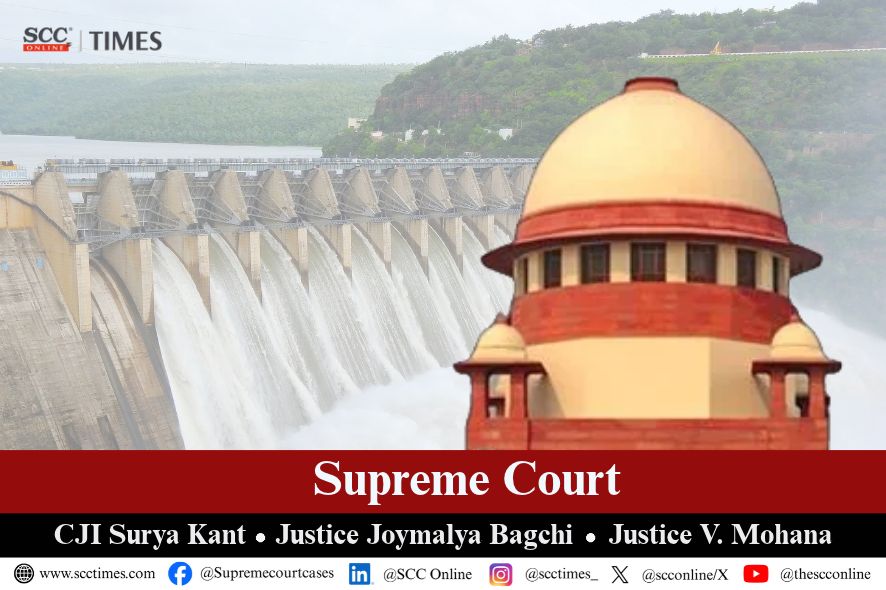
Supreme Court: Bhakra-Beas Energy Arrears Order for Punjab, Haryana, Himachal
Summary
- The Supreme Court has directed Punjab and Haryana to supply energy arrears to Himachal Pradesh.
- The total energy arrears to be supplied, after adjustment, amount to approximately 11,973 million units of electricity.
- This supply is mandated to occur over a period of 20 lean seasons.
- The directive includes an adjustment for Himachal Pradesh's capital-cost liability of ₹420.77 crores.
- This ruling resolves a long-standing Bhakra-Beas power allocation dispute among the states.
Judicial Resolution in Inter-State Power Dispute
Lawyers advising state governments or public sector undertakings involved in inter-state resource allocation should analyze this Supreme Court precedent for its implications on similar long-standing disputes concerning energy or other shared resources, particularly regarding the calculation and enforcement of arrears and capital cost adjustments.
The Supreme Court of India has delivered a pivotal ruling in the long-running Bhakra-Beas power dispute, issuing a clear directive for the states of Punjab and Haryana. The apex court has mandated that these two states supply a substantial quantity of energy arrears, specifically approximately 11,973 million units of electricity, to Himachal Pradesh, after factoring in Himachal Pradesh's capital-cost liability. This significant energy transfer is scheduled to occur over a period of 20 lean seasons, establishing a structured and phased approach to address the historical deficit. This resolution directly tackles the Supreme Court Bhakra-Beas energy arrears that have been a point of contention for years.
A critical component of the Supreme Court's order involves a financial adjustment. The total energy arrears that Punjab and Haryana are obligated to provide will be determined after factoring in Himachal Pradesh's capital-cost liability, which has been quantified at ₹420.77 crores. This comprehensive approach ensures that both the energy deficit and the financial obligations are meticulously balanced, offering a definitive resolution to a complex aspect of the Punjab Haryana Himachal Pradesh power sharing arrangement. The ruling underscores the judiciary's role in untangling intricate inter-state resource allocation challenges.
Context of the Bhakra-Beas Allocation
The Bhakra-Beas power dispute has been a subject of contention among the northern Indian states for an extended period, reflecting the intricate challenges inherent in the allocation of shared natural resources. This particular case revolves around the equitable distribution of power generated from the Bhakra-Beas management projects, which are vital for the energy security and agricultural needs of the region. Such inter-state power dispute India cases often involve complex historical agreements, evolving demand patterns, and the need for judicial intervention to ensure fairness and compliance.
The Supreme Court's engagement in this matter underscores the judiciary's role in mediating disputes that have significant economic and developmental implications for multiple states. The long-standing nature of the Bhakra-Beas power dispute highlights the difficulties in achieving consensus on resource sharing without a definitive legal pronouncement. This ruling provides a clear framework for the involved parties to move forward, addressing a critical aspect of their power-sharing arrangements.
Implications for Resource Sharing
The Supreme Court power allocation judgment holds considerable weight as a precedent for managing historical energy arrears and capital cost adjustments within inter-state resource disputes. The precise directive to supply 11,973 MU energy arrears over a specific timeframe, combined with a clearly defined financial offset, illustrates a thorough methodology for resolving intricate claims. This detailed approach could well serve as a blueprint for future cases involving shared infrastructure and the distribution of vital resources among different states.
This decision not only brings closure to a particular dispute but also offers crucial clarity on the principles of accountability and equitable distribution in such scenarios. Lawyers advising state governments or public sector undertakings involved in inter-state resource allocation should analyze this Supreme Court precedent for its implications on similar long-standing disputes concerning energy or other shared resources, particularly regarding the calculation and enforcement of arrears and capital cost adjustments. The comprehensive nature of the ruling, which carefully balances energy supply with financial obligations, provides invaluable insights for developing legal strategies in comparable situations across India.
Practical Implications
Lawyers advising state governments or public sector undertakings involved in inter-state resource allocation should analyze this Supreme Court precedent for its implications on similar long-standing disputes concerning energy or other shared resources, particularly regarding the calculation and enforcement of arrears and capital cost adjustments.
Source
Source: Original reporting via SCC Times
How does this affect you?
Get an AI analysis of this article grounded in your jurisdictions, practice areas, and any policy documents you've uploaded to Wansom.
Finish Reading the Full Story and the Expert Analysis.
Get the latest legal & regulatory intelligence in India
Wansom is AI and can make mistakes.