
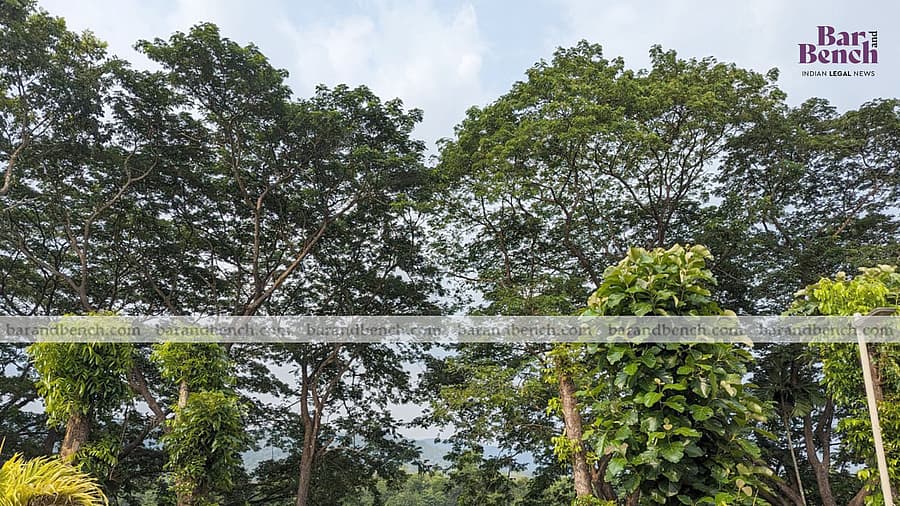
Supreme Court: Aarey IICT Project of National Importance
Summary
- The Supreme Court has characterized the proposed Indian Institute of Creative Technologies (IICT) campus in Mumbai's Film City as a project of "eminent national importance."
- The project requires felling 124 trees and transplanting 333 trees, according to an application by the Municipal Corporation of Greater Mumbai's Tree Authority.
- The Court emphasized the need to balance development with environmental safeguards, suggesting an independent agency for compensatory afforestation.
- No permission for tree felling has been granted yet, and responses from involved parties are due within two weeks.
- The IICT is envisioned as India's emerging center of excellence for animation, visual effects, gaming, comics, and extended reality.
Recent Supreme Court Deliberations
The Court's explicit labeling of the IICT campus as a 'project of national importance India' sets a precedent for how such designations might influence judicial considerations when environmental concerns clash with developmental goals.
The Supreme Court recently weighed in on an application concerning tree removal and transplantation for a significant development in Mumbai. A bench comprising Chief Justice of India Surya Kant, alongside Justices Joymalya Bagchi and V Mohana, heard the plea submitted by the Tree Authority of the Municipal Corporation of Greater Mumbai (MCGM). This application is part of the ongoing suo motu Aarey tree-felling matter, which has garnered considerable public attention regarding environmental preservation in urban development.
The IICT Project and its National Significance
Central to the Court's discussion was the nature of the Indian Institute of Creative Technologies itself. The IICT is envisioned as India's premier hub for excellence in animation, visual effects, gaming, comics, and extended reality (AVGC-XR). Recognizing its potential contribution, Chief Justice Kant specifically characterized the proposed IICT campus as a "project of eminent national importance." This designation highlights the judiciary's acknowledgment of the strategic value of such initiatives for national growth and technological advancement.
The Tree Authority's submission clarified that the specific plot designated for the IICT campus is located within Film City and is distinct from the Aarey forest area, which has been at the center of previous environmental disputes. This geographical distinction was presented to underscore that the proposed tree felling and transplantation would not directly impact the core Aarey forest, despite being in its vicinity.
Balancing Development with Environmental Safeguards
While acknowledging the project's national importance, the Supreme Court simultaneously underscored the critical need to strike a balance between developmental imperatives and environmental protection. Chief Justice Kant articulated that for projects deemed to be of national significance, an effective balance could be achieved by entrusting the implementation of the compensatory afforestation plan to an independent agency. This suggestion points towards a mechanism for ensuring environmental commitments are met objectively and robustly.
At this juncture, the Court has not granted permission for any tree felling. Instead, it has issued a formal notice regarding the application. The State of Maharashtra, along with various petitioners and intervenors involved in the Aarey tree-felling case, have been given a two-week period to submit their respective responses to the Tree Authority's application. This procedural step indicates a thorough review process before any final decision is made on the proposed tree removal and transplantation.
Implications for Future Large-Scale Projects
This development in the Supreme Court's handling of the Aarey tree-felling case carries significant implications for future large-scale infrastructure and development projects across India. The Court's explicit labeling of the IICT campus as a "project of national importance India" sets a precedent for how such designations might influence judicial considerations when environmental concerns clash with developmental goals. It suggests a judicial willingness to weigh the broader national interest in specific project approvals.
The emphasis on an independent agency for compensatory afforestation plans also signals a potential shift towards more rigorous and transparent environmental mitigation strategies. Lawyers advising on projects requiring environmental clearances, particularly those with significant tree removal or transplantation components, should closely monitor the outcome of this case. It could shape future requirements for environmental impact assessments and the execution of compensatory measures, especially where the "Supreme Court environmental balance" between progress and preservation is sought.
Practical Implications
This development indicates the Supreme Court's willingness to weigh 'national importance' against environmental concerns in project approvals. Lawyers advising on large-scale infrastructure or development projects with environmental impacts should monitor this case for potential precedents regarding environmental clearances and compensatory afforestation requirements.
Source
How does this affect you?
Get an AI analysis of this article grounded in your jurisdictions, practice areas, and any policy documents you've uploaded to Wansom.
Finish Reading the Full Story and the Expert Analysis.
Get the latest legal & regulatory intelligence in India
Wansom is AI and can make mistakes.