
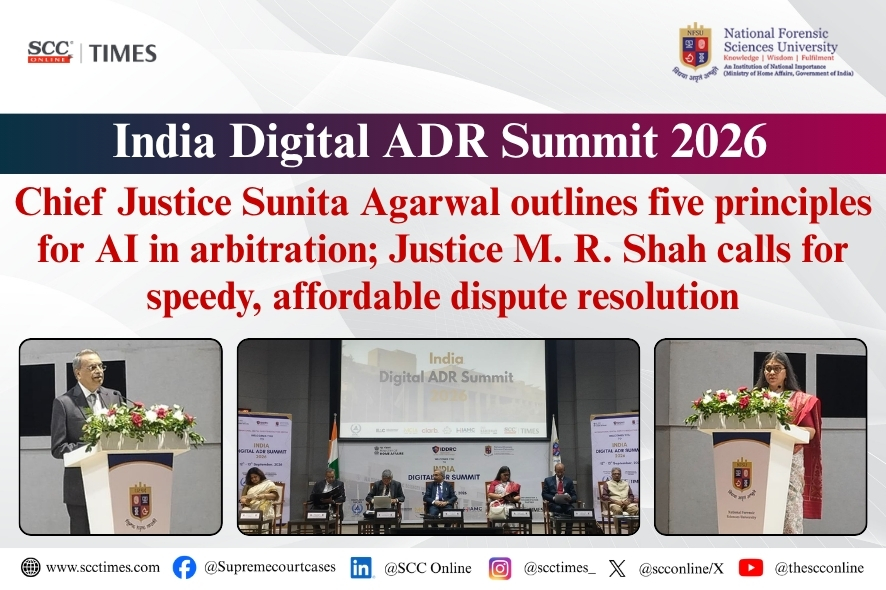
Chief Justice Sunita Agarwal: 5 AI Arbitration Principles for India
Summary
- Chief Justice Sunita Agarwal emphasized the necessity of balancing artificial intelligence with human judgment in arbitration.
- She also outlined five specific principles for the application of AI in arbitration.
- Former Justice M. R. Shah cautioned that AI should not supplant the human mind in legal processes.
- Former Justice Shah additionally advocated for dispute resolution mechanisms that are both speedy and affordable.
- These significant statements were delivered during the India Digital ADR Summit 2026.
Judicial Guidance on AI in Arbitration
These judicial insights are poised to significantly influence the development of ethical guidelines and best practices for AI adoption within the arbitration landscape.
At the recent India Digital ADR Summit 2026, senior judicial figures offered crucial perspectives on the integration of artificial intelligence into arbitration processes. Chief Justice Sunita Agarwal articulated the vital need to strike a careful balance between the capabilities of artificial intelligence and the indispensable role of human judgment within arbitration. Her address further included the outlining of five specific principles intended to guide the application of AI in this critical legal domain.
Concurrently, former Justice M. R. Shah delivered a strong caution regarding the deployment of AI, emphasizing that such technology must not be allowed to replace the human mind in legal decision-making. Beyond this cautionary note, former Justice Shah also underscored the broader imperative for dispute resolution systems to be both swift and economically accessible. These pronouncements from prominent members of the judiciary signal a proactive engagement with the evolving landscape of legal technology.
The insights shared by Chief Justice Agarwal and former Justice Shah at the summit highlight a growing recognition within the judiciary of both the potential benefits and inherent challenges associated with leveraging AI in dispute resolution. Their statements lay foundational markers for how AI tools should be approached and integrated, ensuring that technological advancement aligns with core legal principles and human oversight.
The Evolving Landscape of AI in Dispute Resolution
The discussions at the India Digital ADR Summit 2026 reflect a broader global trend towards incorporating artificial intelligence into various facets of the legal profession, particularly in alternative dispute resolution. The emphasis by Chief Justice Sunita Agarwal on balancing AI with human judgment speaks directly to a central concern in legal tech: how to harness AI's efficiency without compromising the nuanced, ethical, and empathetic elements that human arbitrators bring to complex disputes. This balance is crucial for maintaining trust and fairness in the arbitration process.
Former Justice M. R. Shah's assertion that AI should not replace the human mind resonates with widespread debates about maintaining human agency and accountability in AI-driven systems. In the context of arbitration, this means ensuring that while AI can assist with data analysis, document review, or even predictive analytics, the ultimate decision-making authority and the responsibility for justice remain firmly with human professionals. This perspective is vital for developing AI tools that augment, rather than diminish, the role of legal experts.
Furthermore, former Justice Shah's call for speedy and affordable dispute resolution highlights a key driver behind the adoption of AI in legal services. AI is often presented as a solution to reduce costs and accelerate proceedings, making justice more accessible. However, the judicial caveats provided at the summit indicate that this pursuit of efficiency must be tempered with careful consideration of ethical boundaries and the preservation of human oversight, ensuring that the quest for speed does not compromise the quality or integrity of the resolution process.
Implications for Future AI Adoption and Ethical Frameworks
The judicial perspectives articulated at the India Digital ADR Summit 2026 are poised to significantly influence the development of ethical guidelines and best practices for AI adoption within the arbitration landscape. Chief Justice Sunita Agarwal's outlining of five principles for AI in arbitration, coupled with her focus on balancing AI with human judgment, provides a clear signal about the judiciary's evolving stance on these technologies. Legal professionals and technology developers alike will need to pay close attention to these emerging principles, as they are likely to shape future regulatory frameworks and industry standards.
Former Justice M. R. Shah's insistence that AI should not supplant the human mind serves as a foundational ethical directive for any legal tech innovation. This principle underscores the importance of designing AI systems that support, rather than supersede, human intellect and moral reasoning in dispute resolution. It suggests that future AI tools in arbitration will need to be transparent, auditable, and ultimately subject to human review and override, ensuring that the core values of justice and fairness are upheld.
These judicial insights collectively indicate that the Indian judiciary is not merely observing the rise of AI but is actively engaging in shaping its responsible integration into the legal system. The emphasis on ethical considerations, human oversight, and the pursuit of accessible justice through appropriate technological means will be paramount as AI continues to transform arbitration and other legal processes. This proactive stance is essential for fostering an environment where technological advancements can thrive while safeguarding fundamental legal principles.
Practical Implications
Legal professionals should pay attention to these outlined principles as they indicate the judiciary's evolving stance on AI in arbitration, which could shape future ethical guidelines and best practices for legal tech adoption in dispute resolution.
Source
Source: Original reporting via SCC Times
How does this affect you?
Get an AI analysis of this article grounded in your jurisdictions, practice areas, and any policy documents you've uploaded to Wansom.
Finish Reading the Full Story and the Expert Analysis.
Wansom is AI and can make mistakes.