
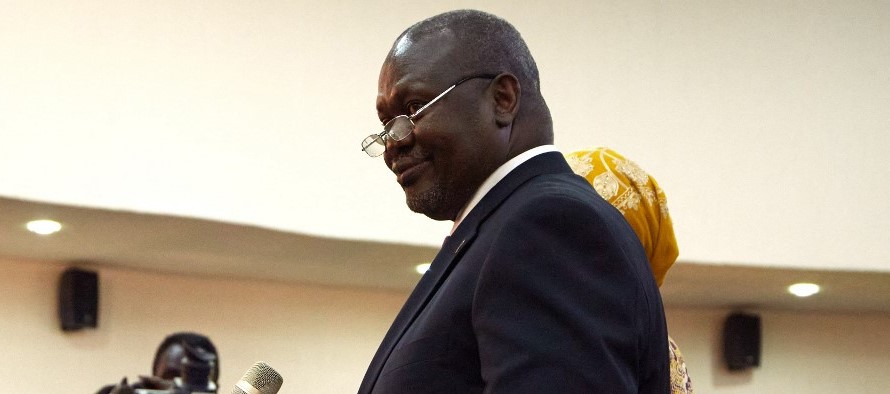
South Sudan Special Court: Machar Claims Political Motivation in Ongoing Treason Trial
Former South Sudan First Vice President Riek Machar on Wednesday accused the prosecution and other officials of turning his ongoing trial into a political process intended to settle political differences. Machar made the accusation during the 120th session of the Special Court in Juba, as he continued presenting his defence in the case involving him and seven co-accused over violence in Nasir, Upper Nile State, in March 2025. The defendants face charges including treason, murder, conspiracy, terrorism, destruction of public property and crimes against humanity. Prosecutors allege that forces aligned with Machars Sudan Peoples Liberation Movement/Army in Opposition (SPLM/A-IO), together with the White Army militia, attacked a government military garrison in Nasir and killed 257 South Sudan Peoples Defence Forces (SSPDF) soldiers, including commander General David Majur Dak. The prosecution has also alleged that military equipment worth about $58 million was destroyed or seized during the fighting. Machar and the other defendants have denied the charges. Machar said his concerns were not primarily about his defence team but about what he described as a series of court rulings that had raised questions about the fairness and independence of the proceedings. “In actual fact, this proves that this trial is political in nature and is intended to settle political differences. My concern has not been about losing confidence in my defence team. Rather, my concern stems from my disappointment and dismay over the following rulings of this court,” Machar said. He also questioned the role of private advocates who have been involved in the prosecution, arguing that government prosecutors from the Ministry of Justice and Constitutional Affairs had taken a back seat while co-opted advocates had assumed a leading role. “We have observed that the co-opted advocates have taken over the prosecution from the Ministry of Justice and Constitutional Affairs. If there is a particular reason for this, I do not need an answer now,” he said. “I have noted that the prosecutors from the Ministry of Justice, who represent the State, have taken a back seat, while co-opted private advocates have taken the lead in prosecuting us, the accused persons in this trial.” Machar asked whether co-opted advocates are members of the National Security Service who had been assigned to prosecute the case on behalf of the complainant, the NSS, or whether the case had been reduced to a private prosecution. “I am aware that, initially, the then First Vice President, Dr. Riek Machar Teny, was facilitating the prosecution and others. I hope this case remains the State versus the FVP and the co-accused,” he said. “I do not mind whether the co-opted advocates are NSS personnel taking over the prosecution from the Ministry of Justice prosecutors, as long as this remains a case brought by the State against the FVP and the co-accused.” The 74-year-old chairman of the SPLM-IO argued that the case should remain a prosecution by the state against him and his co-accused, rather than becoming what he called “a case of private advocates against the FVP and co-accused.” “It is unfortunate for a private advocate who is a member of a political party — in this case, the SPLM-IG — to lead the government prosecution team in prosecuting members of another political party, in this case myself, as chairperson of the SPLM-IO, and my co-accused persons, who are members of the SPLM-IO,” he said. Machar also challenged several previous court decisions, including rulings concerning audio-visual recording of proceedings, defence access to accused persons, media coverage, the courts jurisdiction, presidential immunity and his designation as the fifth accused. “Ruling of Wednesday, 19 August 2026, Session 108: The court denied the defence request for audio-visual recording of the proceedings. In my view, this ruling was politically motivated because the request was made to ensure parity and equality in th
How does this affect you?
Get an AI analysis of this article grounded in your jurisdictions, practice areas, and any policy documents you've uploaded to Wansom.
Finish Reading the Full Story and the Expert Analysis.
Get the latest legal & regulatory intelligence in South Sudan
Wansom is AI and can make mistakes.