
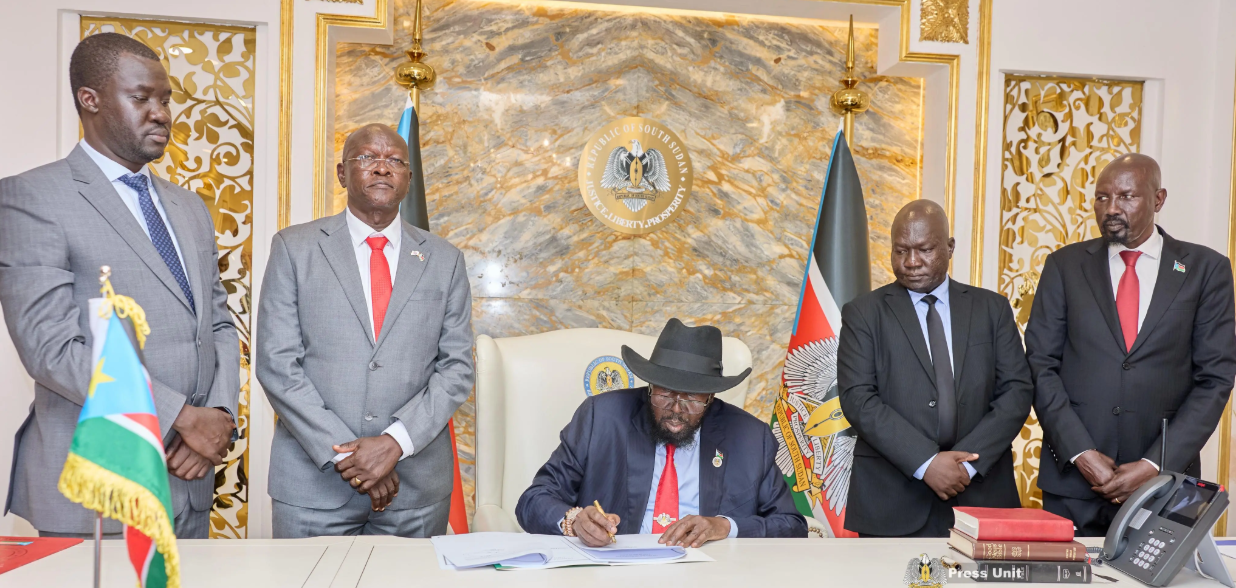
Kiir Signs South Sudan Election Law: Paves Way for 2026 General Elections
Summary
- President Salva Kiir signed amendments to South Sudan's election law on Monday, hours after parliamentary approval, paving the way for the December 22, 2026, general election.
- The amended law allows the incumbent president to remain in office during elections but requires the First Vice President and other vice presidents to leave three months prior.
- The legislation separates election conduct from constitution-making and census processes, enabling the National Elections Commission to proceed with preparations.
- The law also sets the composition of national, state, and administrative area legislative bodies and allocates parliamentary seats.
- Opposition groups have criticized the amendments, citing a lack of adequate consultation among signatories to the 2018 peace agreement.
President Kiir Enacts Key Election Law Amendments
The newly amended South Sudan election law introduces several crucial provisions that redefine the roles of executive officeholders during the electoral cycle.
President Salva Kiir Mayardit of South Sudan officially signed into law significant amendments to the nation's election legislation on Monday, mere hours after the Transitional National Legislative Assembly had passed them. This pivotal action sets the stage for the country's long-anticipated general elections, which are currently slated for December 22, 2026.
The swift enactment of these changes to the South Sudan National Elections Act, 2012, marks a critical step as the nation prepares for its inaugural general election since gaining independence in 2011. The timing of President Kiir's signature is particularly notable, occurring just one day before September 22, the date marking the commencement of the three-month period preceding the scheduled election.
Key Legal Provisions and Executive Transitions
The newly amended South Sudan election law introduces several crucial provisions that redefine the roles of executive officeholders during the electoral cycle. Notably, the legislation permits the incumbent president to retain their position and exercise full constitutional powers throughout the election period. Conversely, the First Vice President and all other vice presidents are mandated to vacate their offices within three months prior to the election date.
Minister of Presidential Affairs Africano Mande Gedima articulated that the primary objective behind these amendments was to harmonize the existing electoral framework with the Transitional Constitution, thereby resolving inconsistencies within the legislation. Furthermore, the revised law strategically separates the conduct of elections from the ongoing permanent constitution-making process and the national population and housing census. This separation empowers the National Elections Commission to advance South Sudan 2026 general election preparations without being contingent on the completion of these other foundational processes. The law also specifies the composition of legislative bodies, setting the National Legislative Assembly at 270 members, each state legislative assembly at 58 members, and each administrative area legislative council at 20 members, alongside provisions for parliamentary seat allocation and the mandate of high elections committees.
Implications for South Sudan's Transitional Period
These amendments carry profound implications for South Sudan's political landscape, particularly as the nation approaches the scheduled December 22, 2026, general election. This vote is intended to signify the conclusion of the country's transitional period, which was initially established under the 2018 peace agreement. The National Elections Commission has already been actively advancing preparations for the vote, although voter registration has yet to commence.
However, the legislative changes have not been universally welcomed. The South Sudan Opposition Alliance, a coalition comprising various opposition parties and armed groups, voiced concerns on Monday, asserting that amendments to the 2018 peace agreement, the transitional constitution, and the election laws were enacted without sufficient consultation among the original signatories to the agreements. This highlights ongoing political disagreements surrounding the country's transitional arrangements and electoral framework, even as the nation moves forward with its first general election in over a decade after years of delays since independence.
Practical Implications
Lawyers advising on political risk, governance, or electoral processes in South Sudan must immediately familiarize themselves with these amended election laws, particularly the provisions affecting the roles of the President and Vice Presidents during the electoral period, and the National Elections Commission's mandate to proceed with preparations for the 2026 elections.
Source
How does this affect you?
Get an AI analysis of this article grounded in your jurisdictions, practice areas, and any policy documents you've uploaded to Wansom.
Finish Reading the Full Story and the Expert Analysis.
Get the latest legal & regulatory intelligence in South Sudan
Wansom is AI and can make mistakes.