
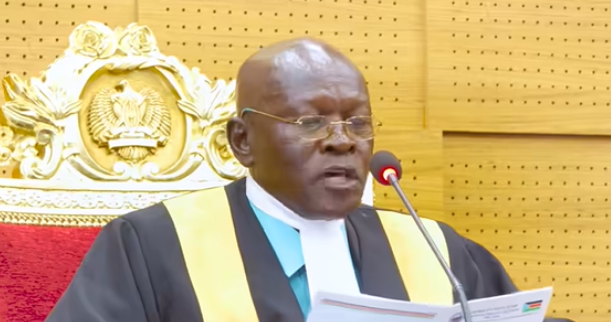
South Sudan Parliament: Media Barred Constitutional Debate
Summary
- South Sudan's parliament barred media and the public from a debate on constitutional amendments for the 2026 elections.
- Speaker Joseph Paciko Ngere cited national security and public order, invoking Parliamentary Regulation 24, to close the session.
- The Constitution Amendment Bill No. 13 seeks to remove legal requirements linking elections to a permanent constitution and census.
- Proposed changes include allowing the December 2026 elections to proceed under an amended transitional constitution and establishing a five-year presidential term.
- Opposition groups and international partners have criticized the electoral plan, citing concerns over security and institutional readiness.
What Happened
The decision to bar media from a constitutional debate underscores a potential risk to public oversight and accountability in future legislative developments affecting the nation's governance.
South Sudan's parliament recently initiated debates on proposed constitutional amendments, but the session was marked by a significant lack of transparency. On Tuesday, journalists and members of the public were explicitly denied access to the parliamentary chamber as lawmakers commenced the second reading of the Constitution Amendment Bill No. 13.
Speaker Joseph Paciko Ngere issued the directive for media and public exclusion. He justified this decision by citing concerns for national security, emphasizing the imperative to safeguard the nation's sovereignty, maintain public order, and ensure social stability. Ngere invoked Parliamentary Regulation 24 to enforce the closed-door debate, instructing all media representatives to leave the premises.
This move effectively created a closed environment for discussions concerning critical legal changes that will shape the country's future electoral landscape. The parliamentary sitting was scheduled to include a presentation from the Committee on Legal Affairs regarding the 2026 Constitutional Amendment Bill, though the specific provisions under parliamentary deliberation on that day were not immediately disclosed to the public, further obscuring the details of the ongoing legislative process.
Legal and Legislative Context
The Constitution Amendment Bill No. 13, which received cabinet approval in August, aims to revise South Sudan's transitional constitution. Its primary objective is to align the existing legal framework with the electoral timetable, specifically for the presidential and parliamentary elections slated for December 22, 2026.
A central feature of these proposed changes is the removal of certain legal prerequisites for holding elections. Currently, the law links the conduct of elections to the adoption of a permanent constitution and the completion of a national population and housing census. The amendments would decouple these requirements, allowing the December 2026 elections to proceed under the modified transitional constitution while the processes for a permanent constitution and census are conducted independently at a later stage.
Furthermore, the bill introduces a provision for a five-year term for an elected president. The government asserts that these modifications are essential to overcome legal impediments to the upcoming elections and to harmonize the transitional constitution with stipulations of the 2018 peace agreement, which outlines a framework for the electoral process. Parliament had already approved amendments to the 2018 peace agreement in July, which deferred the requirements for a permanent constitution and a national census until after the elections.
Broader Implications and Concerns
The proposed South Sudan 2026 elections constitutional amendments and the broader electoral plan have drawn considerable scrutiny and criticism. Opposition groups and international partners have voiced concerns regarding the adequacy of security conditions and the robustness of electoral institutions to facilitate a credible and inclusive election.
South Sudan has a history of deferring elections since achieving independence in 2011. The current transitional period, which has been extended multiple times, is set to conclude in February 2027. The ongoing debate over the South Sudan Constitution Amendment Bill No. 13, particularly with the Joseph Paciko Ngere media exclusion, highlights a potential lack of transparency in critical legislative processes.
This situation raises questions about due process and legal certainty, especially for stakeholders monitoring the legal framework for the 2026 elections. The decision to bar media from a constitutional debate underscores a potential risk to public oversight and accountability in future legislative developments affecting the nation's governance.
Practical Implications
Lawyers and compliance officers should monitor the progress and final text of South Sudan's Constitution Amendment Bill No. 13, as its provisions will redefine the legal framework for the 2026 elections. The lack of transparency during the parliamentary debate, marked by the media ban, may also indicate potential risks to due process and legal certainty in future legislative developments affecting clients.
Source
How does this affect you?
Get an AI analysis of this article grounded in your jurisdictions, practice areas, and any policy documents you've uploaded to Wansom.
Finish Reading the Full Story and the Expert Analysis.
Wansom is AI and can make mistakes.