
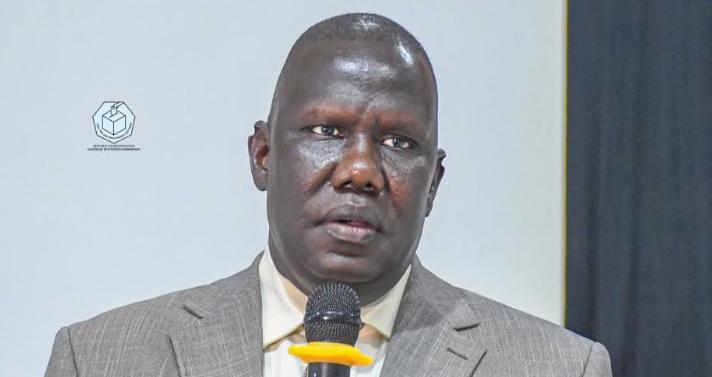
South Sudan NEC: Election Date Changed to February 2027
Summary
- South Sudan's National Elections Commission moved the general election date from December 22, 2026, to February 11, 2027.
- NEC Chairperson Gabriel Bol Deng cited insufficient time for legally required electoral activities as the reason for the adjustment.
- The decision is legally supported by the National Elections Act, including a 2026 amendment, which allows for adjustments under "other circumstances."
- Kornelio Kon, a political party leader, has filed a court case challenging the NEC's decision.
- Political parties face a funding challenge, as current law only provides post-election financing, prompting calls for treasury support for pre-election activities.
Electoral Timetable Adjustment Sparks Controversy
Bol Deng specifically referenced provisions within the South Sudan National Elections Act, including a 2026 amendment, as the legal foundation for the NEC's decision.
The National Elections Commission (NEC) in South Sudan has unilaterally altered the timeline for the upcoming general election, shifting the date from December 22, 2026, to February 11, 2027. This South Sudan NEC election date change was announced and defended by NEC Chairperson Gabriel Bol Deng during the concluding stages of the National Inter-Party Political Dialogue held in Juba. The decision has not been met with universal approval, as several political parties voiced strong objections to the revised schedule.
Among the dissenting voices, a party led by Kornelio Kon has taken legal action, filing a court case on Monday to challenge the NEC's authority and rationale behind the adjustment. Bol Deng, however, maintained that the original electoral timetable was simply impractical, failing to provide adequate time for the comprehensive execution of all legally mandated electoral activities. He emphasized the commission's commitment to ensuring a credible and transparent process, even if it necessitated an electoral timetable adjustment.
Legal Basis for the Shift
In justifying the revised Gabriel Bol Deng election date, the NEC chairperson explained that the commission undertook a thorough review of the existing electoral law and engaged in extensive consultations with political, religious, and community leaders. This comprehensive assessment led to the conclusion that adhering to the December 22, 2026, date was no longer a feasible option. Bol Deng specifically referenced provisions within the South Sudan National Elections Act, including a 2026 amendment, as the legal foundation for the NEC's decision.
According to Bol Deng, this legislation grants the commission the power to modify the electoral timetable under specific circumstances that could impede its ability to conduct a proper, transparent, inclusive, and credible election. He outlined three such conditions: a declared state of emergency, a natural disaster, or "other circumstances" deemed likely to prevent a credible election. While acknowledging that South Sudan was not experiencing the first two conditions, Bol Deng asserted that the third category provided a clear legal basis for the current adjustment. He clarified that the move was not a mere postponement of the election or an extension of the transitional period, but rather a necessary recalibration based on the actual activities required.
Logistical Imperatives and Time Constraints
The NEC's decision to push back the South Sudan general election 2027 was primarily driven by significant logistical and time constraints. Gabriel Bol Deng detailed that an additional 150 days were required to properly budget and execute the commission's activities in accordance with the law. He highlighted that the original schedule left only 40 days before the election, a period grossly insufficient for critical preparatory phases. For instance, voter registration activities alone demand 58 days, while the nomination process for candidates requires 51 days, and campaigning necessitates another 45 days.
Bol Deng underscored the impossibility of condensing these extensive requirements into the limited timeframe, stating emphatically, "You cannot fit 115 days into 40 days." He further explained that the production of valid ballot papers could not be accomplished within 40 days, as the commission still needed to finalize party names, candidate lists, and their respective symbols. Another major logistical hurdle involved the production of over 100,000 transparent ballot boxes, a task for which South African counterparts have offered assistance, but which also demands additional time. The NEC chairperson stressed that the commission was unwilling to compromise the integrity of the election by proceeding without adequate preparation, emphasizing that "Our country needs a soft landing." The commission also consulted with various electoral partners, including the African Union, and other stakeholders before arriving at its decision.
Funding Challenges for Political Parties
Adding another layer of complexity to the electoral landscape, James Akol Zakayo, chairperson of the Political Parties Council, has highlighted a critical funding gap for political parties. Zakayo pointed out that while the existing law stipulates financial support for political parties after elections, it makes no provision for funding their activities prior to the electoral process. This creates a significant challenge, as many parties lack the necessary resources to organize and prepare effectively for the upcoming polls.
The Political Parties Council is actively engaging with the caretaker government to explore alternative funding mechanisms, specifically seeking financial assistance from the national treasury. Akol Zakayo reiterated that the current legal framework designates funding for post-election activities, not pre-election preparations. Given that this will be the nation's first general election, the lack of pre-election financial support for parties is a pressing concern, potentially impacting their ability to participate robustly and contribute to a truly inclusive electoral process.
Practical Implications
Lawyers advising political parties or involved in electoral law in South Sudan should note the National Elections Commission's reliance on the National Elections Act (including a 2026 amendment) to justify the election date change, particularly given the ongoing legal challenge by Kornelio Kon. This development sets a precedent for interpreting the NEC's powers to adjust electoral timetables under 'other circumstances' clauses, which could impact future electoral processes and legal challenges.
Source
How does this affect you?
Get an AI analysis of this article grounded in your jurisdictions, practice areas, and any policy documents you've uploaded to Wansom.
Finish Reading the Full Story and the Expert Analysis.
Get the latest legal & regulatory intelligence in South Sudan
Wansom is AI and can make mistakes.