
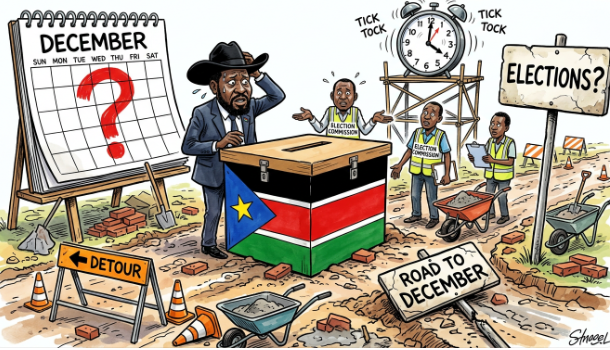
South Sudan NEC: Cannot Meet December 2026 Election Deadline Compliance
Summary
- The National Elections Commission (NEC) is reportedly unable to conduct South Sudan's December 22, 2026, general elections within statutory timelines.
- Critical steps like voter registration, candidate nominations, and polling station notices have either lapsed or cannot be completed in time.
- The National Elections Act, 2012, and its 2023 and 2026 amendments, mandate strict deadlines and procedures for the NEC.
- Key voter register deadlines, including final approval and publication by June 22, 2026, and initial publication by September 22, 2026, were missed.
- While the 2026 Act delinked elections from constitutional completion and census, it did not alter crucial rules for the final register or nomination windows.
Current Assessment of Election Readiness
The current inability of the National Elections Commission to adhere to the statutory timelines for the December 2026 elections carries significant legal and procedural implications for South Sudan.
The National Elections Commission (NEC) in South Sudan is reportedly unable to conduct the general elections scheduled for December 22, 2026, within the legally mandated timelines. This assessment, based on a legal opinion, indicates that critical preparatory steps, such as voter registration, candidate nomination periods, and the issuance of polling station notices, have either already passed or cannot be completed within the remaining 45 days, as stipulated by the National Elections Act, 2012, and its subsequent amendments. The opinion emphasizes that while the Commission possesses a limited authority to adjust its timetable, such adjustments must be made transparently, with clear justifications, and communicated to all relevant parties, rather than through inaction or silence.
The legal analysis specifically addresses whether the NEC can comply with the timeframes set forth in the National Elections Act, 2012, as modified by the 2023 and 2026 Amendment Acts. The conclusion is definitive: the NEC is not positioned to meet these statutory requirements for the December 22 elections. This inability stems from the fact that several foundational elements necessary for a lawful election process are either no longer achievable within the prescribed minimum periods or have already lapsed. The opinion relies on the text of the 2023 and 2026 Amendment Acts, with section numbers following the renumbered text of the 2023 Act, and incorporates public statements and media reports from June to early November 2026 solely to ascertain the actions taken by the NEC. All time calculations are made counting backward from the December 22, 2026, election date.
Statutory Framework and Commission Powers
The legal foundation for the National Elections Commission's operations is exclusively derived from the National Elections Act, 2012. This Act grants the NEC all its powers, obliging it to regulate, conduct, and supervise elections, maintain the voter register, and register candidates, as outlined in Section 15(2). The language of the Act is prescriptive, using mandatory terms like "shall" to dictate that the NEC must announce, publish, notify, and open the register by specific, fixed dates. While the Commission is authorized to issue regulations, this power is strictly limited to facilitating the "proper implementation" of the Act, as per Section 139. Crucially, these regulations cannot legally shorten, waive, or supersede any period explicitly established by the Act itself.
Beyond mere dates, the Act also establishes fundamental standards for election administration, emphasizing credibility, openness, transparency, and impartiality, as detailed in Sections 6(1) and (2). It mandates that the preparation and conduct of elections must be professional, credible, transparent, and open. The NEC is specifically tasked with informing the public about voter registers, polling stations, and candidates (Section 7). The provisions concerning register publication, inspection, objection, and audit, found in Sections 36 to 38, are designed as the primary mechanisms through which these principles of transparency and public engagement are realized for the electorate.
Missed Deadlines and Unchanged Requirements
The National Elections Act, 2012 (Amendment) Act, 2026, directly references the December 2026 elections in Section 9(1). This amendment notably "delinks" the election schedule from the prior preconditions of completing a permanent constitution and a national census, thereby removing these as legal obstacles. The 2026 Act also introduced several shortened periods, including those for voter register publication, register inspection, signature forms, and the campaign duration. However, it is critical to note that the 2026 Act did not alter several key provisions. These include the final-register rule in Section 38, the nomination windows specified in Sections 49, 71, and 72, the polling station notice requirement in Section 32(6), or the deadlines for independent candidates outlined in Section 57.
While the election date of December 22, 2026, was properly announced by the NEC in June 2026, fulfilling the Section 16(1) requirement for at least six months' notice, other critical deadlines have been missed. Specifically, Section 36(e), as amended in 2026, mandated the publication of the voter register at least three months before polling, which would have been September 22, 2026. Under the previous 2023 text, this deadline was June 22. Furthermore, Section 38(1), which remained unchanged by the 2026 Act, requires the final register to be approved and published a minimum of six months before polling, setting a deadline of June 22, 2026, and prohibiting further objections once published. As of early November, these crucial voter register deadlines had not been met. The Transitional Period is understood to conclude in February 2027, making the Section 9(1) requirement for polling approximately 60 days prior a significant factor, though this timing should be verified against the current Agreement and Constitution.
Implications for South Sudan's Electoral Process
The current inability of the National Elections Commission to adhere to the statutory timelines for the December 2026 elections carries significant legal and procedural implications for South Sudan. The foundational elements of a credible electoral process—such as a properly finalized voter register and adherence to nomination schedules—are at risk. This situation suggests that the electoral body may not be able to deliver elections that fully conform to the principles of transparency and fairness enshrined in the National Elections Act, 2012.
Lawyers advising clients on this matter should consider the potential for constitutional challenges arising from a process that deviates from established legal frameworks. The necessity for further legislative amendments to the National Elections Act, 2012, might become apparent if the current deadlines are insurmountable, or if the NEC attempts to use its limited power to adapt the timetable without full transparency. The broader implications include the risk of a delayed or an unconstitutional electoral process, which could undermine public confidence and the legitimacy of the election outcomes. The integrity of the December 2026 elections hinges on strict compliance with these legal requirements, which, as of early November, appear to be unattainable.
Practical Implications
Lawyers should advise clients on the legal ramifications of the National Elections Commission's inability to meet the statutory deadlines for the December 2026 elections, including potential constitutional challenges, the need for further legislative amendments to the National Elections Act, or the implications of a delayed or unconstitutional electoral process.
Source
How does this affect you?
Get an AI analysis of this article grounded in your jurisdictions, practice areas, and any policy documents you've uploaded to Wansom.
Finish Reading the Full Story and the Expert Analysis.
Get the latest legal & regulatory intelligence in South Sudan
Wansom is AI and can make mistakes.