
South Sudan: Journalists Urged to Use Dignified Migrant Worker Language
Summary
- South Sudanese journalists were urged to use accurate, balanced, and dignified language when reporting on migrant workers during a recent paralegal training.
- Rosemary Kabaki of Nonviolent Peaceforce highlighted the disparity in treatment between international staff and other migrant workers, advocating for equitable dignity for all.
- Oyet Patrick Charles, UJOSS President, emphasized migration as a human rights issue, noting migrant workers' economic contributions and the risks of arbitrary restrictions.
- The training, attended by over 30 journalists, aimed to strengthen media coverage of migration, labor rights, and human rights issues.
- James Bidal of the South Sudan Human Rights Defenders Network called for reporting that focuses on the human experiences behind migration, beyond statistics and headlines.
Call for Dignified Reporting on Migrant Workers
A single unverified report or inaccurate statement has the potential to instantly dismantle years of accumulated trust.
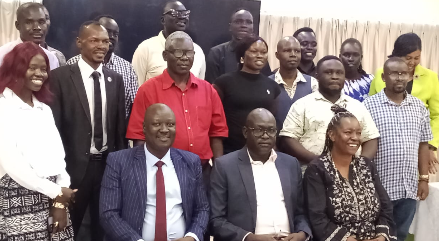
South Sudanese journalists recently received a strong appeal to adopt accurate, balanced, and dignified language when covering migrant workers. This urgent call, issued during a specialized paralegal training session held on Friday, underscored concerns that imprecise terminology and unsubstantiated information could perpetuate negative stereotypes and erode public trust in media outlets. The training brought together over 30 journalists, aiming to enhance the quality of media reporting on critical issues such as migration, labor rights, and broader human rights concerns within South Sudan.
Rosemary Kabaki, the Country Director for Nonviolent Peaceforce, highlighted the crucial need for reporters to grasp the diverse experiences of migrant workers and to exercise caution in their linguistic choices. Drawing from her own experience as a migrant worker, Kabaki emphasized that word choice carries significant weight, noting a stark contrast in how international staff typically enter South Sudan compared to other migrant workers. She advocated for equitable and dignified treatment for all migrant workers across the nation, pointing out that employees of international organizations frequently benefit from privileges, protection, and institutional support often unavailable to other migrant workers, leaving many susceptible to exploitation and abuse.
Media's Role in Safeguarding Rights and Promoting Accountability
Kabaki further stressed the indispensable role of the media in upholding civilian rights, even in the presence of established governmental, executive, and judicial systems. She asserted that when formal mechanisms fall short, society turns to the media to bridge gaps and ensure accountability. Many migrant workers, alongside South Sudanese nationals residing and working abroad, frequently encounter vulnerable conditions and often lack accessible platforms to voice their concerns or seek justice. Kabaki warned that a single unverified report or inaccurate statement has the potential to instantly dismantle years of accumulated trust, urging journalists to ensure rigorous fact-checking, appropriate context, and balance in every article, broadcast, and social media post.
Beyond merely exposing challenges, journalists were encouraged to embrace constructive journalism that also highlights practical solutions. Kabaki suggested that this solutions-oriented approach could help alleviate feelings of helplessness among communities grappling with migration-related issues. This perspective aligns with the broader ethical imperative for media to not only inform but also to contribute positively to societal discourse and problem-solving, particularly concerning vulnerable populations like migrant workers.
Economic Realities and Human Rights Frameworks
Oyet Patrick Charles, President of the Union of Journalists of South Sudan (UJOSS), characterized migration as a significant regional and economic reality that demands a human rights-centered approach. He noted that international bodies such as the International Labour Organization (ILO) and the International Organization for Migration (IOM) recognize the importance of orderly regional labor migration, cautioning that arbitrary restrictions can inadvertently push individuals towards perilous and irregular migration routes. Oyet underscored the mutual benefits of regional cooperation and labor mobility, citing global examples where migrant workers are instrumental in building economies.
He further explained that migrant workers contribute significantly by supporting their families through remittances, which in turn bolster their home economies. Crucially, Oyet reminded attendees that migrant workers are human beings deserving of the same respect and consideration as anyone else. This paralegal training, he added, expands upon UJOSS's prior human rights initiatives by equipping journalists with specialized knowledge of legal terminology, labor migration, and immigration frameworks, thereby strengthening South Sudan migrant worker rights reporting.
Enhancing Media Standards and Protecting Press Freedom
James Bidal, Coordinator of the South Sudan Human Rights Defenders Network, commended UJOSS for its consistent dedication to defending press freedom and its interventions in cases involving journalists and detention. Reading from a prepared statement by the Network’s legal counsel, Bidal articulated that reporting on labor migration must transcend mere statistics, border crossings, and headlines. Instead, it should concentrate on the profound human experiences that underpin migration.
Bidal emphasized that labor migration is not solely about movement across borders in pursuit of employment; rather, behind every migrant worker is an individual striving for dignity, security, and a better life. This focus on individual narratives and human dignity reinforces the call for South Sudan media reporting standards to prioritize ethical considerations and comprehensive understanding when addressing the complex topic of South Sudan journalist migrant worker language.
Practical Implications
Compliance officers and legal counsel for companies operating in South Sudan and employing migrant workers should review internal communication policies and public statements to ensure alignment with calls for dignified language and human rights, mitigating reputational and regulatory risks. This signals heightened scrutiny of labour practices and the potential for increased media attention on worker treatment.
Source
How does this affect you?
Get an AI analysis of this article grounded in your jurisdictions, practice areas, and any policy documents you've uploaded to Wansom.
Finish Reading the Full Story and the Expert Analysis.
Wansom is AI and can make mistakes.