
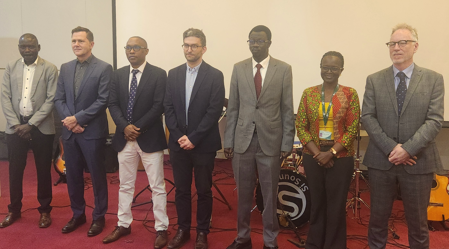
South Sudan MoAFS: Mandates 70% Local Employment in Donor Projects
Summary
- South Sudan's Ministry of Agriculture and Food Security has mandated that 70% of employees on donor-funded projects must be South Sudanese nationals.
- Morris Aduol Dut, who was formerly the MoAFS Undersecretary, specifically urged FAO and UNOPS to prioritize local employment, limiting foreign nationals to 30% of positions.
- The Ministry's demand is driven by the scarcity of employment opportunities for qualified South Sudanese graduates.
- Donor representatives from the UK, WFP, and the THRIVE Consortium highlighted the importance of localization and strengthening local partnerships for sustainable development.
- Concerns were also raised by the Ministry regarding project implementation delays and the scale of completed structures relative to allocated funding.
Ministry Issues Employment Mandate
The Ministry of Agriculture and Food Security (MoAFS) has issued a directive calling for international development agencies to ensure that a minimum of 70 percent of staff employed on donor-funded projects are South Sudanese, citing the scarcity of employment opportunities for the nation's qualified graduates.
The Ministry of Agriculture and Food Security (MoAFS) has issued a directive calling for international development agencies to ensure that a minimum of 70 percent of staff employed on donor-funded projects are South Sudanese, citing the scarcity of employment opportunities for the nation's qualified graduates. Morris Aduol Dut, who was formerly the Undersecretary for the MoAFS, specifically identified organizations such as the Food and Agriculture Organization (FAO) and the United Nations Office for Project Services (UNOPS) as key entities that should prioritize the hiring of South Sudanese individuals in their programs. This mandate stipulates that foreign nationals should constitute no more than the remaining 30 percent of the workforce on these projects.
Rationale Behind Localization Push
Aduol's primary justification for the stringent 70 percent local employment target stems directly from the acute lack of job prospects for the country's educated youth. He highlighted that a considerable number of young South Sudanese graduates frequently approach his office, actively seeking employment and expressing their struggle to secure opportunities within existing development projects. The Undersecretary firmly asserted that capable South Sudanese graduates are readily available and possess the skills required for this work, emphasizing that it is their inherent right to be employed in their own nation's development endeavors.
Beyond the employment mandate, Aduol also voiced broader criticisms regarding the efficacy and implementation of development aid. He specifically called attention to delays in the execution of various projects, noting that communities continue to await promised services despite the allocation of necessary funding. Furthermore, during visits to project sites in Renk and Malut within Upper Nile State, Aduol questioned the actual size and scope of some completed structures in relation to the financial resources that had been designated for them, suggesting potential inefficiencies or discrepancies in project delivery.
Donor Perspectives and Broader Implications
The discussions at the Juba fair extended beyond the immediate employment quotas to encompass the broader principle of localization within international aid and development efforts. Duncan Overfield, formerly the Deputy Development Director at the British Embassy in Juba, and now Deputy Development Director and Head-Prosperity and Economic Growth at the Foreign, Commonwealth and Development Office (FCDO) in Bangladesh, whose government is a key supporter of the South Sudan Humanitarian and Resilience Programme, elaborated on how UK-funded interventions are already actively collaborating with local organizations to bolster community resilience. He specifically mentioned the UK's support for the THRIVE Consortium, WFP, and FAO in initiatives aimed at helping vulnerable households diversify their livelihoods, establish businesses, and adapt to the challenges posed by climate change.
Overfield conveyed the UK's pride in the Foreign, Commonwealth and Development Office (FCDO)'s partnerships with local actors, acknowledging the crucial role that local non-governmental organizations play in strengthening resilience at the community level. He further articulated that effective resilience programs must aspire beyond merely helping communities survive immediate crises, instead focusing on building enduring foundations for sustainable development through strategies such as livelihood diversification, improved market access, and skills enhancement. Overfield also highlighted the measurable progress in UK-supported savings and lending activities, where communities have successfully utilized loans to initiate and expand businesses, and pointed to the involvement of private-sector entities in the fisheries and livestock sectors as evidence of the potential for private-sector development even in fragile and conflict-affected environments.
Partner Perspectives on Sustainable Development
Reinforcing the importance of localization, Phyllis Jepkorir, who serves as the Country Director for GOAL South Sudan and represents the THRIVE Consortium, underscored the critical need to empower and strengthen local institutions and communities. She argued that these local entities should be viewed as active partners in the process of sustainable resilience-building, rather than being treated solely as passive recipients of assistance. Sepkorir emphasized that localization is not merely a theoretical concept discussed in meetings but an essential principle for achieving truly sustainable and lasting impact on the ground.
Thomas Deville, the Deputy Head of Programme for the World Food Programme (WFP) in South Sudan, also advocated for the establishment of stronger strategic partnerships among various development organizations. He proposed that pooling resources through such collaborations would significantly enhance support for vulnerable communities. Deville indicated WFP's strategic shift from purely transactional partnerships towards more enduring, long-term cooperation, with the overarching aim of fostering greater community resilience and self-reliance. Nicholas Kerandi, Project Manager for the Green and Resilient Agriculture and Climate Economy at FAO South Sudan, additionally called for increased attention to these vital areas of development.
Practical Implications
International development agencies and their legal counsel operating in South Sudan should anticipate increased scrutiny and potential formal requirements regarding local employment quotas, particularly the 70% South Sudanese target articulated by the Ministry of Agriculture. This necessitates a review of current hiring practices and preparation for potential policy changes or compliance demands related to localization in donor-funded projects.
Source
How does this affect you?
Get an AI analysis of this article grounded in your jurisdictions, practice areas, and any policy documents you've uploaded to Wansom.
Finish Reading the Full Story and the Expert Analysis.
Get the latest legal & regulatory intelligence in South Sudan
Wansom is AI and can make mistakes.