
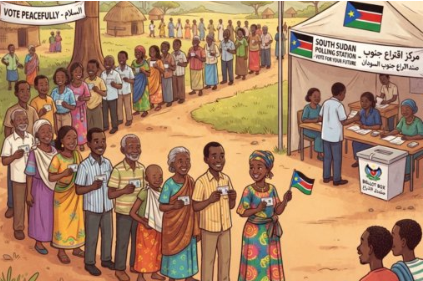
South Sudan: Elections Act Amendments, RTGoNU Dissolution Spark Debate
South Sudan stands at a pivotal moment in its history. The recent amendments to the National Elections Act and the dissolution of the Revitalized Transitional Government of National Unity (RTGoNU) have intensified debate about the countrys future direction. Supporters see these developments as necessary steps toward ending years of prolonged transitional governance and allowing citizens to choose their leaders through elections. Critics question whether the political, security, and institutional conditions required for credible elections are sufficiently in place. Both perspectives deserve serious consideration. The central issue before South Sudan is larger than any single law or political decision. It is whether the country is prepared to move from a system largely sustained by negotiated power-sharing arrangements to one grounded in democratic accountability and electoral legitimacy. A transition was never meant to be permanent When the Revitalized Agreement on the Resolution of the Conflict in the Republic of South Sudan (R-ARCSS) was signed in September 2018, it was designed to provide a pathway from conflict to constitutional governance. Transitional institutions were created to implement reforms, maintain stability, and prepare the country for democratic elections. Over the years, implementation has faced repeated delays. Major provisions of the peace agreement, including aspects of security reform, constitutional development, and electoral preparation, have remained incomplete. As a result, the transitional period has been extended multiple times. While those extensions were intended to preserve peace and create conditions for a successful transition, they have also raised a legitimate question: At what point does a temporary arrangement cease to be temporary? Supporters of the recent electoral reforms argue that continued postponements risk undermining the original purpose of the peace agreement. In their view, transitions are intended to lead somewhere. They argue that eventually citizens must be allowed to confer political legitimacy through elections rather than through indefinitely renewed political arrangements. That argument should not be dismissed lightly. The legality-legitimacy debate Yet legality alone is not enough. A political decision may follow established constitutional procedures while still prompting concerns about legitimacy, preparedness, and public confidence. This distinction lies at the center of the current national debate. One of the most significant changes introduced by the amended electoral law is the removal of previous requirements linking elections to the completion of a permanent constitution and a national population census. Supporters argue that these changes are necessary to prevent further delays and keep the country on a path toward elections. Critics contend that removing those prerequisites weakens important safeguards that were originally intended to strengthen electoral credibility. Both arguments reflect legitimate democratic concerns. The question is not simply whether elections can be held. The question is whether they can be conducted in a manner that commands broad public trust. Why critics remain concerned Many critics of the dissolution support elections in principle. Their concerns focus not on democratic participation itself but on the conditions surrounding it. Security remains among the most frequently cited challenges. The United Nations Commission on Human Rights in South Sudan has warned that important political, security, and human-rights safeguards necessary for a peaceful and credible election remain insufficient in several areas of the country. The Commission emphasized that its concern is not whether South Sudanese should vote, but whether they can do so freely, safely, and without fear. Questions of preparedness have also emerged. Reports indicate that voter registration had not yet commenced when the electoral amendments were adopted and the transitional gov
How does this affect you?
Get an AI analysis of this article grounded in your jurisdictions, practice areas, and any policy documents you've uploaded to Wansom.
Finish Reading the Full Story and the Expert Analysis.
Get the latest legal & regulatory intelligence in South Sudan
Wansom is AI and can make mistakes.