
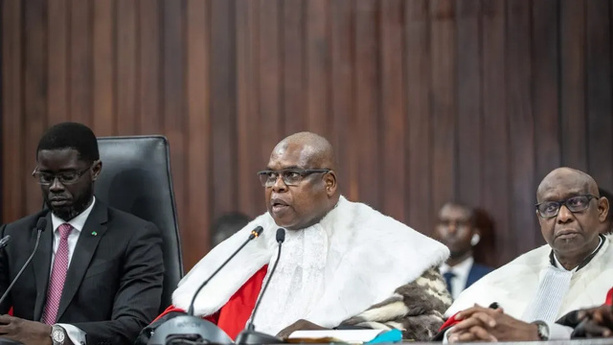
Cour Suprême Noo Lank Élections Locales Sénégal: Recours Rejeté
Summary
- Senegal's Supreme Court rejected an urgent request from the Noo Lank collective to mandate a date for local elections.
- The court ruled that conditions for an emergency intervention were not met, citing insufficient urgency.
- President Bassirou Diomaye Faye has sought advice from the Constitutional Council on potentially combining legislative and local elections.
- Legal experts highlight significant timing obstacles to coupling these elections, as local polls are due in February and legislative dissolution is only possible from late November 2026.
- The local election calendar remains uncertain due to missing regulatory acts and differing interpretations of the electoral code.
Supreme Court Rejects Urgent Plea
The Supreme Court of Senegal has dismissed an urgent application filed by the collective Noo Lank, which sought to compel the State to establish a date for upcoming local elections.
The Supreme Court of Senegal has dismissed an urgent application filed by the collective Noo Lank, which sought to compel the State to establish a date for upcoming local elections. The administrative chamber of the high court, in its ruling issued on Thursday, August 27, determined that the criteria for an emergency intervention were not met, stating that the "urgency was not sufficiently characterized." This decision leaves the timeline for departmental and municipal elections in Senegal in a state of continued ambiguity, as essential preparatory steps for organizing the polls remain unaddressed.
Noo Lank, spearheaded by Seydina Mouhamadou Malal Diallo, had petitioned the urgent applications judge to mandate the Senegalese government to set the election date via decree, adhering to the deadlines stipulated in the country's electoral code. The collective's legal action underscored growing concerns among civil society and opposition groups regarding the executive's perceived inaction.
In a related development, the Front pour la défense de la démocratie et de la République (FDR), a prominent opposition coalition that includes the Alliance pour la République (APR) of former President Macky Sall, also initiated similar legal proceedings. Coordinated by Modou Diagne Fada, the new coordinator of the Front pour la défense de la démocratie et de la République (FDR), the FDR announced on August 21 its intention to seek judicial affirmation of what it termed the government's "manifest refusal to respect the electoral code," further highlighting the widespread apprehension over the electoral schedule.
Legal and Political Context of Uncertainty
The current uncertainty surrounding the calendrier élections locales Sénégal is exacerbated by the absence of several crucial regulatory instruments required for the polls to proceed. These include a presidential decree to officially set the election date and an order from the Minister of Interior specifying the amount of the electoral deposit. Without these foundational acts, the path to holding the elections remains unclear, fueling speculation and criticism from various political factions and civil society.
Adding another layer of complexity, President Bassirou Diomaye Faye has formally requested an advisory opinion from the Conseil constitutionnel. The President's inquiry pertains to the feasibility and implications of potentially combining legislative and local elections, a process referred to as jumelage législatives locales Sénégal. This consultation is intended to provide clarity on the legal and practical aspects of such a consolidation, particularly regarding its potential to reduce the logistical and financial burdens associated with conducting two separate electoral processes. This move comes as President Faye's administration faces a challenging institutional landscape, having lost its parliamentary majority following the rupture with Ousmane Sonko's Pastef party on May 22, 2026.
The differing interpretations of the code électoral Sénégal further complicate the situation. Those who initiated the legal challenges, including the Noo Lank recours élections Sénégal, argue that the elections should take place on a Sunday within the thirty days preceding the expiration of local officials' mandates. Conversely, the presidential party offers an alternative reading of Article L.269 of the electoral code, suggesting that under "exceptional circumstances," elections could be held at any point during the fifth year of the mandate, specifically between January and December 2027. The mandates of current local elected officials are set to conclude on January 23, 2027.
Challenges to Election Coupling
Despite the executive's exploration of combining the legislative and local elections to achieve cost efficiencies, significant legal and practical hurdles remain. Electoral expert Djibril Gningue has highlighted these obstacles, pointing out a fundamental timing discrepancy. Local elections are mandated to occur thirty days before the end of the fifth year of the current mandate, which would place them in February. In contrast, a dissolution of the National Assembly, which would necessitate new legislative elections, would only become legally permissible from the end of November 2026.
This substantial temporal gap significantly constrains the possibility of genuinely coupling both electoral events under a unified calendar. While the concept of simultaneous convocation for both polls might be considered, the distinct legal timelines for each type of election present a formidable challenge to their full integration. The expert's analysis underscores that while the desire to reduce logistical and financial costs is understandable, the existing legal framework imposes strict limitations on how such a consolidation could be practically implemented.
Ongoing Uncertainty for Senegal's Electoral Future
The Cour suprême Noo Lank débouté decision, coupled with the ongoing deliberations by the Constitutional Council and the executive's consideration of various electoral scenarios, ensures that the future of Senegal's local elections remains highly uncertain. The lack of a clear timeline, the absence of necessary regulatory decrees, and the divergent interpretations of the electoral code contribute to a volatile political environment.
The President's initiative to seek advice on coupling elections, particularly in the context of his administration lacking a parliamentary majority, suggests a strategic effort to navigate the complex political landscape. However, the legal and practical challenges to such a coupling, as identified by experts, mean that a definitive resolution to the electoral calendar is not immediately apparent. Stakeholders across the political spectrum continue to monitor developments closely, as the eventual scheduling and format of these élections locales Sénégal will have significant implications for Senegal's governance and political stability.
Practical Implications
Lawyers advising political entities or businesses impacted by political stability in Senegal should note the continued uncertainty surrounding the local election calendar, following the Supreme Court's rejection of an urgent request to set a date. They must monitor the Constitutional Council's upcoming advice and any executive decrees, as different interpretations of the electoral code and the possibility of coupling elections could significantly alter the political and regulatory landscape.
Source
How does this affect you?
Get an AI analysis of this article grounded in your jurisdictions, practice areas, and any policy documents you've uploaded to Wansom.
Finish this article free. Just your email for instant unlock.
Wansom is AI and can make mistakes.