
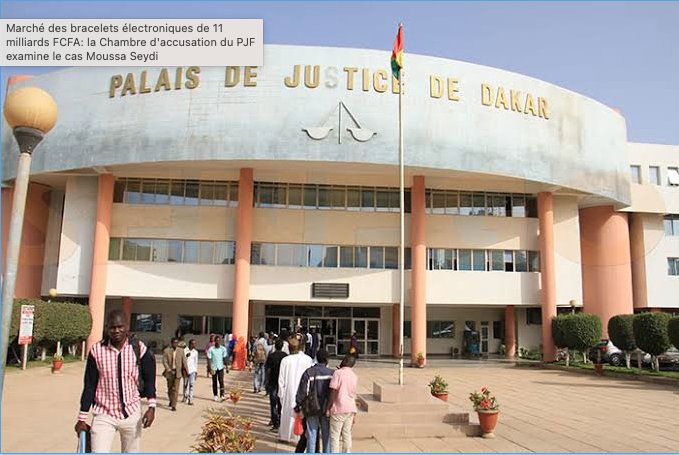
Senegal: Moussa Seydi's Provisional Release Request Examined in Bracelet Case
In Senegal, on October 28, the Chambre d’accusation of the Financial Judicial Pool is examining a request for provisional release for Moussa Seydi, a former director of penitentiary finances, in a public procurement case involving electronic bracelets.
Moussa Seydi, who was detained on June 23, 2026, is facing prosecution for alleged embezzlement and fraud involving public funds amounting to 120,637,720 FCFA, as well as forgery of public authentic documents, criminal association, and money laundering. The financial prosecutor specifically accuses him of authorizing an advance payment of 1,377,900,000 FCFA and an unexplained discrepancy of 3,633,188,987 FCFA in public contracts for electronic bracelets. These contracts, signed in 2020 and 2023, are the subject of a judicial investigation opened on October 24, 2024, with the total value of the markets estimated at 11,178,602,018 FCFA. Seydi's defense is contesting the charges, arguing that the available evidence is insufficient to establish them. The current hearing before the Chambre d’accusation focuses solely on his request for provisional release, which was previously denied at first instance.
This case underscores Senegal's commitment to combating corruption and financial misconduct within public administration, particularly concerning public procurement. The substantial amounts involved and the high-profile nature of the accused highlight the government's focus on transparency and accountability in the management of public funds. For practitioners, it illustrates the complexities of financial crime investigations, the stringent requirements for provisional release in such cases, and the potential for severe penalties for public officials found guilty of embezzlement, fraud, and money laundering. It also signals increased scrutiny of public contracts, especially those involving significant public funds.
The legal context involves the specialized *Pool judiciaire financier* (Financial Judicial Pool) in Senegal, designed to investigate and prosecute complex financial crimes and corruption. The charges—embezzlement (*détournement de deniers publics*), fraud (*escroquerie*), forgery (*faux en écriture publique authentique*), criminal association (*association de malfaiteurs*), and money laundering (*blanchiment de capitaux*)—are serious offenses under the Senegalese Penal Code. The *Chambre d’accusation* (Indictment Chamber) plays a crucial role in reviewing appeals against decisions regarding pre-trial detention and confirming charges before a case proceeds to trial. The ongoing *information judiciaire* (judicial investigation) indicates that the matter is still in the investigative phase, overseen by an investigating judge. Key parties include Moussa Seydi, the *Parquet financier* (Financial Prosecutor's Office), the *Chambre d’accusation* of the *Pool judiciaire financier*, and the Senegalese state as the aggrieved party.
Attorneys advising public officials or entities involved in public procurement must be acutely aware of the heightened scrutiny and severe legal consequences associated with financial irregularities. This case emphasizes the critical importance of meticulous record-keeping, strict adherence to procurement regulations, and robust internal controls to prevent allegations of fraud, embezzlement, or money laundering. Practitioners should closely monitor the *Chambre d’accusation*'s decision on provisional release, as it will provide insight into the judiciary's approach to pre-trial detention in high-stakes financial crime cases. The outcome of the request for provisional release and the broader judicial investigation is not yet reported.
How does this affect you?
Get an AI analysis of this article grounded in your jurisdictions, practice areas, and any policy documents you've uploaded to Wansom.
Finish Reading the Full Story and the Expert Analysis.
Wansom is AI and can make mistakes.