
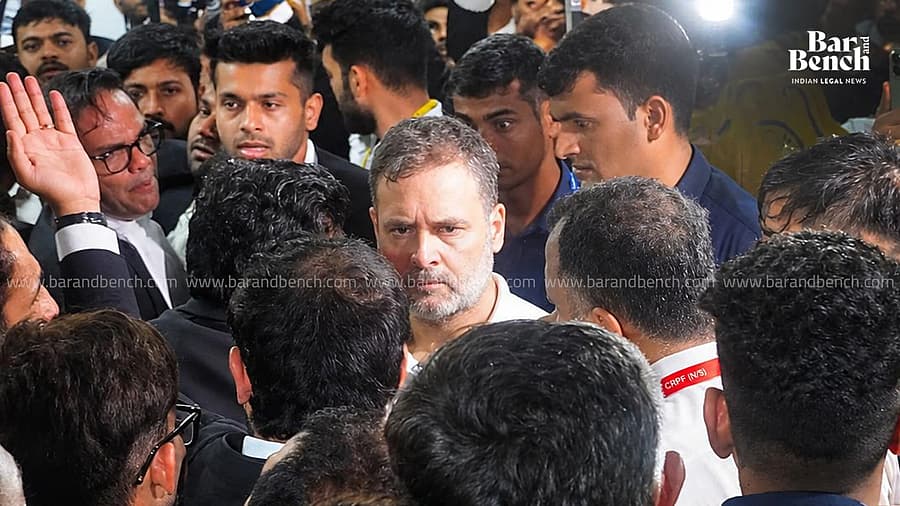
Supreme Court: Lists IA on Richa Parashar Rahul Gandhi Allegation
Summary
- Journalist Richa Parashar alleges Congress leader Rahul Gandhi pushed her during an October 12 Opposition march.
- The alleged incident occurred inside the Supreme Court's registry, leading to the pregnant journalist's hospitalization.
- The Supreme Court agreed to list an interlocutory application concerning the allegation for October 26.
- Senior Advocate Gaurav Bhatia sought the listing and clarification on notices, which CJI Surya Kant confirmed were issued in all related matters.
- The march was part of protests challenging the Election Commission's electoral roll revision and demanding Chief Election Commissioner Gyanesh Kumar's resignation.
The Allegation and Incident
The Supreme Court's decision to hear this interlocutory application is significant, as it will scrutinize not only the alleged actions of a prominent political figure but also the broader issues of public conduct, security personnel actions, and the safety of media professionals during high-profile public events.
A significant allegation has emerged from an Opposition march on October 12, where journalist Richa Parashar claims Congress leader Rahul Gandhi physically accosted her. Ms. Parashar, who is pregnant, reported that the incident occurred inside the Supreme Court's registry as she attempted to fulfill her professional duties covering the event. She specifically alleges that Mr. Gandhi grabbed and pulled her, an action she states was then followed by his security personnel pushing her, leading to her fall.
The immediate aftermath of this alleged October 12 march incident saw Ms. Parashar requiring hospitalization for her injuries. This serious claim, directly implicating a high-profile political figure like Rahul Gandhi in an alleged physical altercation with a journalist, has quickly escalated to the nation's highest judicial body. The Congress party, however, has publicly refuted Ms. Parashar's account, denying the veracity of her claims regarding the incident.
The contrasting narratives surrounding the Richa Parashar Rahul Gandhi encounter underscore the contentious nature of the event and the differing perspectives on what transpired within the Supreme Court premises. This situation highlights the challenges faced by journalists covering politically charged demonstrations and raises questions about the security and conduct of public figures during such events.
Supreme Court Intervention
The Supreme Court has formally acknowledged the gravity of the journalist's complaint, agreeing to list an interlocutory application (IA) concerning the matter. This decision was made on a Friday, with the Court scheduling the hearing for October 26. The judicial proceedings will be overseen by a bench comprising Chief Justice of India (CJI) Surya Kant and Justice Joymalya Bagchi, who will address the specifics of the Supreme Court interlocutory application.
Senior Advocate Gaurav Bhatia played a crucial role in bringing this matter to the Court's immediate attention. He specifically requested the listing of the application and also sought clarification from the bench regarding whether notices had been issued in any connected cases. CJI Kant provided a direct response to Mr. Bhatia's query, confirming that "Notice has been issued in all matters," thereby clarifying the procedural status of related legal actions.
The proactive involvement of Gaurav Bhatia in the Supreme Court proceedings, coupled with the Court's swift agreement to list the IA, signals the judiciary's recognition of the seriousness of the Rahul Gandhi journalist push allegation. This legal step ensures that the claims made by Richa Parashar will undergo formal judicial review, setting the stage for a detailed examination of the alleged incident.
Political Backdrop and Implications
The October 12 march, during which the alleged Richa Parashar Rahul Gandhi incident transpired, was a significant political event. Opposition leaders had converged on the Supreme Court with the explicit purpose of submitting a petition. This petition was intended to challenge the Election Commission of India's Special Intensive Revision (SIR) of electoral rolls, a process that had become a point of contention.
This demonstration was not an isolated event but rather occurred amidst broader protests. These protests were characterized by strong demands for the resignation of Chief Election Commissioner Gyanesh Kumar, following allegations of widespread irregularities in the voter list revision exercise. The political tension surrounding these protests provides an important backdrop to the specific incident involving the journalist and the Congress leader.
The allegations against Rahul Gandhi, made by a journalist within the sensitive confines of the Supreme Court premises during a politically charged march, carry considerable weight. The Supreme Court's decision to hear this interlocutory application is significant, as it will scrutinize not only the alleged actions of a prominent political figure but also the broader issues of public conduct, security personnel actions, and the safety of media professionals during high-profile public events. The outcome of this case could establish important precedents for how similar incidents are handled in the future.
Practical Implications
Lawyers should monitor the Supreme Court's proceedings in this interlocutory application, as the handling of allegations against high-profile political figures and the court's response to incidents during public protests could set a precedent for future cases involving public conduct and security personnel actions.
Source
How does this affect you?
Get an AI analysis of this article grounded in your jurisdictions, practice areas, and any policy documents you've uploaded to Wansom.
Finish Reading the Full Story and the Expert Analysis.
Get the latest legal & regulatory intelligence in India
Wansom is AI and can make mistakes.