
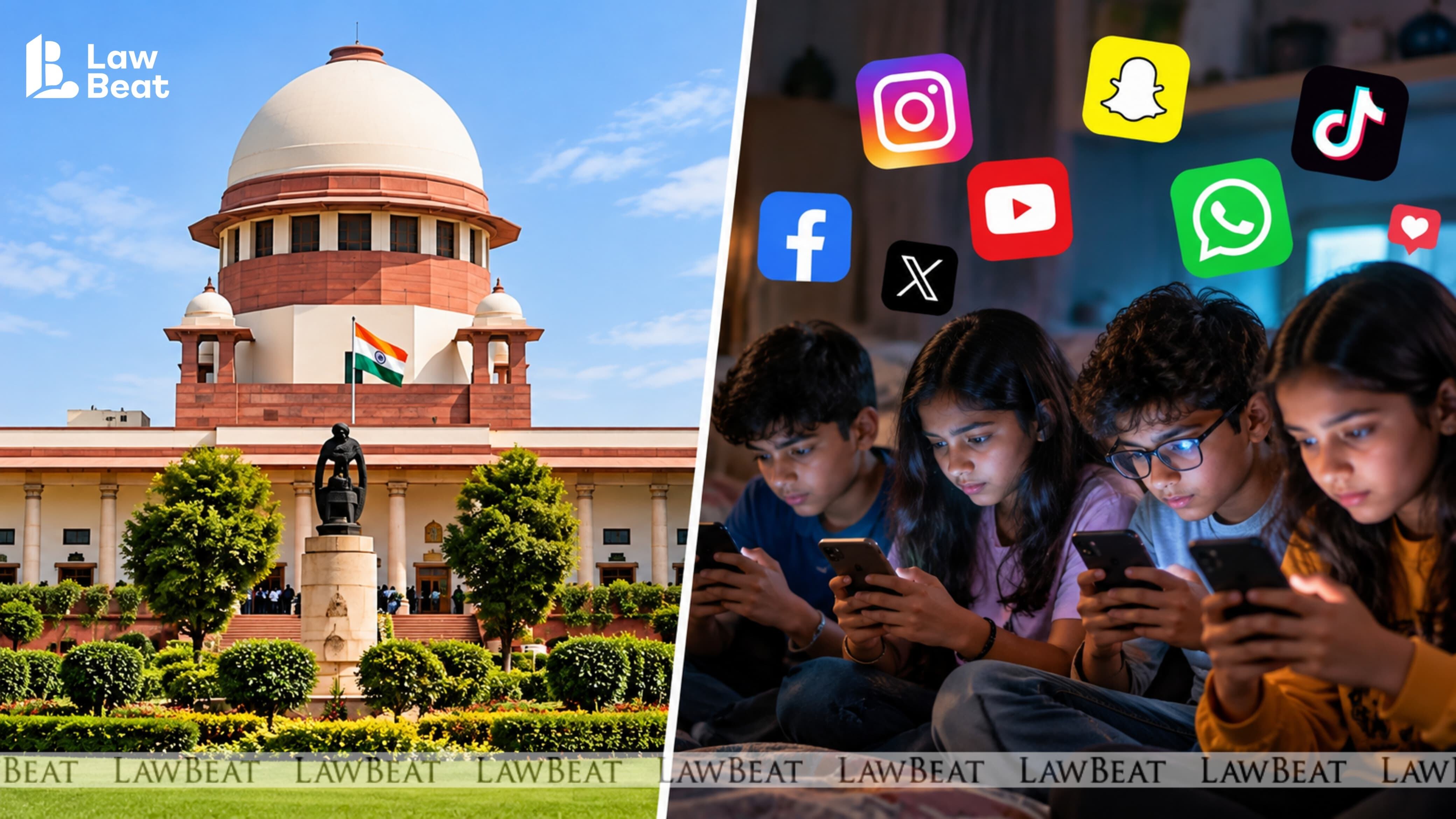
Supreme Court Issues Notice On Child Social Media Age In India
Summary
- The Supreme Court has issued notice on a Public Interest Litigation filed by Emerald Heights International School seeking a regulatory framework for children's social media access.
- The petition argues that social media platforms lack the age verification present in other regulated content like OTT services and online games.
- Petitioners contend that the Digital Personal Data Protection Act, 2023, defines minors as under 18, contrasting with platforms' self-declared 13-year age threshold.
- The school highlights observed issues like underage children on platforms, contact from strangers, and negative impacts on concentration and sleep.
- A 2021 NCPCR study is cited, revealing that 37.8% of 10-year-olds surveyed had Facebook accounts, suggesting platforms prioritize revenue over child safety.
Supreme Court Issues Notice on Child Social Media Access Plea
The petition further contends that the absence of a unified central law leads to unequal protection for children across states.
The Supreme Court of India has issued notice on a Public Interest Litigation (PIL) filed by Emerald Heights International School, Indore, and its Director of Academics, Siddharth Singh Girnar. This Article 32 petition seeks a directive for the Central government to establish a comprehensive regulatory framework governing children's access to social media platforms across the nation.
A bench comprising Chief Justice of India Surya Kant and Justice Bagchi is presiding over the matter. The Indore-based institution, a CBSE-affiliated co-educational day-cum-boarding school with approximately 4,115 students, asserts its role as acting "in loco parentis" for its pupils, underscoring its responsibility for their well-being.
The core of the petitioners' argument is that social media platforms currently operate without the stringent age verification mechanisms that are already applied to other regulated content, such as Over-The-Top (OTT) services and online gaming in India.
Legal and Regulatory Discrepancies Highlighted
The petitioners highlight a critical disparity in age verification standards across different digital services in India. They point out that while minors are legally prohibited from purchasing items like liquor, tobacco, or acid, and face age restrictions for adult content on OTT platforms, they can easily access social media by merely self-declaring their birth dates.
The PIL argues that the common minimum age of 13 years, often adopted by social media platforms, is a self-imposed threshold that does not align with Indian legal protections for children. Specifically, the Digital Personal Data Protection Act, 2023, defines any individual under the age of 18 as a child, creating a significant gap between platform policies and national law regarding minors.
The petition further contends that the absence of a unified central law leads to unequal protection for children across states. It illustrates this by noting that a child in Karnataka might be subject to one set of rules, while a child in Andhra Pradesh faces different age limits, and a child in Madhya Pradesh has no specific regulations, despite all using the same social media services. This argument is supported by references to Entry 31 of List I and Article 253 of the Constitution, asserting that the regulation of such matters falls under the Union government's purview.
Concerns Over Platform Design and Child Safety
The Emerald Heights International School's petition underscores profound concerns regarding the design and operation of social media platforms, which it claims are not inherently child-safe environments. The school's direct observations from its classrooms and hostels reveal that children, including those well below the stated age of 13, are actively using social media accounts. These observations include instances of children being contacted by strangers and exhibiting negative impacts such as sleep deprivation, distraction, and difficulty concentrating in school.
The petition also reflects widespread parental anxiety, frequently voiced during parent-teacher meetings, about the pervasive influence social media holds over their children. The petitioners attribute primary fault to the intermediaries, citing a 2021 study by the National Commission for Protection of Child Rights (NCPCR). This NCPCR social media study 2021 found that a significant 37.8% of 10-year-old children surveyed maintained Facebook accounts.
The PIL alleges that platforms are aware of these underage users but choose not to intervene, driven by the pursuit of increased revenue through higher user engagement. It further argues that features like endless scrolling, autoplay functions, "streaks," "likes," and constant notifications are deliberately designed to maximize attention and prolong engagement, exerting a particularly strong influence on children. The petition concludes that the resulting harm to children is not accidental but a direct consequence of how these digital products are engineered, suggesting that when algorithms push harmful content to a child who never sought it, the intermediary cannot be considered a mere passive conduit.
Practical Implications
Lawyers advising social media platforms, tech intermediaries, or educational institutions in India should closely monitor this Supreme Court PIL. Its outcome could lead to a new, uniform national regulatory framework for child access to social media, potentially imposing stricter age verification requirements and increased liability for platforms regarding child safety and content design.
Source
How does this affect you?
Get an AI analysis of this article grounded in your jurisdictions, practice areas, and any policy documents you've uploaded to Wansom.
Finish Reading the Full Story and the Expert Analysis.
Get the latest legal & regulatory intelligence in India
Wansom is AI and can make mistakes.