
South Africa: Ramaphosa Kiir 2018 Peace Deal Implementation Urged
Summary
- South African President Cyril Ramaphosa urged South Sudanese President Salva Kiir to fully implement the 2018 peace agreement ahead of December elections.
- President Ramaphosa chairs the AU C5 committee, which leads regional efforts to support South Sudan's peace process and political transition.
- President Kiir reaffirmed his commitment to the December 22 elections and outlined ongoing preparations, including staffing and civic education.
- Kiir requested South African support for ballot boxes, election staff training, security uniforms, and digital IDs, which Ramaphosa agreed to provide.
- The meeting took place less than three months before the elections and followed the dissolution of South Sudan's transitional government on September 22.
Key Meeting on South Sudan's Future
President Ramaphosa strongly urged his counterpart to fully uphold and implement the 2018 peace agreement, known as the Revitalised Agreement on the Resolution of the Conflict in South Sudan (R-ARCSS).
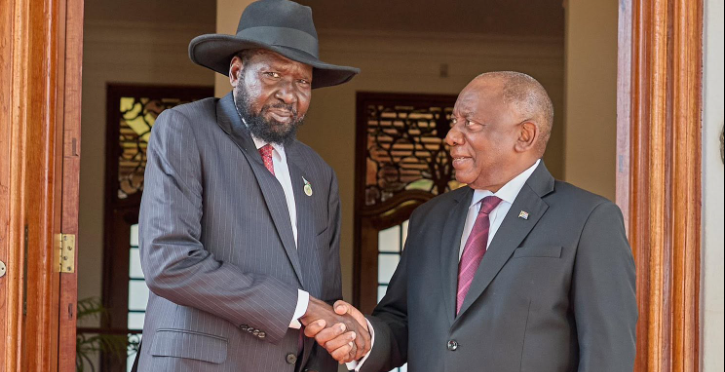
South African President Cyril Ramaphosa recently hosted South Sudanese President Salva Kiir Mayardit at Mahlamba Ndlopfu, the official presidential residence in Pretoria, for a crucial meeting on a Wednesday afternoon. During their discussions, President Ramaphosa strongly urged his counterpart to fully uphold and implement the 2018 peace agreement, known as the Revitalised Agreement on the Resolution of the Conflict in South Sudan (R-ARCSS). This call for adherence comes as South Sudan intensifies its preparations for nationwide elections scheduled for December.
President Kiir's visit to South Africa followed a series of engagements, including a two-day trip to Kenya where he held talks with President William Ruto in Nairobi. He departed Juba on October 4, arriving in South Africa on Tuesday, October 6. The South Sudanese presidency indicated that the primary purpose of this visit was to facilitate follow-up discussions with President Ramaphosa, particularly in the wake of the latest declaration issued by the African Union's C5 committee on South Sudan. This high-level meeting took place less than three months before the December 22 elections and shortly after the dissolution of South Sudan's transitional government on September 22.
Diplomatic Efforts and Peace Framework
President Ramaphosa's emphasis on the 2018 peace deal stems from his significant role as the chair of the African Union High-Level Ad Hoc Committee on South Sudan, commonly referred to as the C5. This committee, which includes South Africa, Algeria, Chad, Nigeria, and Rwanda, actively spearheads regional initiatives aimed at supporting the implementation of the peace agreement and facilitating South Sudan's broader political transition. The South African presidency underscored the necessity of an inclusive electoral process, built on trust and cooperation among all South Sudanese political stakeholders, to effectively tackle outstanding challenges and ensure the peace agreement's successful execution.
The C5 recently convened a virtual meeting on September 29, chaired by President Ramaphosa, to assess the prevailing developments in South Sudan ahead of the upcoming elections. During this session, the committee deliberated on areas requiring further regional and continental support to stabilize the nation. President Kiir, through his office, expressed gratitude to President Ramaphosa for South Africa's consistent support for his country's peace process, acknowledging Pretoria's historical contributions to the 2005 Comprehensive Peace Agreement and the 2011 independence referendum.
Election Preparations and International Assistance
President Kiir reaffirmed his government's unwavering commitment to conducting the elections on December 22. His office detailed several key preparatory steps already underway, including securing the headquarters of the National Elections Commission, initiating civic education programs, identifying voter-registration centers, and commencing the printing of voter-registration ledgers. Furthermore, more than 20,000 election workers are currently being recruited, and over 25,000 election security personnel are undergoing specialized training to ensure a secure and orderly electoral process.
During the meeting, President Kiir specifically requested South African assistance in four critical areas: the provision of ballot boxes, training for the staff of the elections commission, uniforms for election security personnel, and digital identification cards for election officials and operational staff. These requests were cited by his office as a primary reason for his visit, with President Kiir stressing the importance of close coordination to guarantee the timely delivery of this support. President Ramaphosa agreed to provide assistance in all four requested areas, and both leaders concurred that work should commence as swiftly as possible through South Sudan’s independent National Elections Commission.
Broader Context and Ongoing Engagement
The recent high-level discussions between Presidents Ramaphosa and Kiir underscore the ongoing international focus on South Sudan's adherence to its foundational peace agreement and the integrity of its impending elections. This engagement is critical for fostering political stability and ensuring a credible transition. The timing of these diplomatic efforts, just weeks before the December polls and following the dissolution of the transitional government, highlights the urgency of the situation.
President Kiir's recent travels to Kenya and South Africa have also occurred amidst unconfirmed social media reports concerning his health, though his office has not issued any public statements on the matter. This was not President Kiir's first visit to South Africa this year; he previously held talks with President Ramaphosa during a visit from August 23 to August 30, indicating a sustained pattern of high-level engagement between the two leaders on matters concerning South Sudan's future.
Practical Implications
This development signals ongoing international focus on South Sudan's adherence to the 2018 peace agreement and the integrity of its upcoming December elections. Lawyers and compliance officers should monitor the implementation progress and election outcomes closely, as these will significantly impact political stability, regulatory certainty, and the overall risk environment for businesses and human rights in South Sudan.
Source
Source: Original reporting via Briefly
How does this affect you?
Get an AI analysis of this article grounded in your jurisdictions, practice areas, and any policy documents you've uploaded to Wansom.
Finish Reading the Full Story and the Expert Analysis.
Get the latest legal & regulatory intelligence in South Sudan
Wansom is AI and can make mistakes.