
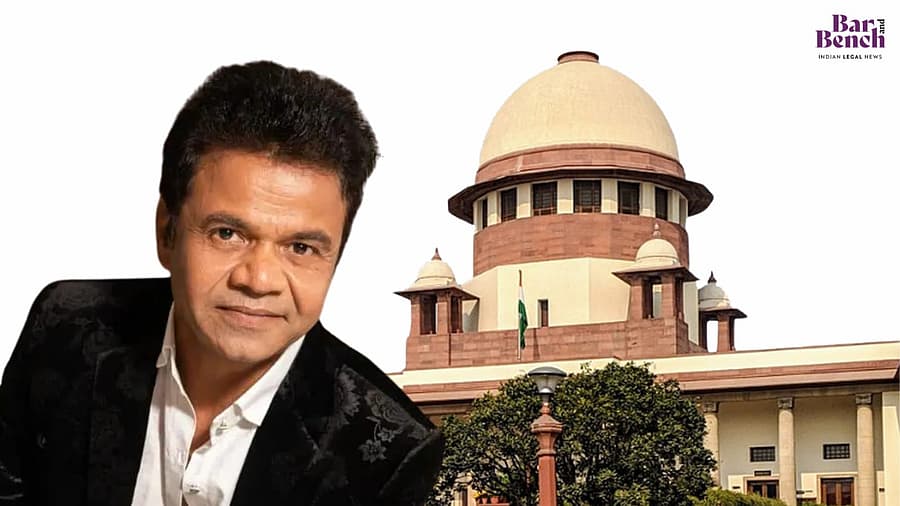
Rajpal Yadav: Supreme Court Grants Conditional Surrender Exemption
Summary
- The Supreme Court exempted actor Rajpal Yadav from surrendering in multiple cheque bounce cases.
- This exemption is conditional on him depositing ₹5 crore with the Registry by September 9.
- The Court also issued a conditional notice on Yadav’s plea challenging his conviction and a 3-month jail sentence by the Delhi High Court.
- The dispute originated from a ₹5 crore amount received by Yadav for a film, leading to dishonoured security cheques.
- The next hearing in the Supreme Court for this matter is scheduled for September 15.
Supreme Court Grants Conditional Exemption
The decision to grant a conditional exemption from surrender, even after a conviction has been upheld by a High Court, underscores the Supreme Court's discretionary powers and its role as the final arbiter of justice in India.
Actor Rajpal Yadav has received a conditional exemption from immediate surrender in connection with multiple cheque dishonour cases, following a recent directive from the Supreme Court. On Tuesday, the apex court mandated that Mr. Yadav deposit a sum of ₹5 crore with its Registry by September 9. This significant interim relief was granted by a bench comprising Chief Justice of India Surya Kant, Justice Joymalya Bagchi, and Justice V Mohana, in the case titled Rajpal Naurang Yadav & Anr v. M/S Murli Projects Pvt Ltd.
The Court's order also included the issuance of a conditional notice regarding Mr. Yadav's petition, which seeks to overturn his conviction and the three-month jail sentence imposed by the Delhi High Court. The next hearing for this matter has been scheduled for September 15. This development marks a crucial turn in the ongoing legal battle, providing a temporary reprieve for the actor while his challenge against the lower court's judgment proceeds. The Rajpal Yadav Supreme Court surrender exemption is a key aspect of this recent ruling, offering a glimpse into the Court's approach to such high-profile cases.
Genesis of the Cheque Dishonour Dispute
The legal entanglement stems from a financial transaction involving ₹5 crore, which Mr. Yadav and his wife received from a private entity known as Murli Projects. This amount was intended for a film production in which Mr. Yadav was involved. As the film's production faced delays and could not be completed within the initially agreed timelines, the parties subsequently entered into a series of four distinct agreements to manage the evolving circumstances.
Under the terms of the third agreement, Mr. Yadav provided eight security cheques to Murli Projects. However, the situation became contentious when this third agreement was reportedly superseded by a fourth, described as a consent agreement, dated April 21, 2013. According to Mr. Yadav's submissions, this consent agreement stipulated that the original eight security cheques would be returned, and in their place, four new cheques, each valued at ₹10 crore, would be issued.
Mr. Yadav alleges that Murli Projects failed to return the initial eight security cheques as agreed. Instead, the company proceeded to present seven of these original cheques for payment, all of which were subsequently dishonoured. This action directly led to the initiation of criminal complaints against both Mr. Yadav and his wife, primarily under the provisions of Section 138 Negotiable Instruments Act, concerning cheque dishonour.
Legal Journey and Current Challenge
The trajectory of the case saw a sessions court convict Mr. Yadav in May 2024, imposing a six-month jail sentence. Following this, the Delhi High Court intervened, suspending his sentence. However, the actor's legal team has now escalated the matter to the Supreme Court, presenting a Delhi High Court conviction challenge that seeks to overturn the three-month imprisonment.
The Supreme Court's recent intervention, granting the Rajpal Yadav Supreme Court surrender exemption, is contingent upon the substantial ₹5 crore deposit condition. This demonstrates the Court's careful consideration of the appellant's plea while also ensuring a measure of financial accountability. The ongoing challenge to the Delhi High Court's decision highlights the complex legal avenues available to individuals seeking to contest adverse judgments in cheque bounce cases in India, particularly when facing a cheque dishonour Supreme Court India review.
Implications of the Ruling
This Supreme Court order carries significant implications for legal practitioners and individuals involved in cheque bounce cases, particularly those of high value or public interest. The decision to grant a conditional exemption from surrender, even after a conviction has been upheld by a High Court, underscores the Supreme Court's discretionary powers and its role as the final arbiter of justice in India.
The imposition of a substantial ₹5 crore deposit condition serves as a critical precedent, indicating that while relief may be granted, it often comes with stringent financial requirements. This approach balances the need for justice with the practical realities of legal challenges, especially when dealing with the complexities of Section 138 Negotiable Instruments Act cases.
Practical Implications
Lawyers advising clients in cheque bounce cases, particularly those involving significant amounts or high-profile individuals, should note this Supreme Court order. It demonstrates the Court's discretion to grant conditional exemption from surrender, even after conviction, subject to a substantial deposit, offering a potential strategy for clients seeking interim relief while challenging a lower court's decision.
Source
How does this affect you?
Get an AI analysis of this article grounded in your jurisdictions, practice areas, and any policy documents you've uploaded to Wansom.
Finish Reading the Full Story and the Expert Analysis.
Wansom is AI and can make mistakes.