
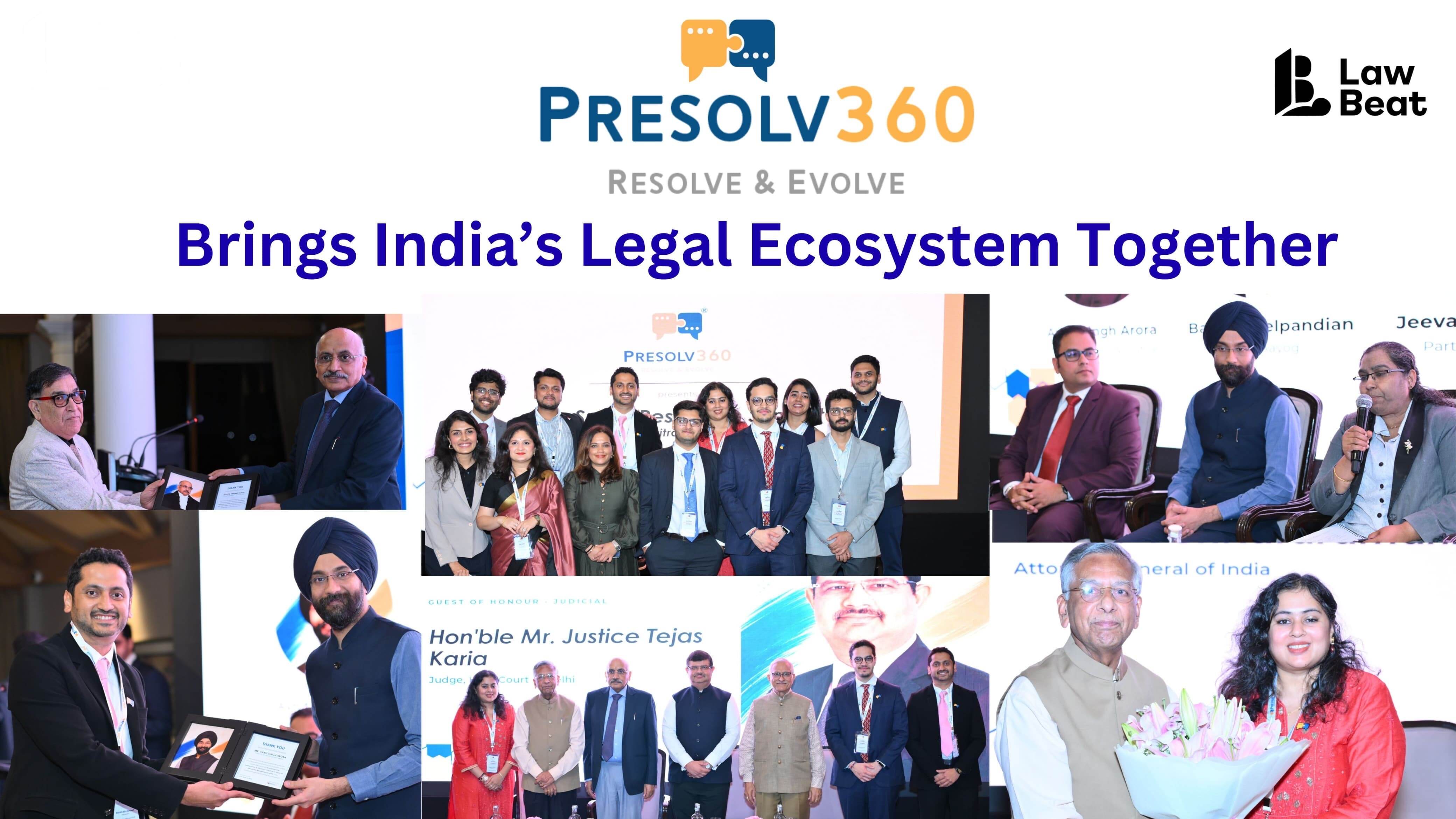
Presolv360 Smart Resolution Summit India: Advancing ODR & Arbitration
Summary
- The Presolv360 Smart Resolution Summit India gathered judiciary, government, and legal experts to promote institutional arbitration and technology-led Online Dispute Resolution.
- Attorney General R. Venkataramani criticized the "mechanical" adversarial system, while former Supreme Court Justice Hemant Gupta (now Chairperson of the New Delhi International Arbitration Centre), Justice Tejas Karia, and former Delhi High Court Justice J. R. Midha (now a Professor of Practice at National Law University, Delhi, an Arbitrator, and a Senior Advocate) advocated for ODR's efficiency and societal evolution.
- NITI Aayog and the Ministry of Law & Justice highlighted government efforts to expand ADR to rural areas and establish India as a global ADR hub.
- Presolv360 launched an open-source AI library for Arbitration, designed to assist practitioners and researchers in finding legal precedents and insights.
- Speakers emphasized that successful dispute resolution reforms require a mindset shift within the legal community and judiciary, alongside policy and technological advancements.
Summit Highlights India's Dispute Resolution Evolution
She articulated a belief that the technological capabilities inherent in ODR offer an opportunity to fundamentally rethink and tailor dispute resolution processes to meet diverse and unique requirements.
The Presolv360 Smart Resolution Summit India recently convened a diverse group of legal and governmental leaders to champion the evolution of dispute resolution mechanisms. Hosted by Presolv360 on a Thursday, the event served as a critical platform for advancing technology-led frameworks for Online Dispute Resolution (ODR) and reinforcing the significance of institutional arbitration in India. Attendees included distinguished sitting and retired judges, high-ranking government officials, and prominent industry figures, all gathered to deliberate on the future trajectory of dispute resolution within the nation.
The summit commenced with a powerful keynote address delivered by Mr. R. Venkataramani, the Attorney General for India. He critically assessed the traditional adversarial system, describing it as "mechanical," and emphasized the necessity of approaching dispute resolution with a more empathetic perspective. This opening set a contemplative tone for the discussions that followed, highlighting a growing recognition among legal luminaries of the need for systemic change.
Judicial Push for ODR and Technological Integration
Following the Attorney General's remarks, a comprehensive plenary session featured insights from former Supreme Court Justice Hemant Gupta, who is now the Chairperson of the New Delhi International Arbitration Centre, Justice Tejas Karia, and former Delhi High Court Justice J. R. Midha, who is now a Professor of Practice at National Law University, Delhi, an Arbitrator, and a Senior Advocate. Justice Tejas Karia underscored the dynamic nature of dispute resolution, asserting that it must continuously adapt to societal demands. Both Justice Karia and Justice Gupta extensively discussed the considerable advantages of India Online Dispute Resolution initiatives, particularly its capacity to manage large volumes of disputes. They highlighted existing industry applications where ODR is already effectively addressing specific dispute-resolution challenges, urging the broader legal community to adopt these practices more widely.
Justice J. R. Midha further contributed to the discourse by advocating for enhanced efficiency in arbitration processes through the strategic integration of technology. This collective judicial voice strongly indicated a unified push towards modernizing India's dispute resolution landscape, emphasizing both the practical benefits and the imperative for technological adoption. The discussions underscored a clear governmental and judicial push towards institutional arbitration India NITI Aayog and other bodies are also championing.
Policy, Innovation, and India's Global Ambitions
A dedicated panel discussion delved into the policy and legal considerations essential for fostering greater confidence in institutional arbitration and online dispute resolution. Dr. Banusri Velpandian, a Senior Specialist at NITI Aayog, articulated how regulatory bodies and various industry ecosystems are increasingly embracing an ODR-first approach. She drew a direct correlation between these dispute resolution reforms and broader economic growth, positioning ODR as a catalyst for national development.
Mr. Avnit Singh Arora, Director at the Ministry of Law & Justice, detailed the proactive measures undertaken by the Government of India to champion both institutional arbitration and ODR. These efforts are driven by a dual objective: to extend Alternative Dispute Resolution (ADR) services to tier 2 and tier 3 cities and villages, and to firmly establish India as a prominent regional and global ADR hub, aligning with India ADR hub strategy. In a significant development during the event, Presolv360 also unveiled its AI library for Arbitration. This open-source tool, launched in the presence of the dignitaries, is designed to accelerate the process for practitioners and researchers to locate precedents, principles, and insights, while also enabling them to contribute to its expanding knowledge base. This Presolv360 AI library arbitration launch represents a tangible step towards technology-led dispute resolution India.
Shaping the Future of Dispute Resolution
The summit concluded with reflections on the broader vision for dispute resolution in India. Mr. Jeevan Ballav Panda, a Partner at Khaitan & Co, emphasized that the efficacy of policy and regulatory measures hinges on a fundamental shift in mindset within both the legal community and the judiciary. This highlights the human element crucial for the successful implementation of technology-led dispute resolution India strategies.
Namita Shah, Co-Founder of Presolv360, expressed the organization's aspiration for the event to ignite widespread dialogue and foster greater acceptance of Online Dispute Resolution across governmental, judicial, and independent dispute ecosystems. She articulated a belief that the technological capabilities inherent in ODR offer an opportunity to fundamentally rethink and tailor dispute resolution processes to meet diverse and unique requirements. Presolv360, as an independent, technology-driven ADR and ODR Institution, remains dedicated to enhancing the efficiency, accessibility, and future-readiness of dispute resolution in India through institutional arbitration, mediation, conciliation, and online processes.
Practical Implications
Lawyers and compliance officers in India should note the strong governmental and judicial push towards institutional arbitration and Online Dispute Resolution (ODR), signaling a shift in dispute resolution strategies. They should evaluate integrating ODR into their practice and stay informed on policy developments, such as the Presolv360 AI library, as these will impact client advice and dispute management in the evolving legal landscape.
Source
How does this affect you?
Get an AI analysis of this article grounded in your jurisdictions, practice areas, and any policy documents you've uploaded to Wansom.
Finish this article free. Just your email for instant unlock.
Wansom is AI and can make mistakes.