
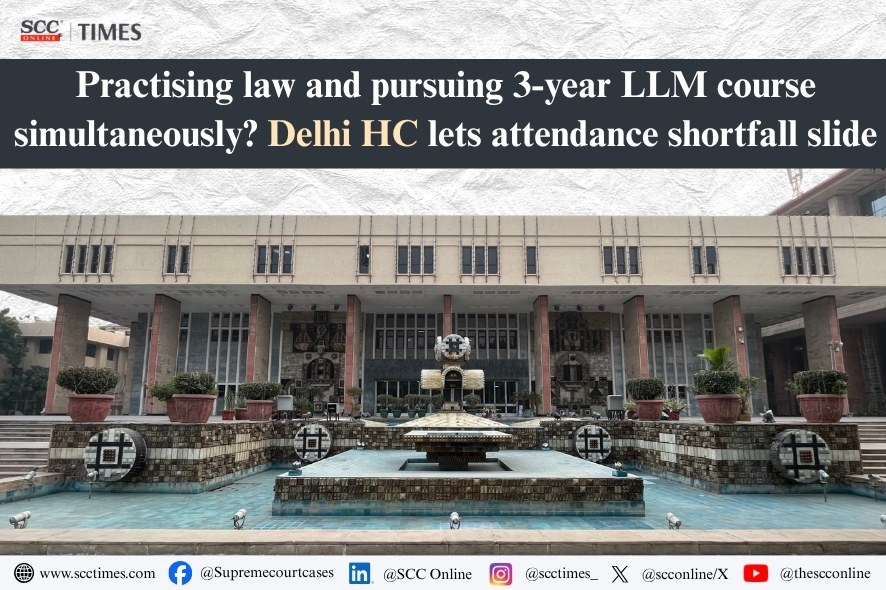
Delhi High Court: LLM Attendance for Practicing Lawyers Must Facilitate Practice
Summary
- The Delhi High Court clarified the core purpose of the three-year LLM program.
- This program is designed to allow practicing lawyers to pursue their Masters while continuing their court practice.
- The court's observation supports flexibility regarding attendance requirements for these professionals.
- This judicial stance provides a strong basis for practicing advocates to seek accommodations for attendance shortfalls.
What Happened
The Delhi High Court articulated that the very design and intent of the three-year LLM curriculum is to facilitate legal practitioners in continuing their professional engagements before the courts.
The Delhi High Court recently issued a significant observation clarifying the fundamental purpose behind the three-year Master of Laws (LLM) program. This judicial insight directly addresses the unique circumstances of legal professionals seeking to advance their academic qualifications while maintaining their active practice. The court's stance provides crucial guidance on how attendance requirements should be viewed for practicing advocates enrolled in such programs.
Specifically, the High Court articulated that the very design and intent of the three-year LLM curriculum is to facilitate legal practitioners in continuing their professional engagements before the courts. This means the program is specifically structured to allow individuals to pursue their advanced legal studies simultaneously with their ongoing careers. This understanding from the Delhi High Court effectively supports a more flexible approach to attendance for practicing lawyers, acknowledging the inherent conflict between rigorous court schedules and traditional academic attendance mandates.
Legal Context of the 3-Year LLM
The three-year LLM program in India is distinct from its shorter, often full-time, counterparts, precisely because it caters to a demographic that cannot typically commit to a conventional, intensive academic schedule. It is designed as a pathway for practicing lawyers to deepen their legal knowledge and specialization without requiring them to pause their professional lives. This structure inherently recognizes the demands of legal practice, which often involve unpredictable court appearances, client meetings, and case preparations, making the Delhi High Court LLM attendance observation particularly relevant.
The Delhi High Court's observation reinforces this foundational principle, suggesting that academic institutions offering the LLM 3-year course should align their policies, particularly concerning attendance, with this overarching objective. By emphasizing that the program's purpose is to enable simultaneous practice and study, the court provides a strong basis for challenging rigid attendance rules that might otherwise impede a practicing advocate's ability to complete their Masters. This judicial perspective underscores the program's role as an accessible avenue for professional development within the legal fraternity, directly impacting LLM 3-year course attendance rules India.
Why This Matters for Practicing Lawyers
This pronouncement from the Delhi High Court holds considerable weight for practicing lawyers across India who are either currently enrolled in or considering a three-year LLM program. It establishes a judicial precedent that can be leveraged to advocate for waivers or accommodations regarding attendance shortfalls. The court's explicit recognition that the program's purpose is to allow simultaneous legal practice LLM Delhi and study means that institutions are expected to understand and adapt to the professional commitments of their advocate-students, potentially leading to a Delhi HC attendance shortfall waiver.
For practicing advocates, this observation clarifies that their dedication to their legal careers should not be an impediment to pursuing higher education. It provides a powerful argument against strict, inflexible attendance policies that do not account for the realities of legal practice, thereby supporting practicing advocate Masters attendance. Ultimately, the Delhi High Court's insight ensures that the spirit of the three-year LLM program—to foster continuous learning among active legal professionals—is upheld, thereby making advanced legal education more attainable and less burdensome for those serving the justice system.
Practical Implications
This Delhi High Court observation clarifies that the intent of the 3-year LLM program is to accommodate practicing lawyers, providing a strong precedent for challenging rigid attendance requirements. Lawyers pursuing or considering such programs can leverage this judicial understanding to advocate for flexibility, ensuring their academic pursuits do not unduly hinder their professional practice.
Source
How does this affect you?
Get an AI analysis of this article grounded in your jurisdictions, practice areas, and any policy documents you've uploaded to Wansom.
Finish this article free. Just your email for instant unlock.
Wansom is AI and can make mistakes.