
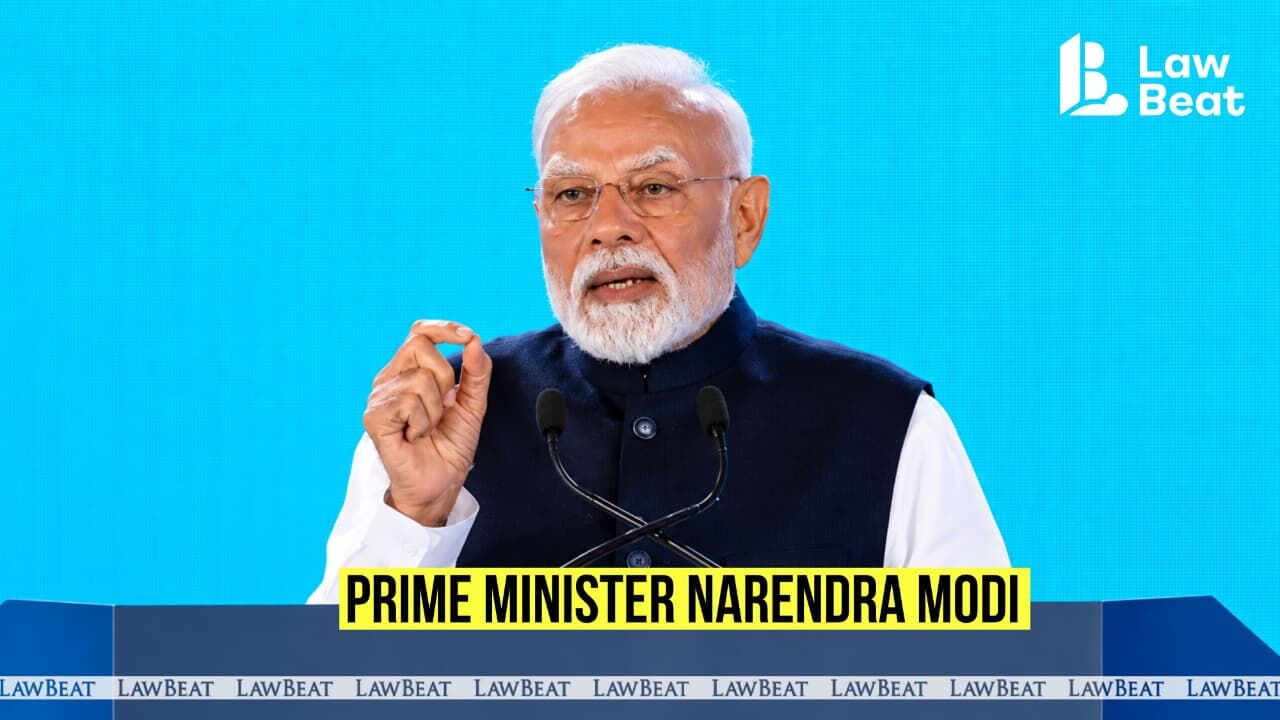
PM Modi: Bloomberg Forum Unveils India Legal Reforms
Summary
- Prime Minister Modi addressed the Bloomberg New Economy Forum in New Delhi, presenting his "Power to Empower" vision.
- He highlighted India's digital public infrastructure, including affordable mobile data and digital payments, as examples of inclusive technology.
- Modi detailed significant legal reforms, including the Goods and Services Tax, a new insolvency law, consolidated labor codes, and the decriminalization of minor business errors.
- He emphasized that these reforms were driven by conviction, not compulsion, to foster a more predictable business environment.
- The Prime Minister also showcased India's economic growth, startup ecosystem, and commitment to global collaboration on issues like climate change and responsible technology use.
PM Modi's Vision for Empowerment
Prime Minister Modi underscored that these significant legal and regulatory changes were driven by "conviction," rather than mere "compulsion," signaling a deep-seated commitment to a more streamlined and predictable business environment.
Addressing the Bloomberg New Economy Forum in New Delhi, Prime Minister Narendra Modi articulated his "Power to Empower" vision, emphasizing that technology, data, and knowledge represent the new global power. He posed a critical question regarding the utilization of this power: whether it would serve to advance a select few or create opportunities for millions, advocating for its use to enable others rather than merely control.
During his speech, Prime Minister Modi extensively highlighted India's digital public infrastructure. He pointed to the widespread availability of affordable mobile data, which has facilitated digital learning for students in remote areas and expanded customer bases for village shopkeepers. He also showcased India's inclusive digital payments ecosystem, noting that it is uniformly accessible to both street vendors and large car dealerships. Furthermore, Modi mentioned India's initiative to share its digital public infrastructure, including the open-source CoWIN platform developed during the COVID-19 pandemic, with other nations to help them build tailored systems, asserting that India's capabilities should benefit humanity.
On the topic of governance, Modi stated that while a government possesses authority, its primary objective should not be to foster citizen dependence on the system. He cited the JAM Trinity (Jan Dhan-Aadhaar-Mobile) and Direct Benefit Transfer programs, which directly deposit aid into beneficiaries' bank accounts, as examples that have successfully reduced corruption and established a direct connection between the government and its citizens.
Key Legal and Regulatory Reforms
Prime Minister Modi used the forum as an opportunity to present India's ongoing legal and regulatory reforms to global investors. He detailed how the nation has transitioned from a complex array of taxes to a unified national market through the implementation of the Goods and Services Tax (GST). Additionally, he highlighted the establishment of a comprehensive insolvency law, designed to streamline corporate resolution processes.
Further demonstrating India's commitment to a more business-friendly environment, Modi noted the significant consolidation of 29 disparate labor laws into four cohesive codes. He also underscored the decriminalization of hundreds of minor business-related errors, a move aimed at reducing regulatory burdens and fostering greater ease of doing business. Prime Minister Modi underscored that these significant legal and regulatory changes were driven by "conviction," rather than mere "compulsion," signaling a deep-seated commitment to a more streamlined and predictable business environment.
Economic Growth and Global Trust
Modi presented a robust picture of India's economic landscape, noting the dramatic increase in startups from a few hundred before 2014 to over 250,000 currently. He highlighted that nearly half of these new ventures originate from smaller cities and towns, with over 45 percent having at least one woman director or partner. Economically, he reported a 7.8 percent growth rate in the April-June quarter, a current account deficit reduced to 0.61 percent of GDP, and foreign exchange reserves surpassing $700 billion.
In a broader global context, Modi cautioned that elements once connecting the world—such as supply chains, energy, minerals, payments, and technology—are now at risk of becoming instruments of pressure and dominance. He stressed the paramount importance of trust in an era where artificial intelligence is transforming every sector, emphasizing the need for assurances regarding supply continuity, adherence to promises, and mutual support among partners during crises. He referenced India's AI Impact Summit, which explored AI's potential benefits for both humanity and animals.
Concluding his address, Modi identified the responsible application of emerging technologies, climate change, water governance, and public health as critical areas requiring global solutions. He invoked a Vedic verse advocating for collective action and dialogue to foster understanding, and pointed to India's collaborative platforms like the International Solar Alliance, the Coalition for Disaster Resilient Infrastructure, and the Global Biofuels Alliance as initiatives designed to benefit everyone globally.
Practical Implications
Lawyers advising clients on investment in India should note PM Modi's emphasis on ongoing legal reforms, including GST, insolvency law, labor codes, and decriminalization of minor business errors, as indicators of a commitment to ease of doing business and a stable regulatory environment. Compliance officers should monitor these areas for further legislative changes and their practical impact on operations.
Source
How does this affect you?
Get an AI analysis of this article grounded in your jurisdictions, practice areas, and any policy documents you've uploaded to Wansom.
Finish Reading the Full Story and the Expert Analysis.
Get the latest legal & regulatory intelligence in India
Wansom is AI and can make mistakes.